
iPhoneAlle anzeigen
iPhone 11iPhone 11 ProiPhone 11 Pro MaxiPhone 12iPhone 12 ProiPhone 12 Pro MaxiPhone 12 miniiPhone 13iPhone 13 ProiPhone 13 Pro MaxiPhone 13 miniiPhone 14iPhone 14 PlusiPhone 14 ProiPhone 14 Pro MaxiPhone 15iPhone 15 PlusiPhone 15 ProiPhone 15 Pro MaxiPhone 16iPhone 16 PlusiPhone 16 ProiPhone 16 Pro MaxiPhone 16eiPhone 8iPhone 8 PlusiPhone SE 2020iPhone SE 2022iPhone XiPhone XRiPhone XSiPhone XS Max
Galaxy A-SerieAlle anzeigen
Galaxy A12Galaxy A13Galaxy A13 5GGalaxy A14Galaxy A15Galaxy A16Galaxy A17 5GGalaxy A20eGalaxy A21Galaxy A22Galaxy A23Galaxy A24Galaxy A25Galaxy A26 5GGalaxy A32Galaxy A33Galaxy A34Galaxy A35Galaxy A36 5GGalaxy A40Galaxy A41Galaxy A42Galaxy A50Galaxy A51Galaxy A52Galaxy A53Galaxy A54Galaxy A55Galaxy A56 5GGalaxy A70Galaxy A71Galaxy A72
Redmi SeriesAlle anzeigen
Redmi 10Redmi 13CRedmi 15 5GRedmi Note 10Redmi Note 10 ProRedmi Note 11Redmi Note 11 ProRedmi Note 11 Pro Plus 5GRedmi Note 11sRedmi Note 12Redmi Note 12 5GRedmi Note 12 ProRedmi Note 12 Pro 5GRedmi Note 12 Pro PlusRedmi Note 13Redmi Note 13 5GRedmi Note 13 ProRedmi Note 13 Pro PlusRedmi Note 14Redmi Note 14 Pro PlusRedmi Note 8Redmi Note 8 ProRedmi Note 9Redmi Note 9 Pro
- Startseite
Bücher Englische Bücher Wissen & Bildung Naturwissenschaft, Medizin, Informatik, Technik Chemie Nuclear magnetic resonance investigation of the local structure of (100-x) (Bi1/2Na1/2)TiO3 – (x) BaTiO3 lead-free piezoelectric materials
Derzeit nicht verfügbar
Handgeprüfte Gebrauchtware
Bis zu 50 % günstiger als neu
Der Umwelt zuliebe
Nuclear magnetic resonance investigation of the local structure of (100-x) (Bi1/2Na1/2)TiO3 – (x) BaTiO3 lead-free piezoelectric materials
Pedro Braga Groszewicz (Taschenbuch, Englisch)
★★★★★
☆☆☆☆☆ Keine Bewertungen vorhanden
Optischer Zustand
Beschreibung
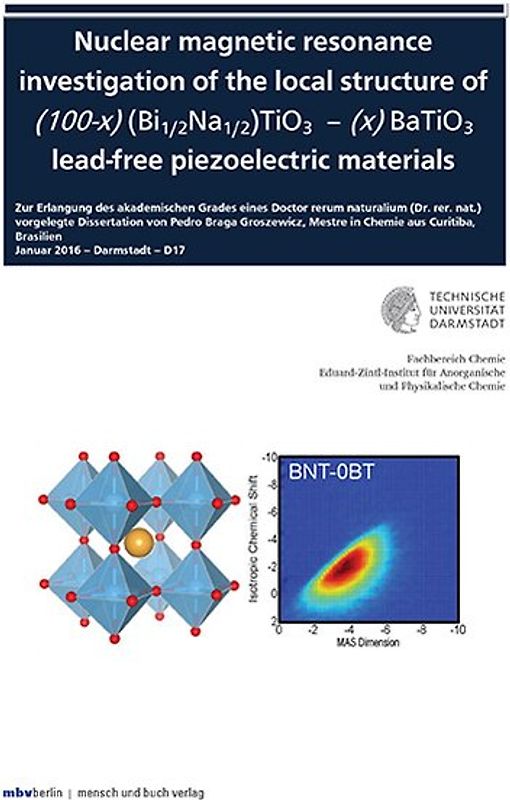
The search for an environment-friendly substitute to lead-based piezoelectric ceramics has stimulated the research on lead-free electrically functional materials. Among the bismuth-based alternatives with a perovskite structure, barium-doped bismuth-sodium titanate (BNT-xBT) is considered one of the most promising compositions. It is generally assumed that this material’s enhanced electrical… properties are consequence of its structure. Nevertheless, the structural characterization of BNT-xBT is challenging and key aspects of its structure-property relations, as for example the role of barium doping and the occurrence of a relaxor ferroelectric state, are still unclear. The structure of BNT-xBT exhibits distortions with small magnitude and short coherence length, which pose a challenge to its characterization with diffraction methods. Despite that, these features are not a problem for the application of solid-state nuclear magnetic resonance spectroscopy (NMR). This method is based on interactions between a nucleus and its near surroundings, what makes it sensitive to the local structure. Hence, this technique is the method of choice for the structural characterization of BNT-xBT.
The main goal of the present work is to identify what local structure features are relevant to the electrical properties of BNT-xBT. For this purpose, samples with the formula (100-x)(Bi1/2Na1/2)TiO3 – (x)BaTiO3 and a barium content of 0<x<15 are investigated by means of NMR. The analysis of static and MAS NMR spectra, particularly the two-dimensional 23Na 3QMAS NMR ones, enables the description of two nuclear interactions, which most influence the investigated NMR lines: the chemical shift and the quadrupolar coupling.
The 23Na MAS NMR spectra of all investigated samples exhibit a shape typical of the 1st order quadrupolar coupling. This fact corresponds to a non-cubic symmetry for the local surroundings of sodium nuclei. The comparison of these quadrupole-perturbed NMR lines of BNT-xBT samples before and after electrical poling reveals the coexistence of phases with cubic and polar symmetries for the samples found in a relaxor state. The cubic portion vanishes when a ferroelectric state is induced, either by the application of an electric field or by composition changes. This result supports a model of polar nanoregions (PNRs) embedded in a cubic non-polar matrix for the ground state of these lead-free relaxors, hence, helping to solve the long-standing open question about the structure of relaxor ferroelectrics.
In the scope of this work it was found that the isotropic chemical shift of sodium corresponds to a fingerprint of the average rhombohedral or tetragonal symmetries, which occur macroscopically for BNT-xBT samples as a function of the barium content. In addition to that, a broad distribution of chemical shift values is observed. This is a surprising result for a material that, according to diffraction studies, possesses a well-defined crystallographic structure. Furthermore, since the 23Na chemical shift has a known relationship to the average sodium-oxygen distance (), its distribution implies that these materials exhibit locally substantial disorder, characterized by a distribution of distances. The width of the distribution of the 23Na chemical shift, i.e. the degree of disorder in the structure, correlates with the piezoelectricity of this material. BNT-xBT samples with a barium content around 6~7 % exhibit the highest piezoelectric coefficients d33 and display the broadest distributions of chemical shift in the 23Na NMR spectra. This disorder is interpreted in terms of a distribution of sodium ionic displacements away from the polar axis of the structure. Therefore, it can be concluded that a wider variety of local structural distortions is related to enhanced piezoelectrical properties. Furthermore, the hypothesis that the MPB compositions consist of the coexistence between disordered rhombohedral and tetragonal phases could be refuted; a third phase with larger degree of disorder is proposed instead.
In the present study, the analysis of the quadrupolar coupling and the corresponding electric field gradient (EFG) reveals a further element of the structural disorder in BNT-xBT. The 23Na NMR spectra of these solid solutions are characterized by a distribution of EFG values. This spectroscopic parameter is determined by the symmetry of local environment; nonzero values indicate a deviation from the ideal cubic perovskite structure. DFT calculations were performed in order to determine what kind of structure distortion is responsible for the EFG at the sodium site. They demonstrate the EFG is majorly influenced by tilting of TiO6 oxygen octahedra present in the perovskite structure. Hence, it can be concluded that the continuous distribution of EFG values observed for the 23Na site is produced by the contribution of a variety of tilting angles and tilt systems in these samples.
In addition to that, a correlation can be observed between the width of the distribution of the EFG and the presence of a relaxor or ferroelectric state, which occur according to the sample’s barium content. While a broad distribution of EFG values is observed for compositions in a relaxor state, samples found in a spontaneous ferroelectric state exhibit rather narrower distributions. From these results it can be concluded that the distribution of the EFG is a measure of the degree of disorder in the octahedral tilting of BNT-xBT. This disorder, in its turn, can be recognized as an essential component of the relaxor state in these materials.
The B-site of the investigated perovskites is occupied by titanium atoms. Towards a deeper understanding of the local structure of BNT-xBT, NMR spectra of the demanding titanium isotopes 47Ti and 49Ti were acquired. For this purpose, the NMR probe was adapted for the relatively low NMR frequency of titanium nuclei. This modification is validated by the analysis of the spectra of known substances similar to BNT-xBT, as for example BaTiO3. It is observed that the 47,49Ti NMR spectra of BNT-xBT with different compositions do not exhibit any significant difference. From this result, it can be concluded that the oxygen octahedra may be regarded as rigid units in these materials. This experimental fact also confirms the hypothesis that the main structural changes, which occur as a consequence of barium addition, concern the tilting of oxygen octahedra, and are therefore constrained to the A-site of these materials.
Furthermore 23Na spin-lattice (T1) relaxation times in BNT-xBT samples are investigated as a function of temperature, with the aim of gaining first insights on the dynamics of the structure of these materials. Nuclear spin relaxation processes are mediated by time-dependent interactions between the spin and its environment, which can be either of magnetic (e.g. dipole-dipole) or electric (quadrupolar) nature. Despite the fact that relaxor ferroelectrics exhibit fluctuating electric dipole moments, the progress of magnetization recovery after saturation of the 23Na central transition in BNT-xBT is unexpectedly better described by a relaxation mechanism of magnetic nature instead of a electric quadrupolar one. This result is consistently observed, regardless of the sample’s spontaneous electric state (relaxor or ferroelectric) or temperature. In addition to that, it is found that the T1 magnetization recovery curves can be equally well-fitted by a stretched exponential function. However, such a hypothesis starts from the premise that the width of the distribution of T1 times, and thus the shape of the stretched exponential function describing it, should be related to the degree of disorder in the local structure of sodium nuclei as a function of barium content. Since the shape of the magnetization curves is invariant to either the barium content or the degree of disorder, the hypothesis of a distribution of T1 relaxation times can be refuted. Therefore, based on the analysis performed until now, it can be concluded that the actual nature of the 23Na spin-lattice relaxation in these materials is of magnetic nature. Hence, it can be concluded that the major contribution to local fluctuations of electric dipole moments, a characteristic feature of the relaxor state, is probably related to a cation other than sodium.
Overall, the NMR investigation of BNT-xBT materials indicates that the structure on a local level is marked by considerable disorder, which degree correlates with the material’s electrical properties. The insights gained by the present work indicate their structure consists of a broad distribution of local environments, with varying bonding lengths and angles. These local variations within the structure complement the structural models proposed so far, which are to a great extent based on a clearly defined crystallographic structure. In addition to that, the results reported here are essential pieces of information for a thorough characterization of the structure of BNT-xBT and the structure-property relations governing its functional properties. Dieses Produkt haben wir gerade leider nicht auf Lager.
Handgeprüfte Gebrauchtware
Bis zu 50 % günstiger als neu
Der Umwelt zuliebe
Technische Daten
Erscheinungsdatum
01.09.2016
Sprache
Englisch
EAN
9783863877491, 9783863877491
Herausgeber
Mensch & Buch
Sonderedition
Nein
Autor
Pedro Braga Groszewicz
Seitenanzahl
184
Auflage
1
Einbandart
Taschenbuch
Einbandart Details
Laminiert
Schlagwörter
(100-x) (Bi1/2Na1/2)TiO3 – (x) BaTiO3, lead-free piezoelectric material, NMR
Thema-Inhalt
PNK - Anorganische Chemie
Thema-Zusatz
für die Hochschulausbildung, für die Erwachsenenbildung
-.-
★★★★★
☆☆☆☆☆ Leider noch keine Bewertungen
Leider noch keine Bewertungen
Sicher bei rebuy kaufen

Schreib die erste Bewertung für dieses Produkt!
Wenn du eine Bewertung für dieses Produkt schreibst, hilfst du allen Kund:innen, die noch überlegen, ob sie das Produkt kaufen wollen. Vielen Dank, dass du mitmachst!
Sicher bei rebuy kaufen