
Derzeit nicht verfügbar
Handgeprüfte Gebrauchtware
Bis zu 50 % günstiger als neu
Der Umwelt zuliebe
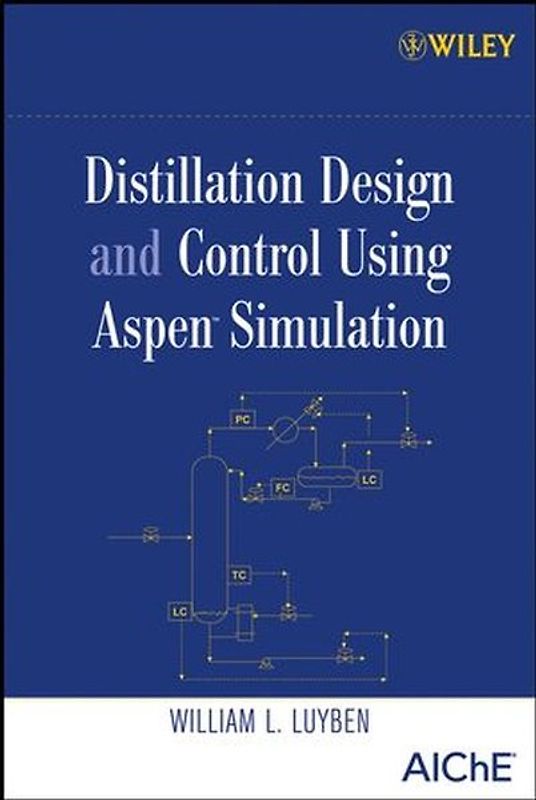
Distillation Design and Control Using Aspen Simulation
William L. Luyben (Gebundene Ausgabe, Englisch)
Keine Bewertungen vorhanden
Optischer Zustand
Beschreibung
A timely treatment of distillationcombining steady-state designand dynamic controllability
As the world continues to seek new sources of energy, the distillation process remains one of the most important separation methods in the chemical, petroleum, and energy industries. And as new renewable sources of energy and chemical feedstocks become more universally utilized, the issues of distillation Dieses Produkt haben wir gerade leider nicht auf Lager.
Handgeprüfte Gebrauchtware
Bis zu 50 % günstiger als neu
Der Umwelt zuliebe
Technische Daten
Erscheinungsdatum
23.05.2006
Sprache
Englisch
EAN
9780471778882
Herausgeber
John Wiley & Sons
Sonderedition
Nein
Autor
William L. Luyben
Seitenanzahl
360
Auflage
1
Einbandart
Gebundene Ausgabe
Autorenporträt
WILLIAM L. LUYBEN, PhD, is Professor of Chemical Engineering at Lehigh University. In addition to thirty-eight years of teaching, Dr. Luyben spent nine years as an engineer with Exxon and DuPont. Over the years, he has written eight books and more than 200 papers. He was the 2004 recipient of the Computing Practice Award from the CAST Division of the AIChE and was elected in 2005 to the Process Automation Hall of Fame.
Schlagwörter
Chemische Verfahrenstechnik
Inhaltsverzeichnis
PREFACE.
1 FUNDAMENTALS OF VAPOR-LIQUID PHASE EQUILIBRIUM (VLE).
1.1 Vapor Pressure.
1.2 Binary VLE Phase Diagrams.
1.3 Physical Property Methods.
1.4 Relative Volatility.
1.5 Bubblepoint Calculations.
1.6 Ternary Diagrams.
1.7 VLE Nonideality.
1.8 Residue Curves for Ternary Systems.
1.9 Conclusion.
2 ANALYSIS OF DISTILLATION COLUMNS.
2.1 Design Degrees of Freedom.
2.2 Binary MCCabe-Thiele Method.
2.3 Approximate Multicomponent Methods.
2.4 Analysis of Ternary Systems Using DISTIL.
2.5 Conclusion.
3 SETTING UP A STEADY-STATE SIMULATION.
3.1 Configuring a New Simulation.
3.2 Specifying Chemical Components and Physical Properties.
3.3 Specifying Stream Properties.
3.4 Specifying Equipment Parameters.
3.5 Running the Simulation.
3.6 Using "Design Spec/Vary" Function.
3.7 Finding the Optimum Feed Tray and Minimum Conditions.
3.8 Column Sizing.
3.9 Conclusion.
4 DISTILLATION ECONOMIC OPTIMIZATION.
4.1 Heuristic Optimization.
4.2 Economic Basis.
4.3 Results.
4.4 Operating Optimization.
4.5 Conclusion.
5 MORE COMPLEX DISTILLATION SYSTEMS.
5.1 Methyl Acetate/Methanol/Water System.
5.2 Ethanol Dehydration.
5.3 Heat-Integrated Columns.
5.4 Conclusion.
6 STEADY-STATE CALCULATIONS FOR CONTROL STRUCTURE SELECTION.
6.1 Summary of Methods.
6.2 Binary Propane/Isobutane System.
6.3 Ternary BTX System.
6.4 Multicomponent Hydrocarbon System.
6.5 Ternary Azeotropic System.
6.6 Conclusion.
7 CONVERTING FROM STEADY STATE TO DYNAMIC SIMULATION.
7.1 Equipment Sizing.
7.2 Exporting to Aspen Dynamics.
7.3 Opening the Dynamic Simulation in Aspen Dynamics.
7.4 Installing Basic Controllers.
7.5 Installing Temperature and Composition Controllers.
7.6 Performance Evaluation.
7.7 Comparison with Economic Optimum Design.
7.8 Conclusion.
8 CONTROL OF MORE COMPLEX COLUMNS.
8.1 Methyl Acetate Column.
8.2 Columns with Partial Condensers.
8.3 Control of Heat-Integrated Distillation Columns.
8.4 Control of Azeotropic Columns/Decanter System.
8.5 Conclusion.
9 REACTIVE DISTILLATION.
9.1 Introduction.
9.2 Types of Reactive Distillation Systems.
9.3 TAME Process Basics.
9.4 TAME Reaction Kinetics and VLE.
9.5 Plantwide Control Structure.
9.6 Conclusion.
10 CONTROL OF SIDESTREAM COLUMNS.
10.1 Liquid Sidestream Column.
10.2 Vapor Sidestream Column.
10.3 Liquid Sidestream Column with Stripper.
10.4 Vapor Sidestream Column with Rectifier.
10.5 Sidestream Purge Column.
10.6 Conclusion.
11 CONTROL OF PETROLEUM FRACTIONATORS.
11.1 Petroleum Fractions.
11.2 Characterization of Crude Oil.
11.3 Steady-State Design of PREFLASH Column.
11.4 Control of PREFLASH Column.
11.5 Steady-State Design of Pipestill.
11.6 Control of Pipestill.
11.7 Conclusion.
INDEX.
Höhe
256 mm
Breite
18.3 cm
-.-
Leider noch keine Bewertungen
Leider noch keine Bewertungen
Sicher bei rebuy kaufen

Schreib die erste Bewertung für dieses Produkt!
Wenn du eine Bewertung für dieses Produkt schreibst, hilfst du allen Kund:innen, die noch überlegen, ob sie das Produkt kaufen wollen. Vielen Dank, dass du mitmachst!
Sicher bei rebuy kaufen