
Derzeit nicht verfügbar
Handgeprüfte Gebrauchtware
Bis zu 50 % günstiger als neu
Der Umwelt zuliebe
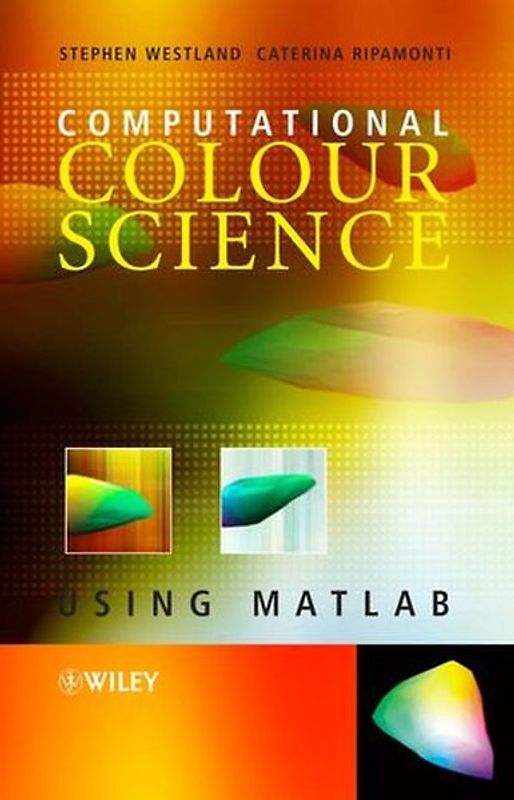
Computational Colour Science using MATLAB
Stephen Westland (Gebundene Ausgabe, Englisch)
Keine Bewertungen vorhanden
Optischer Zustand
Beschreibung
Presenting a practical, problem-based approach to colour physics, this title describes the key issues encountered in modern colour engineering, including efficient representation of colour information, fourier analysis of reflectance spectra and advanced colorimetric computation. Emphasis is placed on the practical applications rather than the techniques themselves, with material structured around Dieses Produkt haben wir gerade leider nicht auf Lager.
Handgeprüfte Gebrauchtware
Bis zu 50 % günstiger als neu
Der Umwelt zuliebe
Technische Daten
Erscheinungsdatum
16.03.2004
Sprache
Englisch
EAN
9780470845622
Herausgeber
John Wiley & Sons
Sonderedition
Nein
Autor
Stephen Westland
Seitenanzahl
220
Auflage
1
Einbandart
Gebundene Ausgabe
Schlagwörter
Farbstoff
Inhaltsverzeichnis
Acknowledgements.
1. Introduction.
1.1 Who this book is for.
1.2 Why base this book on MATLAB?
1.3 A brief review of the CIE system of colorimetry.
2. Linear Algebra for Beginners.
2.1 Some basic definitions.
2.2 Solving systems of simultaneous equations.
2.3 Transposes and inverses.
2.4 Linear and non-linear transforms.
3. A Short Introduction to MATLAB.
3.1 Matrix operations.
3.2 Computing the transpose and inverse of matrices.
3.3 M-files.
3.4 Using functions in MATLAB.
4. Computing CIE Tristimulus Values.
4.1 Introduction.
4.2 Standard colour-matching functions.
4.3 Interpolation methods.
4.4 Extrapolation methods.
4.5 Tables of weights.
4.6 Correction for spectral bandpass.
4.7 Chromaticity diagrams.
4.8 Implementation and examples.
4.8.1 Spectral bandpass correction.
4.8.2 Reflectance interpolation.
4.8.3 Computing tristimulus values.
4.8.4 Plotting the spectral locus.
5. Computing Colour Difference.
5.1 Introduction.
5.2 CIELAB and CIELUV colour space.
5.3 CIELAB colour difference.
5.4 Optimized colour-difference formulae.
5.4.1 CMC(l:c).
5.4.2 CIE94.
5.4.3 CIEDE2000.
5.5 Implementations and examples.
5.5.1 Computing CIELAB and CIELUV coordinates.
5.5.2 Computing colour difference.
6. Chromatic-adaptation Transforms and Colour Appearance.
6.1 Introduction.
6.2 CATs.
6.2.1 CIECAT94.
6.2.2 CMCCAT97.
6.2.3 CMCCAT2000.
6.3 CAMs.
6.3.1 CIECAM97s.
6.3.2 CMCCAM2000.
6.4 Implementations and examples.
6.4.1 CATs.
6.4.2 Computing colour appearance.
7. Characterization of Computer Displays.
7.1 Introduction.
7.2 Gamma.
7.3 The GOG model.
7.4 Device-independent transformation.
7.5 Typical characterization procedure.
7.6 Implementations and examples.
8. Characterization of Cameras.
8.1 Introduction.
8.2 Correction for non-linearity.
8.3 Device-independent representation.
8.4 Implementations and examples.
9. Characterization of Printers.
9.1 Introduction.
9.2 Physical models.
9.3 Neural networks.
9.4 Characterization of half-tone printers.
9.4.1 Correction for non-linearity.
9.4.2 Device-independent representation.
9.4.3 The Kubelka-Munk model.
9.5 Implementations and examples.
9.5.1 Half-tone printer.
9.5.2 Continuous-tone printer.
10. Multispectral Imaging.
10.1 Introduction.
10.2 Computational colour constancy and linear models.
10.3 Surface and illuminant estimation algorithms.
10.4 Techniques for multispectral imaging.
10.4.1 The Hardeberg method.
10.4.2 The Imai and Berns method.
10.4.3 Methods based on maximum smoothness.
10.5 Implementations and examples.
10.5.1 Deriving a set of basis functions.
10.5.2 Representation of reflectance spectra in a linear model.
10.5.3 Estimation of reflectance spectra from tristimulus values.
10.5.4 Estimation of reflectance spectra from camera responses.
10.5.5 Fourier operations on reflectance spectra.
11. Colour Toolbox.
11.1 cband.m (Box 1).
11.2 pinterp.m (Box 2).
11.3 r2xyz.m (Box 3).
11.4 plocus.m (Box 4).
11.5 xyz2lab.m (Box 5).
11.6 lab2xyz.m (Box 6).
11.7 xyz2luv.m (Box 7).
11.8 car2pol.m (Box 8).
11.9 pol2car (Box 9).
11.10 cielabde.m (Box 10).
11.11 dhpolarity (Box 11).
11.12 cmcde.m (Box 12).
11.13 cie94de.m (Box 13).
11.14 cie00de.m (Box 14).
11.15 cmccat97.m (Box 15).
11.16 cmccat00.m (Box 16).
11.17 ciecam97s.m (Box 17).
11.18 gogtest.m (Box 18).
11.19 compgog.m (Box 19).
11.20 rgb2xyz.m (Box 20).
11.21 xyz2rgb.m (Box 21).
11.22 compigog (Box 22).
11.23 getlincam.m (Box 23).
11.24 lincam (Box 24).
11.25 gettrc (Box 25).
11.26 r2xyz (Box 26).
References.
Index.
Höhe
252 mm
Breite
17.5 cm
-.-
Leider noch keine Bewertungen
Leider noch keine Bewertungen
Sicher bei rebuy kaufen

Schreib die erste Bewertung für dieses Produkt!
Wenn du eine Bewertung für dieses Produkt schreibst, hilfst du allen Kund:innen, die noch überlegen, ob sie das Produkt kaufen wollen. Vielen Dank, dass du mitmachst!
Sicher bei rebuy kaufen