
Derzeit nicht verfügbar
Handgeprüfte Gebrauchtware
Bis zu 50 % günstiger als neu
Der Umwelt zuliebe
Optischer Zustand
Beschreibung
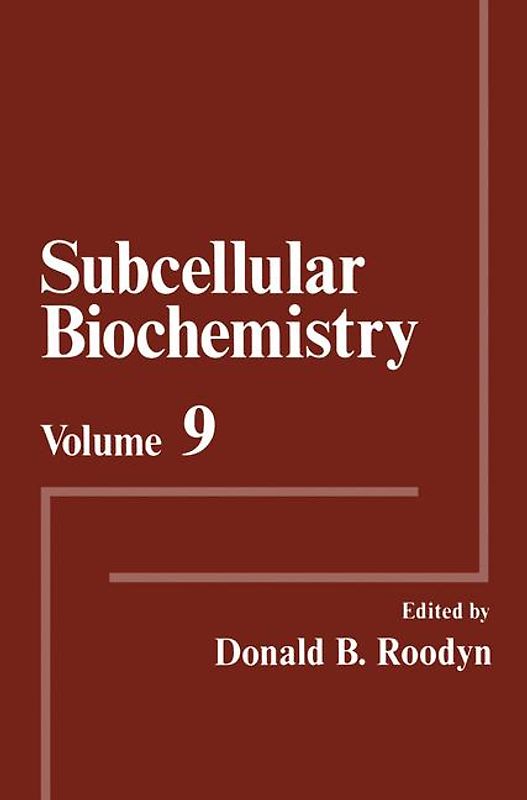
It has always been the policy of SUBCELLULAR BIOCHEMISTRY to be flexible in the size of its articles. In some cases the author may wish to deal with a relatively narrow aspect of his subject and suggestions that he enlarge the article would not necessarily be welcomed. On the other hand, there are occasions when the topic demands a large canvas. It could be argued that the present facilities Dieses Produkt haben wir gerade leider nicht auf Lager.
Handgeprüfte Gebrauchtware
Bis zu 50 % günstiger als neu
Der Umwelt zuliebe
Technische Daten
Erscheinungsdatum
02.01.1983
Sprache
Englisch
EAN
9780306410918
Herausgeber
Springer US
Sonderedition
Nein
Autor
Donald B. Roodyn
Seitenanzahl
425
Einbandart
Gebundene Ausgabe
Buch Untertitel
Volume 9
Thema-Inhalt
PSB - Biochemie
Inhaltsverzeichnis
1 Electron Microscopic in Cellular and Molecular Biology.- 1 Introduction.- 2 The Electron Microscope.- 2.1 Signal Formation in Electron Microscopes.- 2.2 Operation Modes and Types of Electron Microscope.- 2.3 Image Formation in Transmission Electron Microscopes.- 2.4 Special Imaging Techniques in Transmission Electron Microscopy.- 2.5 Surface Imaging.- 2.6 Imaging Recording.- 3 Preparation and Analysis—Structural Aspects.- 3.1 Chemical Methods.- 3.2 Phsysical Methods.- 4 Preparation and Analysis—Functional Aspects.- 4.1 Group- and Charge-Specific “Stains” and Enzymatic Digestion.- 4.2 The Electron Microscope.- 4.3 Signal Formation in Electron Microscopes.- 4.4. Immunocytochemistry.- 4.5 Lectin Labeling.- 4.6. Affinity Labeling.- 4.7. Autoradiography.- 4.8. Morphometry.- 4.9. X-Ray Microanalysis.- 4.10. Ion Precipitation.- 5. Molecular Electron Microscopy.- 5.1. General Aspects.- 5.2. Radiation Damage.- 5.3. Preparative Aspects.- 5.4. Instrumental Aspects.- 5.5. Data Analysis (Image Processing).- 6. Units and Conventions.- 7. Perspectives.- References.- 2 Chloroplast Protein Synthesis: Principles and Problems.- 1 Introduction.- 2. Possible Principles Governing Nuclear-Chloroplast Interactions.- 2.1. The First Principle.- 2.2. The Second Principle.- 2.3. The Third Principle.- 2.4. The Fourth Principle.- 2.5. The Fifth Principle.- 3. The Nucleocytoplasmic Origin of the Majority of Chloroplast.- 3.1. Genetic Experiments.- 3.2. In Vitro Protein Synthesis.- 3.3. Use of Selective Inhibitors.- 3.4. Evidence from Heat-Treated Plants.- 4. The Post-Translational Import of Polypeptides into.- 4.1. In Vitro Transport of Cytoplasmically-Synthesized Chloroplast Polypeptides.- 4.2. Features of Post-Translational Polypeptide Transport.- 5. The Essential Contribution of the Chloroplast Genome.- 6. The Confinement of Chloroplast DNA-Encoded Molecules.- 7. The Stimulatory Role of Light.- 7.1. Light Stimulation of Chloroplast Polypeptide Formation.- References.- 3 Thesaurisomes, A Novel Kind of Nucleoprotein Particle.- 1 Introduction.- 2. Discovery of the Thesaurisomes.- 3. Composition of Thesaurisomes.- 3.1. The 7S Particles.- 3.2. The 42S Particles.- 4. Comparison Between the 7S and 42S Particles.- 4.1. The RNA Components.- 4.2. The Protein Components.- 5. Relationship Between RNA and Protein in Thesaurisomes.- 6. Intracellular Location of Thesaurisomes.- 7. Comparison Between Thesaurisomes and Ribosomes.- 8. Relationship Between Thesaurisomes and Ribosomes in the Oocyte.- 9. State of Acylation of tRNA in Thesaurisomesz.- 10. Reconstruction of the Thesaurisomes.- 11. Occurrence and Role of Thesaurisomes.- 12. Thesaurisomes as Objects for Structural Studies.- 4 Platelet Phospholipid Asymmetry and its Significance in Hemostasis.- 1 Introduction.- 2. Aspects of Platelet Structure and Function.- 2.1. Nonactivated Platelets.- 2.2. Activated Platelets.- 3. Membrane Lipid Asymmetry.- 3.1. Methodological Principles.- 3.2. Erythrocytes.- 3.3. Plasma Membranes and Intracellular Membranes.- 3.4. Nonactivated Platelets.- 3.5. Activated Platelets.- 4. Mechanism and Significance of Changes in Membrane Phospholipid Orientation.- 4.1. Possible Mechanisms.- 4.2. Significance for Platelet Hemostatic Activities.- 5. Conclusion.- References.- 5 The Diversity of Function and Structure of Cellular Membranes.- 1. The Approach.- 1.1. The New Situation.- 1.2. The Improved Preparatory Techniques.- 1.3. The Analysis of the Observations.- 2. Mitochondria.- 2.1. First Step in Interpretation: Meaning of Pictures.- 2.2. Second Step in Interpretation: Deduction of Molecular Models.- 2.3. Third Step in Interpretation: Some Basic Properties of the Crista Membrane.- 2.4. Fourth Step in Interpretation: Effects of Membrane Environment on Molecular Interactions.- 2.5. Fifth Step in Interpretation: Membrane Structure and Specific Functions.- 2.6. The Two Surface Membranes of Mitochondria.- 3. Photoreceptor Cell Outer Segment Disks.- 3.1. Structure.- 3.2. Function.- 4. A Plasma Membrane.- 5. Conclusions.- 6. A Note on the Danielli-Davson Membrane Model.- References.- Some Recent Books in Cell Biochemistry and Biology.- 1. Evolution and Development.- 2. Plant Cell Biochemistry.- 3. Miscellaneous Topics.
Höhe
0 mm
-.-
Leider noch keine Bewertungen
Leider noch keine Bewertungen
Sicher bei rebuy kaufen

Schreib die erste Bewertung für dieses Produkt!
Wenn du eine Bewertung für dieses Produkt schreibst, hilfst du allen Kund:innen, die noch überlegen, ob sie das Produkt kaufen wollen. Vielen Dank, dass du mitmachst!
Sicher bei rebuy kaufen