
Derzeit nicht verfügbar
Handgeprüfte Gebrauchtware
Bis zu 50 % günstiger als neu
Der Umwelt zuliebe
Optischer Zustand
Beschreibung
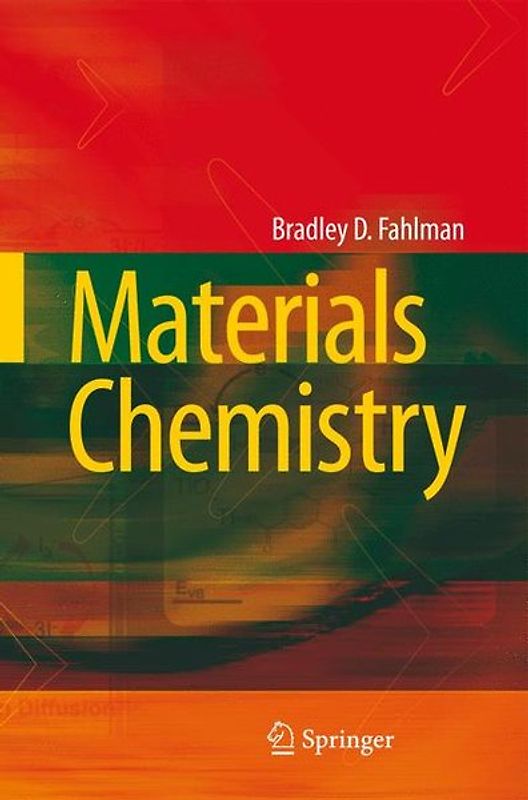
Winner of a 2008 Textbook Excellence Award from the Text and Academic Authors Association (TAA)!
Written to fill the need for a textbook that addresses inorganic-, organic-, and nano-based materials from a structure vs. property treatment, Materials Chemistry aims to provide a suitable breadth and depth coverage of the rapidly evolving materials field -- in a concise format. This modern treatment Dieses Produkt haben wir gerade leider nicht auf Lager.
Handgeprüfte Gebrauchtware
Bis zu 50 % günstiger als neu
Der Umwelt zuliebe
Technische Daten
Erscheinungsdatum
26.05.2008
Sprache
Englisch
EAN
9781402061196
Herausgeber
Springer Netherland
Sonderedition
Nein
Autor
Bradley D. Fahlman
Seitenanzahl
485
Auflage
1
Einbandart
Gebundene Ausgabe
Schlagwörter
Textbook excellence award (TEXTY), Silicon-containing polymers, Semiconducting Materials, Materials Chemistry, Nanomaterials, Materials Characterization, Soft Materials, Textbook on materials chemistry, Biomimetics sensors
Thema-Inhalt
TGM - Materialwissenschaft
TGMT - Werkstoffprüfung
PNNP - Polymerchemie
TJFD - Elektronische Geräte und Materialien
PHF - Materialwissenschaft / Aggregatzustände
TBN - Nanotechnologie
Inhaltsverzeichnis
Chapter 1 What is Materials Chemistry? Historical Perspectives; Considerations in the Design of New Materials; Design of New Materials Through a "Critical Thinking" Approach; References and Notes; Topics for Further Discussion; Further Reading.Chapter 2 Solid-State ChemistryAmorphous vs. Crystalline Solids; Types of Bonding in Solids; Ionic Solids; Metallic Solids; Molecular Solids; Covalent Network Solids; The Crystalline State; Crystal Growth Techniques; The Unit Cell; Crystal Lattices; Definitions and Nomenclature; Interstitial Crystal Lattices; Metal Oxide Lattices; Crystal Imperfections; Phase-Transformation Diagrams; Crystal Symmetry and Space Groups; Physical Properties of Crystals; Hardness; Cleavage and Fracturing; Color; Properties Resulting from Crystal Anisotropy; The Amorphous State; Sol-Gel Processing; Glasses; Cementitious Materials; Important Materials Applications I: Fuel Cells; References and Notes; Topics for Further Discussion; Further Reading.Chapter 3 Metals Mining and Processing of Metals; Powder Metallurgy; Metallic Structures and Properties; Phase Behavior of Iron and Iron-Carbon Alloys; Hardening Mechanisms of Steels; Stainless Steels; Non-Ferrous Metals and Alloys; The Coinage Metals; Aluminum Alloys; Refractory Metals; Shape-Memory Alloys; Metal Surface Treatments for Corrosion Resistance; Magnetism in Metals, Alloys, and Organometallic Complexes; Reversible Hydrogen Storage; Important (and Controversial!) Materials Applications II: Depleted Uranium; References and Notes; Topics for Further Discussion; Further Reading. Chapter 4 Semiconducting Materials Properties and Types of Semiconductors; Silicon-Based Applications; Silicon Wafer Production; Integrated Circuits; Field-Effect Transistors: Structure and Properties; Integrated Circuit Fabrication; Thin-Film Deposition Methodologies; Light-Emitting Diodes: There is Life Outside of Silicon!; Thermoelectric (TE) Materials; Important Materials Applications III: Photovoltaic (Solar) Cells; References and Notes;Topics for Further Discussion; Further Reading. Chapter 5 Organic "Soft" MaterialsPolymer Classifications and Nomenclature; Polymerization Mechanisms; Addition Polymerization; Heterogeneous Catalysis; Homogeneous Living Catalysis; Step-Growth Polymerization; "Soft Materials" Applications: Structure vs. Properties; Molecular Magnets; Polymer Additives: Plasticizers and Flame Retardants; Important Materials Applications IV: Self-Healing Polymers; References and Notes; Topics for Further Discussion; Further Reading. Chapter 6 NanomaterialsWhat is "Nanotechnology"?; Nanoscale Building Blocks and Applications; Zero-Dimensional Nanomaterials; Mechanism for the Nucleation/Growth/Agglomeration of Metal Nanoclusters; The First 0-D Nanoarchitecture: The Fullerenes; The Solution-Phase Synthesis of Nanoparticles; Self-Assembly of Nanoparticles/Nanoclusters into Arrays; One-Dimensional Nanostructures; Carbon Nanotubes; Growth of 1-D Nanostructures; Top-Down Nanotechnology: "Soft Lithography"; Important Materials Applications V: Nanoelectromechanical Systems (NEMS); References and Notes; Topics for Further Discussion; Further Reading.Chapter 7 Materials CharacterizationOptical Microscopy; Electron Microscopy; Transmission Electron Microscopy (TEM); Sample Preparation Techniques; Non-Imaging Applications for TEM; Scanning Transmission Electron Microscopy (STEM); Electron Energy-Loss Spectroscopy (EELS); Scanning Electron Microscopy (SEM); Structure Determination using SEM; Sample Considerations and Auger Electron Spectroscopy (AES); Environmental SEM (ESEM); Photoelectron Spectroscopy (PES); Structure Determination using XAFS; Surface Characterization Techniques Based on Ion Bombardment; Scanning Probe Microscopy (SPM); Bulk Characterization Techniques; Important Materials Applications VI: So Which Acronym Shall I Use?; References and Notes; Topics for Further Discussion; Further Reading. Appendix A Timeline of Materials DevelopmentsAppendix B "There’s Plenty of Room at the Bottom" Appendix C Materials-Related Laboratory Experiments
Höhe
235 mm
Breite
15.5 cm
-.-
Leider noch keine Bewertungen
Leider noch keine Bewertungen
Sicher bei rebuy kaufen

Schreib die erste Bewertung für dieses Produkt!
Wenn du eine Bewertung für dieses Produkt schreibst, hilfst du allen Kund:innen, die noch überlegen, ob sie das Produkt kaufen wollen. Vielen Dank, dass du mitmachst!
Sicher bei rebuy kaufen