
Derzeit nicht verfügbar
Handgeprüfte Gebrauchtware
Bis zu 50 % günstiger als neu
Der Umwelt zuliebe
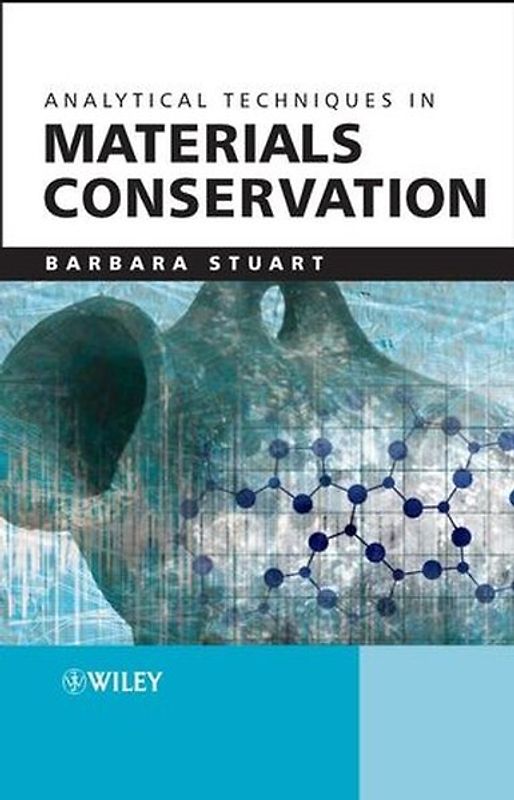
Analytical Techniques in Materials Conservation
Barbara H. Stuart (Gebundene Ausgabe, Englisch)
Keine Bewertungen vorhanden
Optischer Zustand
Beschreibung
The use of scientific techniques in materials conservation has expanded considerably in recent decades and there is a great deal of interest in identifying the materials used in culturally important objects. Of importance is a clear understanding of the state and mechanisms of degradation of objects. Of importance is a clear understanding of the state and mechanisms of degradation of objects Dieses Produkt haben wir gerade leider nicht auf Lager.
Handgeprüfte Gebrauchtware
Bis zu 50 % günstiger als neu
Der Umwelt zuliebe
Technische Daten
Erscheinungsdatum
09.02.2007
Sprache
Englisch
EAN
9780470012802
Herausgeber
John Wiley & Sons
Sonderedition
Nein
Autor
Barbara H. Stuart
Seitenanzahl
444
Einbandart
Gebundene Ausgabe
Autorenporträt
Barbara Stuart (BSc(Hons), MSc(Syd), PhD(Lond), DIC, MRSC, MRACI, Cchem)
After graduating with a BSc degree from the University of Sydney in Australia, Barbara Stuart worked as a tutor at this university. She also carried out research in the field of biophysical chemistry in the Department of Physical Chemistry and graduated with a MSc in 1990. The author moved to the UK to carry out doctoral studies in polymer engineering within the Department of Chemical Engineering and Chemical Technology at Imperial College (University of London). After obtaining her PhD in 1993, she took up a position as Lecturer in Physical Chemistry at the University of Greenwich in London. Barbara joined the staff at the University of Technology, Sydney, Australia in 1995, where she is currently a Senior Lecturer in the Department of Chemistry, Materials and Forensic Science. She is presently conducting research in the fields of polymer spectroscopy, materials conservation and forensic science. Barbara is the author of three other books published by John Wiley and Sons, "Modern Infrared Spectroscopy" and "Biological Applications of Infrared Spectroscopy", both in the ACOL series of open learning texts, and "Polymer Analysis" and "Infrared Spectroscopy: Fundamentals and Applications" in the current ANTS series of texts.
Schlagwörter
Analytical Chemistry, Analytische Chemie, Chemie, Chemistry
Thema-Inhalt
PNF - Analytische Chemie
Inhaltsverzeichnis
1. Conservation materials.
1.1 Introduction.
1.2 Proteins.
1.3 Lipids.
1.4 Carbohydrates.
1.5 Natural resins.
1.6 Natural materials.
1.7 Synthetic polymers.
1.8 Dyes and pigments.
1.9 Textiles.
1.10 Paintings.
1.11 Written material.
1.12 Glass.
1.13 Ceramics.
1.14 Stone.
1.15 Metals.
2. Basic identification techniques.
2.1 Introduction.
2.2 Visual examination.
2.3 Chemical tests.
2.4 Density and specific gravity.
2.5 Solubility.
2.6 Heat tests.
3. Light examination and microscopy.
3.1 Introduction.
3.2 Infrared techniques.
3.3 Ultraviolet techniques.
3.4 Radiography.
3.5 Refractometry.
3.6 Optical microscopy.
3.7 Transmission electron microscopy.
3.8 Scanning electron microscopy.
3.9 Scanning probe microscopy.
4. Molecular spectroscopy.
4.1 Introduction.
4.2 Infrared spectroscopy.
4.3 Raman spectroscopy.
4.4 Ultraviolet-visible spectroscopy.
4.5 Photoluminescence spectroscopy.
4.6 Nuclear magnetic resonance spectroscopy.
4.7 Electron spin resonance spectroscopy.
4.8 Mössbauer spectroscopy.
5. Atomic spectroscopy.
5.1 Introduction.
5.2 Atomic absorption spectroscopy.
5.3 Atomic emission spectroscopy.
5.4 Laser induced breakdown spectroscopy.
6. X-ray techniques.
6.1 Introduction.
6.2 X-ray diffraction.
6.3 X-ray fluorescence spectroscopy.
6.4 Electron microprobe analysis.
6.5 Proton induced X-ray emission.
6.6 X-ray photoelectron spectroscopy and Auger spectroscopy.
7. Mass spectrometry.
7.1 Introduction.
7.2 Molecular mass spectrometry.
7.3 Secondary ion mass spectrometry.
7.4 Atomic mass spectrometry.
8. Chromatography and electrophoresis.
8.1 Introduction.
8.2 Paper chromatography.
8.3 Thin layer chromatography.
8.4 Gas chromatography.
8.5 High performance liquid chromatography.
8.6 Size exclusion chromatography.
8.7 Ion chromatography.
8.8 Capillary electrophoresis.
9. Thermal and mechanical analysis.
9.1 Introduction.
9.2 Thermogravimetric analysis.
9.3 Differential Scanning Calorimetry/Differential Thermal Analysis.
9.4 Tensile Testing.
9.5 Flexural Testing.
9.6 Thermal Mechanical Analysis.
9.7 Dynamic Mechanical Analysis.
9.8 Hardness.
10. Nuclear methods.
10.1 Introduction.
10.2 Radioisotopic dating.
10.3 Neutron activation analysis.
10.4 Luminescence.
10.5 Neutron diffraction.
Appendix Infrared spectra of polymers.
Index.
Höhe
229 mm
Breite
15.2 cm
-.-
Leider noch keine Bewertungen
Leider noch keine Bewertungen
Sicher bei rebuy kaufen

Schreib die erste Bewertung für dieses Produkt!
Wenn du eine Bewertung für dieses Produkt schreibst, hilfst du allen Kund:innen, die noch überlegen, ob sie das Produkt kaufen wollen. Vielen Dank, dass du mitmachst!
Sicher bei rebuy kaufen