
Handgeprüfte Gebrauchtware
Bis zu 50 % günstiger als neu
Der Umwelt zuliebe
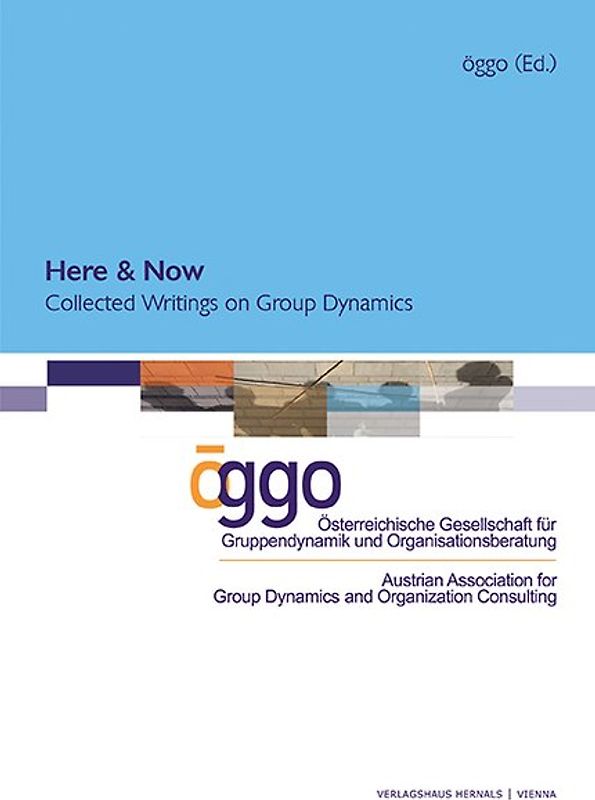
Here and Now - Collected Writings on Group Dynamics
(Gebundene Ausgabe, Englisch)
Keine Bewertungen vorhanden
Optischer Zustand
Sehr guter Zustand: leichte Gebrauchsspuren vorhanden z.B. mit vereinzelten Knicken, Markierungen oder mit Gebrauchsspuren am Cover Gut als Geschenk geeignet
Beschreibung
“Here and Now” is the result of a joint process of international
network partners in group dynamics. Despite all the differences
in group dynamics practice around the globe, “here and now”
as the essential working principle unites group dynamics all
over the world. This book reflects the variety of different truths
and values practicing group dynamics can have and it embraces
the various calls and 2,79 €
zzgl.
zzgl.
Handgeprüfte Gebrauchtware
Bis zu 50 % günstiger als neu
Der Umwelt zuliebe
Technische Daten
Erscheinungsdatum
20.06.2013
Sprache
Englisch
EAN
9783902744982
Herausgeber
Verlagshaus Hernals
Sonderedition
Nein
Seitenanzahl
246
Einbandart
Gebundene Ausgabe
Autorenporträt
Uliana S. Alekseeva is an Associate Professor at Siberian State University
of Transport, (Novosibirsk, Russia) and Deputy Director for Science and
Innovations at the Institute of Professional Development and Training of
Vocational Education Personnel (Novosibirsk).
Since 2008, she has been teaching courses in branding, organizational culture,
internal and external communication for top managers and professionals
of Russian companies.
The topics of most of her Russian publications include aspects of organizational
culture in Russian companies, management change issues in modern
economic conditions, as well as professional audience management techniques.
Her textbook Systemic Approach to Forming Organizational Culture was
awarded the Golden Medal of the 21st International Educational Fair Uch-
Sib-2013 held in Novosibirsk.
She is an alumna of Novosibirsk State University where she received both
undergraduate degree in philology and Candidate of Science (PhD) degree
in Russian Literature.
Ed Batista is an executive coach, a change management consultant, and
a Leadership Coach at the Stanford Graduate School of Business. Ed’s work
as a coach began after a 15-year career in management, during which he
helped launch three new organizations. Ed has been blogging since 2005,
and his writing at www.edbatista.com has been cited by Tom Peters, among
others. Ed earned his MBA from the Stanford Graduate School of Business,
and his AB, magna cum laude, from Brown University. He lives in San Francisco
with his wife, Amy Wright.
Scott Bristol Ed.D. is known internationally for authoring the Life
Journey Map® an online values measurement tool and an educational methodology
for influencing meaningful change at the individual, group, and
cultural level. His work as an educator at the Stanford Graduate School of
Business (GSB) focuses on the intersection of values, emotions, and “languaging”
as they influence interpersonal effectiveness within small self-organizing
groups. His corporate and educational work also focuses on teaching
facilitators how to use these concepts to mobilize the potential of human
diversity. Scott Bristol is an educator who in the past 40 years has worked in
many different organizations and cultures. During his career a common
theme in his work as a teacher, leader, counselor, consultant, and author has
been influencing meaningful change at the individual, group, and organizational
level. In 2004 he joined a team of colleagues at Stanford GSB as a
Lecturer in “Interpersonal Dynamics”. From 2006–2009 he was Coordinator
of the GSB Group Facilitation Program. Recently his work at Stanford is
beginning to explore how to build emotional resilience in social and business
entrepreneurs.
Elena Bevzova is a Professor at Siberian State University of Transport
(STU) and a Business Coach of the Business and Management Center at
STU. She is occupied with the problems of intracorporate cooperation and
professional communications that deal with the problems of development
and changes in professional environment.
She has more than 5 years of experience in educating and consulting in the
domain of professional communications, group dynamics, as well as in the
domain of professional education services in Siberian Federal District of
Russia.
For more than 12 years she teaches the subjects of communication and linguistic
orientation in STU. She is the author of a number of articles and
manuals of the specialty of culture of discourse, professional communication.
Her book that is a set of training manuals, concerns the organization
of communications in intracorporate environment, won a gold medal at the
regional exhibition Siberian Fair in 2013.
Birgit Dietl is currently working as Head of Human Resources in an international
company in the energy industry in Austria. Before that she held
various positions being responsible for personnel development and as internal
consultant in the automotive and petrochemical industry.
She is member of the ÖGGO (Austrian Association for Group Dynamics &
Organization Consulting) and served as board member from 2006 to 2012.
Being a trained consultant and trainer she continuously extends her knowledge
especially in the fields of organizational consulting, mediation, systemic
coaching, and psychotherapy beside keeping up-to-date in her professional
field of HR practices including labor law. She holds an university degree
in communication.
Margit Gietler is a trainer and consultant mainly in the field of workplace
health promotion. Her core areas / responsibilities include the supervision
of learning and development processes for individuals, groups and
organizations as well as conflict management, mental health and stress prevention
and also the management of change. She graduated as Master of
Psychology (specialist field: Group Dynamics) at the University of Klagenfurt.
She is an active member at the ÖGGO (Austrian Association for Group
Dynamics & Organization Consulting) and is further a certified Industrial
Psychologist in the occupational union of Austrian psychologists.
Andrea Handsteiner studied European Ethnology, Mass Media and
Communication Science at the Universities of Vienna and Copenhagen and
holds a doctorate degree in philosophy. Meeting other cultures together
with exploring ways of communication is one of her main interests in professional
and private life. She untertook various journeys and frequently stays
abroad for matters of learning and growing. Since fifteen years her main
professional identity refers to human resources development. She has been
working in the fields of training and coaching for social and professional
skills and organizational consulting for human resources management. She
was head of human resources at University of Natural Resources and Life
Sciences in Vienna for eight years and specialized in strategic personnel
development. She has postgraduate trainings for systemic leadership and
coaching of individuals and groups according to their function and role
within the organization and is member of ÖGGO (Austrian Association for
Group Dynamics & Organization Consulting) since 2002.
Karl G. Kasenbacher completed a secondary school specialized in the
field of Mechanical Engineering. He holds a MA in Psychology and a PH.D.
in Group Dynamics. He is a member of the education-board of the OEGGO,
the Austrian Association for Group Dynamics & Organization Consulting.
He works self-employed as I/O psychologist, group-dynamics-trainer, coaching
expert and massage therapist. In Austria he is lecturer at the University
of Graz and at the Vienna University of Technology. He describes his multidisciplinary
approach in his book “Gruppen und Systeme” (2003). His working
languages are German and English.
Sigrun Koller holds a degree in business management and economic
pedagogy. She has been member of the leadership team executives of a large
insurance company (development and management of the human resources
development), and organizational consultant for more than twenty years
(mainly hospitals, non profit and public administration).(www.palum.at)
Her work focuses in managers- and project coaching, potential recognition
and promotion, leadership development, team- and organizational learning.
She is spezialized in support people and organizations in change situations.
She is qualified for systemic consultation, group dynamics, logotherapy
and existential analysis
Ewald E. Krainz. Studies in humanities and social sciences in Vienna,
doctorate in Psychology 1975; Habilitation on “The Morphology of the
Social World” 1997, since then Professor for Group Dynamics & Organization
Development, University of Klagenfurt, Austria; Development of the
scientific headquarter of the Austrian group dynamics network, head of
the headquarter; Researcher, consultant and trainer with a broad-band social
science background; focus on project management, conflict management,
leadership, team development, group and organization dynamics,
cultural anthropology, intercultural cooperation, epistemology of social
science; Author and editor of numerous books, journals and articles; continuing
lectures and seminars in various universities (Klagenfurt, Vienna,
Kassel); extramural teaching and training activities (corporate universities);
conception and chairing of numerous curricula; coaching of managers
and executives; Globetrotting as trainer, consultant and researcher in
diverse fields and with diverse organizations on problems related to the
issues mentioned, in megacities of the capitalist world and threshold countries.
Gerhard P. Krejci. Consultant, trainer and management coach who
works for international organisations (industries: finance, production and
IT). His main topics are leadership, teams, organization development, virtual
cooperation and intercultural competences;
Gerhard studied International Business in Vienna and Wolverhampton/GB
and writes his dissertation paper about “Management of interculturally
mixed virtually working project teams“;
He is lecturer in intercultural competences, project management, and
group dynamics at various universities in Austria (Linz, Klagenfurt, Wels)
and member of the Austrian Association for Group Dynamics and Organization
Consulting (OeGGO).
Further information: www.forTeamsAndLeaders.at
Barbara Lesjak is teacher and researcher at the University of Klagenfurt,
Faculty for Interdisciplinary Research and Training, Department of Organization,
Development and Group Dynamics. Her main topics are group dynamics,
action learning, social competence and organization development.
She is also a lecturer at various universities on group dynamics, social skills
and organizational learning. She has been qualified to train the trainer for
the ÖGGO (Austrian Association for Group Dynamics and Organization
Consulting); she holds a doctorate degree in philosophy and group dynamics.
She also holds a political mandate (parliament in the province Carinthia).
Barbara.Lesjak@aau.at
Ruth Maclean is a journalist at The Times newspaper in London. She
has reported from Africa, Latin America and Europe on everything from
the persecution of the church in Zimbabwe to the Mexican drug war. She
has a degree in history and philosophy from the University of York and a
master’s in broadcast journalism from City University, London.
Tatiana Medvedeva is an Associate Professor at Siberian State University
of Transport, Novosibirsk, Russia. She was a Visiting Professor at Georgetown
University and The George Washington University in Washington,
DC, USA. She has eight years of experience in educating and consulting
with managers of Russian enterprises for work in the new social and economic
conditions.
Most of her publications in Russia and abroad concern the economics of
transitions, social and labor relations and change management, particularly
the changes in values, beliefs, and institutions now occurring in the postcommunist
countries; interactive planning methods; group dynamics; crosscultural
studies; total quality management; and a constructivist approach to
education. She received a diploma in economic cybernetics from Novosibirsk
State University and a kandidatskaya degree (Ph.D) in economics
from Moscow State University. Her biography can be found in the Marquis
Edition of Who’s Who in the World, 2009.
Roman Sander has been a clinical and health psychologist for the recent
years and works in a private praxis. He teaches on topics related to addiction
at the clinical university of Graz. Roman Sander further does various trainings,
seminars and workplace evaluations in NGO’s or private businesses.
His consulting topics are mainly stress and burnout, communication, leadership
and addiction. He is in the process of being qualified to train the
trainer for the ÖGGO (Austrian Association for Group Dynamics & Organization
Consulting). He holds a doctorate degree in psychology.
For further information see http://www.praxiskalvarienberg.at/
Klaus Scala is the Founder of the Center for Social Competence at the
University of Graz, Austria. He is also engaged as a Permanent Visiting Professor
at the Department for Organizational Development of the University
of Klagenfurt, Austria. He conducts master and PhD level classes in Organizational
Development. His main area in consulting and research is leadership
and the development of cooperation between public service organizations
(education, public health, health care, traffic). He is a member of the
Austrian Association of Group Dynamics and Organizational Consulting
and is Teacher Trainer there. He has taught at universities and academic
institutions in Austria, Mongolia, USA (Stanford) and Zimbabwe.
Andrea Schüller has been working as organziational consultant and
executive coach with business firms, NGOs, public institutions and transorganisational
networks for more than 15 years. Her focus is on transformation,
corporate strategy and vision, leadership, team development, culture
development and innovation. She has carried out consulting and leadership
development projects in Europe and Africa. Before, Andrea was assistant professor
at the University of Economics & BA in Vienna with a research focus
on social innovation (mainly health care and social services). She lectures at
various universities and has developed several experiental learning settings
(HR, leadership, change & transformation, team & generative collaboration,
group dynamics) for small and large groups. Her passion is in creating
integrative consulting and learning designs aiming at the conscious(ness)
development of systems and people. Various publications in these fields.
She currently serves as a board member of the OEGGO (Austrian Association
for Group Dynamics & Organization Consulting). She holds a doctorate
degree in Economics and Business Administration.
www.andrea-schueller.com
Joachim Schwendenwein. Joachim’s focus is on helping organizations
create sustainable strategic capabilities that foster innovation, change,
acumen and continuous learning. He does so by sparring, consulting, advising
senior executives and management teams in organizations of all sizes
and sectors. He lectures on Group-Dynamics, Organization Design, and CSR
at various Austrian universities, facilitates at the Stanford GSB and chairs the
OEGGO since 2005. Joachim draws on 20 years of international experience
having worked in more than 20 countries on four continents – Africa, The
Americas, Asia, and Europe. His clients describe him as relentless in generating
an abundance of options, finding structure in chaos, and building
bridges to unexpected collaborations and innovation. He supports initiatives
for the “betterment of the world” – in 2011 the African Peace Training
Center Association in aligning their efforts on Protection of Civilians in
Armed Conflicts; in 2012 the creation of a Social Business Pilot for rural
poor in Colombia.
Maria Spindler has been an organizational consultant for twenty years
in economics (mainly banking and production) and NGOs (mainly universities
and foundations). Her consulting topics are strategy development, creating
and changing organizations and structures, leadership culture and
organizational learning. She is a lecturer at various universities in Europe
and USA on corporate culture, organization and management and group
dynamics. Her book publications deal with organizational learning, innovation,
management, group dynamics, consulting and research. She has been
qualified to train the trainer for the ÖGGO (Austrian Association for Group
Dynamics & Organization Consulting) since 2002 and also served as a board
member. She holds a doctorate degree in philosophy and group dynamics.
For further information see www.maria-spindler.at.
Gary Wagenheim is adjunct management professor at the Beedie School
of Business at Simon Fraser University and Aalto University Executive Education
and former professor of organizational leadership at the School of
Technology at Purdue University. His research and teaching interests are
reflective practice, individual and organizational change, and organizational
behavior. He owns and operates Wagenheim Advisory Group that provides
corporate training, coaching, and organizational development programs.
Dr. Wagenheim received a Ph.D. and an M.A. in Human and Organizational
Systems from Fielding Graduate University, an M.B.A. in Organizational Behavior/ Organizational Change and Development from
Syracuse University, and a B.S. in Business and Management from the University
of Maryland.
Liselotte Zvacek. As a management consultant Liselotte Zvacek focuses
on processes of organisational change, corporate vision and strategy, postmerger
integration, organisational culture, team development, and innovative
learning designs for more than 15 years. She has carried out consulting/
training projects both on a national and an international/cross-cultural level
in Europe, USA and Africa. As a management trainer she conducts trainings
in the field of leadership skills focusing on role management, teamwork,
conflict, and change management. She lectures at several Austrian
Universities in the fields of group-dynamics, human resource development
and change management. She is senior facilitator at the Graduate School of
Business at Stanford University (USA) for interpersonal dynamics. She is a
member of the faculty of the IFF, the Hernstein Institute for Management
and Leadership, the NTL (USA) and cooperates within the network of
ÖGGO (Austrian Association for Group Dynamics and Organization Consulting),
where she has been qualified to train the trainer for the ÖGGO
and serves as a board member. In 2003 she edited together with H. Lobnig
and J. Schwendenwein a compendium of current consulting strategies in
changemangement: “Beratung der Veränderung – Veränderung der Beratung”.
Her working languages are German and English.
Schlagwörter
ÖGGO, Self-Learning-System, Gruppendynamik
Thema-Inhalt
JHBL - Soziologie: Arbeit und Beruf
Thema-Zusatz
Qualifier für pädagogische Zwecke, Qualifier für Altersstufen und Besondere Interessensgruppen
Höhe
225 mm
Breite
16 cm
-.-
Leider noch keine Bewertungen
Leider noch keine Bewertungen
Sicher bei rebuy kaufen

Schreib die erste Bewertung für dieses Produkt!
Wenn du eine Bewertung für dieses Produkt schreibst, hilfst du allen Kund:innen, die noch überlegen, ob sie das Produkt kaufen wollen. Vielen Dank, dass du mitmachst!
Sicher bei rebuy kaufen