
iPhoneAlle anzeigen
iPhone 11iPhone 11 ProiPhone 11 Pro MaxiPhone 12iPhone 12 ProiPhone 12 Pro MaxiPhone 12 miniiPhone 13iPhone 13 ProiPhone 13 Pro MaxiPhone 13 miniiPhone 14iPhone 14 PlusiPhone 14 ProiPhone 14 Pro MaxiPhone 15iPhone 15 PlusiPhone 15 ProiPhone 15 Pro MaxiPhone 16iPhone 16 PlusiPhone 16 ProiPhone 16 Pro MaxiPhone 16eiPhone 5iPhone 5CiPhone 5SiPhone 6iPhone 6 PlusiPhone 6SiPhone 6S PlusiPhone 7iPhone 7 PlusiPhone 8iPhone 8 PlusiPhone SEiPhone SE 2020iPhone SE 2022iPhone XiPhone XRiPhone XSiPhone XS Max
NokiaAlle anzeigen
108 Reihe220 Reihe225 Reihe2600 classic Reihe2680 slide Reihe2710 Reihe3120 classic Reihe3220 Reihe500 Reihe515 Reihe5230 Reihe603 Reihe6131 Reihe6200 Reihe6300 Reihe6500 Reihe6700 Reihe700 Reihe7200 Reihe8310 ReiheAshaC1C2C3C5C6C7E51E52E6E63E65E7E71E72N73N8N9N95N97Nokia 3Nokia 4.2Nokia 5Nokia 6Nokia 7Nokia 8SiroccoWeitere ModelleXX2X3X6XLXpressMusic
Galaxy A-SerieAlle anzeigen
Galaxy A12Galaxy A13Galaxy A13 5GGalaxy A14Galaxy A15Galaxy A16Galaxy A17 5GGalaxy A20eGalaxy A21Galaxy A22Galaxy A23Galaxy A24Galaxy A25Galaxy A26 5GGalaxy A3Galaxy A32Galaxy A33Galaxy A34Galaxy A35Galaxy A36 5GGalaxy A37Galaxy A40Galaxy A41Galaxy A42Galaxy A50Galaxy A51Galaxy A52Galaxy A53Galaxy A54Galaxy A55Galaxy A56 5GGalaxy A70Galaxy A71Galaxy A72
Redmi SeriesAlle anzeigen
Redmi 10Redmi 13CRedmi 15 5GRedmi Note 10Redmi Note 10 ProRedmi Note 11Redmi Note 11 ProRedmi Note 11 Pro Plus 5GRedmi Note 11sRedmi Note 12Redmi Note 12 5GRedmi Note 12 ProRedmi Note 12 Pro 5GRedmi Note 12 Pro PlusRedmi Note 13Redmi Note 13 5GRedmi Note 13 ProRedmi Note 13 Pro PlusRedmi Note 14Redmi Note 14 Pro PlusRedmi Note 8Redmi Note 8 ProRedmi Note 9Redmi Note 9 Pro
- Startseite
Bücher Wissen & Bildung Englische Bücher Naturwissenschaft, Medizin, Informatik, Technik Technik Allg. & Lexika Applications of Vector Analysis and Complex Variables in Engineering
Derzeit nicht verfügbar
Handgeprüfte Gebrauchtware
Bis zu 50 % günstiger als neu
Der Umwelt zuliebe
Applications of Vector Analysis and Complex Variables in Engineering
Otto Strack (Gebundene Ausgabe, Englisch)
★★★★★
☆☆☆☆☆ Keine Bewertungen vorhanden
Optischer Zustand
Beschreibung
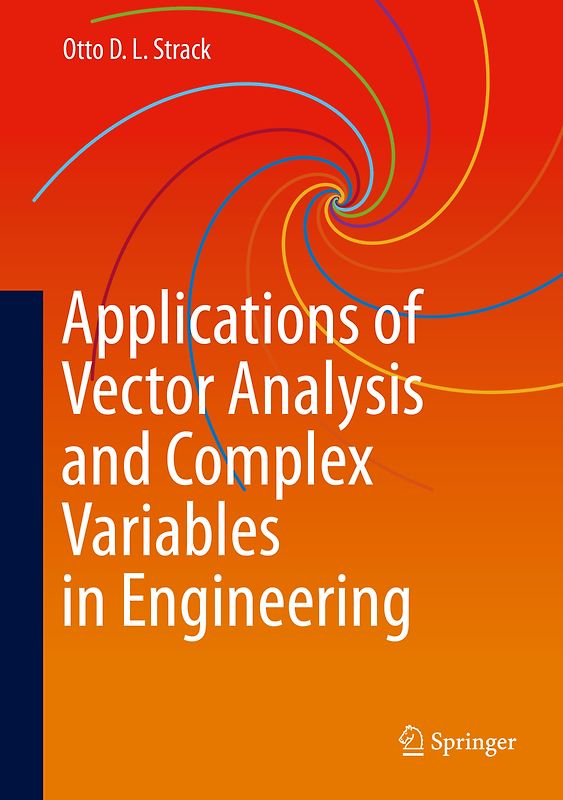
This textbook presents the application of mathematical methods and theorems tosolve engineering problems, rather than focusing on mathematical proofs. Applications of Vector Analysis and Complex Variables in Engineering explains the mathematical principles in a manner suitable for engineering students, who generally think quite differently than students of mathematics. The objective is to… emphasize mathematical methods and applications, rather than emphasizing general theorems and principles, for which the reader is referred to the literature. Vector analysis plays an important role in engineering, and is presented in terms of indicial notation, making use of the Einstein summation convention. This text differs from most texts in that symbolic vector notation is completely avoided, as suggested in the textbooks on tensor algebra and analysis written in German by Duschek and Hochreiner, in the 1960s. The defining properties of vector fields, the divergence and curl, are introduced in terms of fluid mechanics. The integral theorems of Gauss (the divergence theorem), Stokes, and Green are introduced also in the context of fluid mechanics. The final application of vector analysis consists of the introduction of non-Cartesian coordinate systems with straight axes, the formal definition of vectors and tensors. The stress and strain tensors are defined as an application. Partial differential equations of the first and second order are discussed. Two-dimensional linear partial differential equations of the second order are covered, emphasizing the three types of equation: hyperbolic, parabolic, and elliptic. The hyperbolic partial differential equations have two real characteristic directions, and writing the equations along these directions simplifies the solution process. The parabolic partial differential equations have two coinciding characteristics; this gives useful information regarding the character of the equation, but does not help in solving problems. The elliptic partial differential equations do not have real characteristics. In contrast to most texts, rather than abandoning the idea of using characteristics, here the complex characteristics are determined, and the differential equations are written along these characteristics. This leads to a generalized complex variable system, introduced by Wirtinger. The vector field is written in terms of a complex velocity, and the divergence and the curl of the vector field is written in complex form, reducing both equations to a single one. Complex variable methods are applied to elliptical problems in fluid mechanics, and linear elasticity. The techniques presented for solving parabolic problems are the Laplace transform and separation of variables, illustrated for problems of heat flow and soil mechanics. Hyperbolic problems of vibrating strings and bars, governed by the wave equation are solved by the method of characteristics as well as by Laplace transform. The method of characteristics for quasi-linear hyperbolic partial differential equations is illustrated for the case of a failing granular material, such as sand, underneath a strip footing. The Navier Stokes equations are derived and discussed in the final chapter as an illustration of a highly non-linear set of partial differential equations and the solutions are interpreted by illustrating the role of rotation (curl) in energy transfer of a fluid. Dieses Produkt haben wir gerade leider nicht auf Lager.
Handgeprüfte Gebrauchtware
Bis zu 50 % günstiger als neu
Der Umwelt zuliebe
Technische Daten
Erscheinungsdatum
20.04.2020
Sprache
Englisch
EAN
9783030411671
Herausgeber
Springer International Publishing
Sonderedition
Nein
Autor
Otto Strack
Seitenanzahl
216
Auflage
1st edition 2020
Einbandart
Gebundene Ausgabe
Schlagwörter
Tensor analysis, Complex variables, Material-time derivative, Indicial notation, Wirtinger calculus, Vector analysis, Fluid mechanics, Linear elasticity, Soil mechanics, Singularities, Discontinuities
Thema-Inhalt
TBJ - Mathematik für Ingenieure
PBKS - Numerische Mathematik
TGB - Maschinenbau
Höhe
254 mm
Breite
17.8 cm
Hersteller: Springer, Europaplatz 3, Heidelberg, Deutschland, 69115, ProductSafety@springernature.com, Springer Nature Customer Service Center GmbH
-.-
★★★★★
☆☆☆☆☆ Leider noch keine Bewertungen
Leider noch keine Bewertungen
Sicher bei rebuy kaufen

Schreib die erste Bewertung für dieses Produkt!
Wenn du eine Bewertung für dieses Produkt schreibst, hilfst du allen Kund:innen, die noch überlegen, ob sie das Produkt kaufen wollen. Vielen Dank, dass du mitmachst!
Sicher bei rebuy kaufen