
iPhoneAlle anzeigen
iPhone 11iPhone 11 ProiPhone 11 Pro MaxiPhone 12iPhone 12 ProiPhone 12 Pro MaxiPhone 12 miniiPhone 13iPhone 13 ProiPhone 13 Pro MaxiPhone 13 miniiPhone 14iPhone 14 PlusiPhone 14 ProiPhone 14 Pro MaxiPhone 15iPhone 15 PlusiPhone 15 ProiPhone 15 Pro MaxiPhone 16iPhone 16 PlusiPhone 16 ProiPhone 16 Pro MaxiPhone 16eiPhone 8iPhone 8 PlusiPhone SE 2020iPhone SE 2022iPhone XiPhone XRiPhone XSiPhone XS Max
Galaxy A-SerieAlle anzeigen
Galaxy A12Galaxy A13Galaxy A13 5GGalaxy A14Galaxy A15Galaxy A16Galaxy A17 5GGalaxy A20eGalaxy A21Galaxy A22Galaxy A23Galaxy A24Galaxy A25Galaxy A26 5GGalaxy A32Galaxy A33Galaxy A34Galaxy A35Galaxy A36 5GGalaxy A40Galaxy A41Galaxy A42Galaxy A50Galaxy A51Galaxy A52Galaxy A53Galaxy A54Galaxy A55Galaxy A56 5GGalaxy A70Galaxy A71Galaxy A72
Redmi SeriesAlle anzeigen
Redmi 10Redmi 13CRedmi 15 5GRedmi Note 10Redmi Note 10 ProRedmi Note 11Redmi Note 11 ProRedmi Note 11 Pro Plus 5GRedmi Note 11sRedmi Note 12Redmi Note 12 5GRedmi Note 12 ProRedmi Note 12 Pro 5GRedmi Note 12 Pro PlusRedmi Note 13Redmi Note 13 5GRedmi Note 13 ProRedmi Note 13 Pro PlusRedmi Note 14Redmi Note 14 Pro PlusRedmi Note 8Redmi Note 8 ProRedmi Note 9Redmi Note 9 Pro
- Startseite
Bücher Englische Bücher Wissen & Bildung Naturwissenschaft, Medizin, Informatik, Technik Physik & Astronomie Elektrizität, Magnetismus, Optik Mercury Loss in Fluorescent Lamps - Experiment and Modelling
Derzeit nicht verfügbar
Handgeprüfte Gebrauchtware
Bis zu 50 % günstiger als neu
Der Umwelt zuliebe
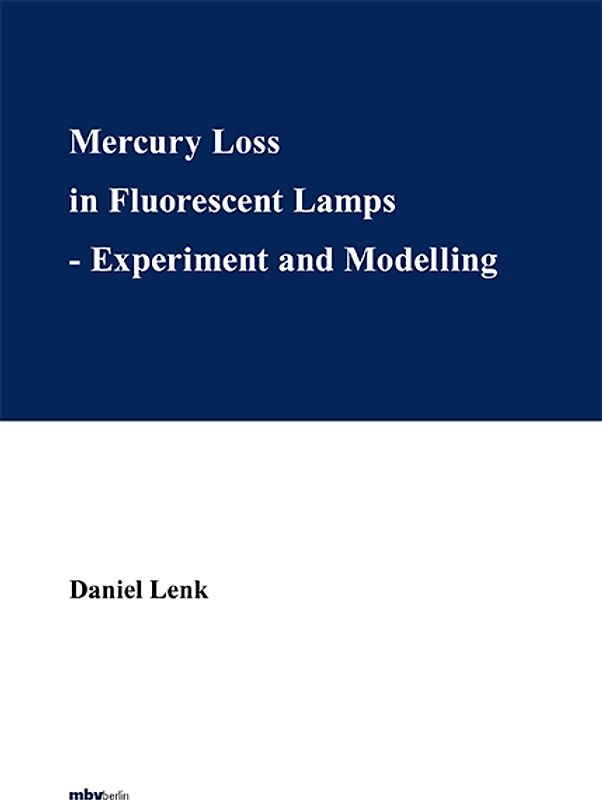
Mercury Loss in Fluorescent Lamps - Experiment and Modelling
Daniel Lenk (Unbekannter Einband, Englisch)
★★★★★
☆☆☆☆☆ Keine Bewertungen vorhanden
Optischer Zustand
Beschreibung
Despite the recent trend towards substitution of fluorescent lamps by LEDs, they remain an important part of global illumination due to their high efficiency, long lifetime and low initial cost. The fundamental working principle of a fluorescent lamp is that the electric discharge of a gas emits ultraviolet (UV) light, which is absorbed by a phosphor layer deposited on the inner surface of a… soda-lime glass tube, which in turn reemits visible light. The gas, which is most efficient to convert an electric current into UV light by electric discharge, is mercury at low pressure. Thus, mercury is indespensible in fluorescent lamps.
Over the course of the lifetime of the lamp, the mercury is bound at the inner glass surface, resulting in graying of the glass and, consequently, in a decrease of luminous efficiency. To reduce the mercury loss by transport into the glass, an additional coating layer is deposited between the phosphor layer and the glass tube. However, mercury has also been observed to be bound in the coating layer and in the phosphor.
If not compensated, these mercury loss processes would reduce the amount of mercury available for the discharge and the lifetime of the lamp would be severely limited. However, since mercury is toxic and, thus, complicates the recycling of the lamps, a reduction of the dose of mercury in fluorescent lamps is desired for ecological reasons and also enforced by increasingly severe limitations by public authorities. However, the processes underlying the mercury loss were still widely not understood. While several approaches existed to investigate and/or simulate the mercury loss processes for simplified systems, containing either a phosphor or a coating layer, yielding evidence for a diffusive transport process and an electrostatic reaction process, there was still no systematic study and a consistent model of the process in a realistic phosphor/coating double-layer system available yet.
The goal of the presented study was to find a consistent description of the mercury loss process in such a double-layer setup and, subsequently apply it to the results of a systematic experimental lamp aging study to verify its applicability. This yields the possibility to predict the mercury loss properties of a specific layer design and material combination to reduce the mercury consumption in fluorescent lamps and, thus, reduce the amount of mercury used in such lamps.
This book provides an extensive study of the aforementioned mercury loss process by investigating the mercury content in the coatings and the luminous flux of hundreds of prototype lamps over the course of thousands of hours. The obtained results are discussed with respect to the electrostatic and structural properties of the materials used for the coatings of the lamps. Empirical models to describe the mercury loss process are developed and a consistent description of the mercury loss process is provided. The presented results isolate the UV-load on the glass as distinct key parameter to reduce the mercury loss in fluorescent lamps. Dieses Produkt haben wir gerade leider nicht auf Lager.
Handgeprüfte Gebrauchtware
Bis zu 50 % günstiger als neu
Der Umwelt zuliebe
Technische Daten
Erscheinungsdatum
16.05.2020
Sprache
Englisch
EAN
9783967291063
Herausgeber
Mensch & Buch
Sonderedition
Nein
Autor
Daniel Lenk
Seitenanzahl
400
Auflage
1
Einbandart
Unbekannter Einband
Schlagwörter
Mercury Reduction, Diffusion-Reaction-Model, Low Pressure Fluorescent Lamp, Modelling, Mercury Plasma
Thema-Inhalt
PHF - Materialwissenschaft / Aggregatzustände
Thema-Zusatz
für die Erwachsenenbildung, für die Hochschulausbildung, für die Berufsbildung / Berufsausbildung
Höhe
210 mm
Breite
14.8 cm
-.-
★★★★★
☆☆☆☆☆ Leider noch keine Bewertungen
Leider noch keine Bewertungen
Sicher bei rebuy kaufen

Schreib die erste Bewertung für dieses Produkt!
Wenn du eine Bewertung für dieses Produkt schreibst, hilfst du allen Kund:innen, die noch überlegen, ob sie das Produkt kaufen wollen. Vielen Dank, dass du mitmachst!
Sicher bei rebuy kaufen