
iPhoneAlle anzeigen
iPhone 11iPhone 11 ProiPhone 11 Pro MaxiPhone 12iPhone 12 ProiPhone 12 Pro MaxiPhone 12 miniiPhone 13iPhone 13 ProiPhone 13 Pro MaxiPhone 13 miniiPhone 14iPhone 14 PlusiPhone 14 ProiPhone 14 Pro MaxiPhone 15iPhone 15 PlusiPhone 15 ProiPhone 15 Pro MaxiPhone 16iPhone 16 PlusiPhone 16 ProiPhone 16 Pro MaxiPhone 16eiPhone 8iPhone 8 PlusiPhone SE 2020iPhone SE 2022iPhone XiPhone XRiPhone XSiPhone XS Max
Galaxy A-SerieAlle anzeigen
Galaxy A12Galaxy A13Galaxy A13 5GGalaxy A14Galaxy A15Galaxy A16Galaxy A17 5GGalaxy A20eGalaxy A21Galaxy A22Galaxy A23Galaxy A24Galaxy A25Galaxy A26 5GGalaxy A32Galaxy A33Galaxy A34Galaxy A35Galaxy A36 5GGalaxy A40Galaxy A41Galaxy A42Galaxy A50Galaxy A51Galaxy A52Galaxy A53Galaxy A54Galaxy A55Galaxy A56 5GGalaxy A70Galaxy A71Galaxy A72
Redmi SeriesAlle anzeigen
Redmi 10Redmi 13CRedmi 15 5GRedmi Note 10Redmi Note 10 ProRedmi Note 11Redmi Note 11 ProRedmi Note 11 Pro Plus 5GRedmi Note 11sRedmi Note 12Redmi Note 12 5GRedmi Note 12 ProRedmi Note 12 Pro 5GRedmi Note 12 Pro PlusRedmi Note 13Redmi Note 13 5GRedmi Note 13 ProRedmi Note 13 Pro PlusRedmi Note 14Redmi Note 14 Pro PlusRedmi Note 8Redmi Note 8 ProRedmi Note 9Redmi Note 9 Pro
- Startseite
Bücher Englische Bücher Wissen & Bildung Sozialwissenschaft, Recht, Wirtschaft Ethnologie Völkerkunde The NGOisation of Education
Derzeit nicht verfügbar
Handgeprüfte Gebrauchtware
Bis zu 50 % günstiger als neu
Der Umwelt zuliebe
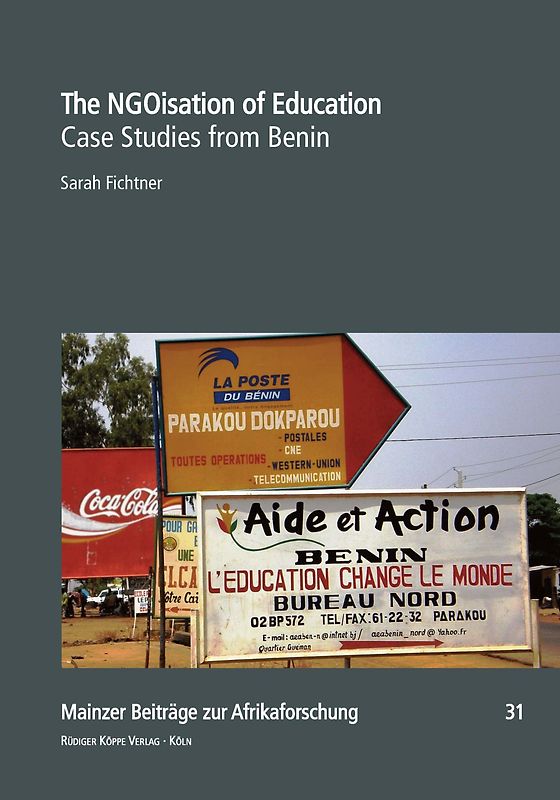
The NGOisation of Education
Sarah Fichtner (Broschiert, Englisch)
★★★★★
☆☆☆☆☆ Keine Bewertungen vorhanden
Optischer Zustand
Beschreibung
Die NGOisierung des Bildungswesens ist sowohl Folge als auch Mittel der Globalisierung von öffentlichen Diensten, die während des Höhepunktes der neoliberalen globalen Herrschaft in den, ‚langen 80er-Jahren‘ einen enormen Anstieg zu verzeichnen hatte. Nichtregierungsorganisationen, die von den internationalen Entwicklungshilfeorganisationen als näher an der ‚Zielbevölkerung‘, weniger korrupt und… effizienter als staatliche Institutionen angesehen werden, entwickelten sich seit dieser Zeit zu den bevorzugten Projektumsetzern im öffentlichen Sektor.
Die vorliegende Studie betrachtet die Entwicklung der NGOisierung des Bildungswesens aus einer empirischen Perspektive, aufbauend auf Eindrücken aus dem westafrikanischen Staat Benin. Hauptaugenmerk liegt auf vier Fallbeispielen: 1. das Primary Education Teacher’s Training Programme, das von der INGO IFESH (International Foundation for Education and Self-Help) betrieben wird; 2. der Aufbau eines Gemeinde-Kommitees für Bildungsfragen in Nikki, durchgeführt von der Organisation Aide et Action; 3. das Education First Project gegen Kinderhandel, entworfen von World Education, Terre des Hommes und dem Catholic Relief Service; 4. ein Projekt für selbstverwaltete Schulkantinen, durchgeführt vom Catholic Relief Service. Die Projektanalysen beruhen auf einer zehnmonatigen Feldforschung in Nikki, Karimama, Parakou, Cotonou und Porto Novo.
Die Autorin argumentiert, dass gegenwärtig die Entwicklungshilfe der NGOs in erster Linie die Bewerbung, Vermarktung und Verwaltung von globalen Modellen, Normen und Standards auf dem Feld der Bildungsarbeit bedient und weniger die Bereitstellung von Hilfsmitteln und Dienstleistungen für ‘die Bedürftigen‘. Diese progressiv ausgerichtete Förderung von Normen – definiert als geteilte, bewertende Erwartungen an die Entwicklung und die Eigenorganisation der Entwicklung der Hilfsempfänger – beinhaltet die Förderung des Schulbesuchs, aber auch (unter anderem) neue Ansätze zu Lehren und Lernen, zu ‘partizipatorischeren‘ und angeblich effizienteren Wegen zur Durchführung von lokaler Bildungspolitik, zur Leitung von Elternpflegschaften und Schulkantinen sowie der Kontrolle des Schulbesuchs.
Die hier untersuchte NGOisierung des Bildungswesens ist aus Sicht der Autorin kein Prozess, der die Entwicklung eines privatisierten Wohlfahrtssystems parallel zum Staat oder im Schatten desselben beschreibt, sondern vielmehr ein Phänomen, das für den Staat, der im internationalen System agiert, zentral ist. Sie sollte daher als auf Empirie basierende Gegenperspektive zu essenzialistischen und exotisierenden Sichtweisen zum afrikanischen Staat gelesen werden.
*****************************************************
The NGOisation of education is an outcome as well as a means of the globalisation of public services that increased tremendously during the peak of neoliberal global governance in the ‘long 1980s’. Non-governmental organisations, with the comparative advantages seen by international development agencies as being closer to the ‘target populations’, less corrupt and more efficient than state institutions, became the preferred project implementers in public sector domains since that time.
Based on insights from the West African country Benin, this thesis studies the processes of the NGOisation of education from an empirical perspective. It focuses on four case studies, namely 1. the Primary Education Teacher’s Training Programme carried out by the INGO IFESH; 2. Aide et Action’s installation of a Municipal Education Committee in Nikki; 3. the Education First Project against child trafficking conceptualised by World Education, Terre des Hommes and the Catholic Relief Services; and 4. a project for self-managed school canteens run by the Catholic Relief Services. The projects’ analyses are grounded in ten months of multi-sited field research in Nikki, Karimama, Parakou, Cotonou and Porto Novo.
The main argument is that currently, NGOs’ development aid involves foremost the promotion, marketing, and management of global models, norms and standards in the field of education, and to a much lesser extent the provision of resources and services to ‘the poor’. This development-driven promotion of norms, defined as shared, evaluative expectations of behaviour of how the beneficiaries of aid are supposed to develop and to manage their own development takes place at the very heart of the state as well as at its margins. It involves not only the promotion of school attendance but new ways of learning and teaching, of teacher training and teacher training management; of more ‘participatory’ and supposedly efficient ways to conduct local education politics, manage parents’ committees and school canteens, and control school attendance. It includes neoliberal management and marketing ideas based on competition and surveillance that are at the centre of econometric based international education campaigns such as Education for All.
The NGOisation of education outlined in this thesis is therefore not a process that describes the development of a privatised welfare system parallel to or in the shadow of the state. It is a phenomenon that is central to the state “at work” in the international system. The “NGOisation of education” must therefore be read as an empirically based counter-perspective to essentialist and exoticising essays on the African state, as well as to dominant econometric approaches to education in the Global South and to macro-sociological perceptions of a conflict and actor free ‘world cultural diffusion’ of educational principles.
About the author:
Sarah Fichtner studied social anthropology at the Free University in Berlin and at Manchester University, and holds a PhD in social anthropology from the Johannes Gutenberg University, Mainz. From 2010 to 2012 she worked as a lecturer at the Department of Anthropology and African Studies, Mainz, where she was also the administrative coordinator of the research project States at Work. Public Services and Civil Servants in West Africa: Education and Justice in Benin, Ghana, Mali and Niger funded by the Volkswagen Foundation. Since 2012, she has been a postdoctoral researcher at the Institut d’Etudes Politiques/Les Afriques dans le Monde, University of Bordeaux, guest researcher at the Robert Bosch Academy in Berlin, as contract lecturer at the Freie Universität Berlin and at present as free consultant in Berlin.
*******************************************
In the same series the following studies have been published:
Sabine Brüntrup-Seidemann: “Entwicklungsmakler, Kleinunternehmer, Dienstleister? Nichtregierungsorganisationen in Benin”, ISBN 978-3-89645-823-0.
Clarisse Tama: “Être enseignant au Bénin – Les mutations d’un groupe professionnel”, ISBN 978-3-89645-835-3. Dieses Produkt haben wir gerade leider nicht auf Lager.
Handgeprüfte Gebrauchtware
Bis zu 50 % günstiger als neu
Der Umwelt zuliebe
Technische Daten
Erscheinungsdatum
09.05.2012
Sprache
Englisch
Originalsprache
Englisch
EAN
9783896458315
Herausgeber
Köppe, R
Titel in Originalsprache
The NGOisation of Education
Serien- oder Bandtitel
Mainzer Beiträge zur Afrikaforschung
Sonderedition
Nein
Autor
Sarah Fichtner
Seitenanzahl
196
-.-
★★★★★
☆☆☆☆☆ Leider noch keine Bewertungen
Leider noch keine Bewertungen
Sicher bei rebuy kaufen

Schreib die erste Bewertung für dieses Produkt!
Wenn du eine Bewertung für dieses Produkt schreibst, hilfst du allen Kund:innen, die noch überlegen, ob sie das Produkt kaufen wollen. Vielen Dank, dass du mitmachst!
Sicher bei rebuy kaufen