
iPhoneAlle anzeigen
iPhone 11iPhone 11 ProiPhone 11 Pro MaxiPhone 12iPhone 12 ProiPhone 12 Pro MaxiPhone 12 miniiPhone 13iPhone 13 ProiPhone 13 Pro MaxiPhone 13 miniiPhone 14iPhone 14 PlusiPhone 14 ProiPhone 14 Pro MaxiPhone 15iPhone 15 PlusiPhone 15 ProiPhone 15 Pro MaxiPhone 16iPhone 16 PlusiPhone 16 ProiPhone 16 Pro MaxiPhone 16eiPhone 8iPhone 8 PlusiPhone SE 2020iPhone SE 2022iPhone XiPhone XRiPhone XSiPhone XS Max
Galaxy A-SerieAlle anzeigen
Galaxy A12Galaxy A13Galaxy A13 5GGalaxy A14Galaxy A15Galaxy A16Galaxy A17 5GGalaxy A20eGalaxy A21Galaxy A22Galaxy A23Galaxy A24Galaxy A25Galaxy A26 5GGalaxy A32Galaxy A33Galaxy A34Galaxy A35Galaxy A36 5GGalaxy A40Galaxy A41Galaxy A42Galaxy A50Galaxy A51Galaxy A52Galaxy A53Galaxy A54Galaxy A55Galaxy A56 5GGalaxy A70Galaxy A71Galaxy A72
Redmi SeriesAlle anzeigen
Redmi 10Redmi 13CRedmi 15 5GRedmi Note 10Redmi Note 10 ProRedmi Note 11Redmi Note 11 ProRedmi Note 11 Pro Plus 5GRedmi Note 11sRedmi Note 12Redmi Note 12 5GRedmi Note 12 ProRedmi Note 12 Pro 5GRedmi Note 12 Pro PlusRedmi Note 13Redmi Note 13 5GRedmi Note 13 ProRedmi Note 13 Pro PlusRedmi Note 14Redmi Note 14 Pro PlusRedmi Note 8Redmi Note 8 ProRedmi Note 9Redmi Note 9 Pro
- Startseite
Bücher Englische Bücher Wissen & Bildung Naturwissenschaft, Medizin, Informatik, Technik Physik & Astronomie Elektrizität, Magnetismus, Optik Energy Dissipation, Clamping and Motional Currents in Suspended Room Temperature Carbon Nanotube Resonators
Derzeit nicht verfügbar
Handgeprüfte Gebrauchtware
Bis zu 50 % günstiger als neu
Der Umwelt zuliebe
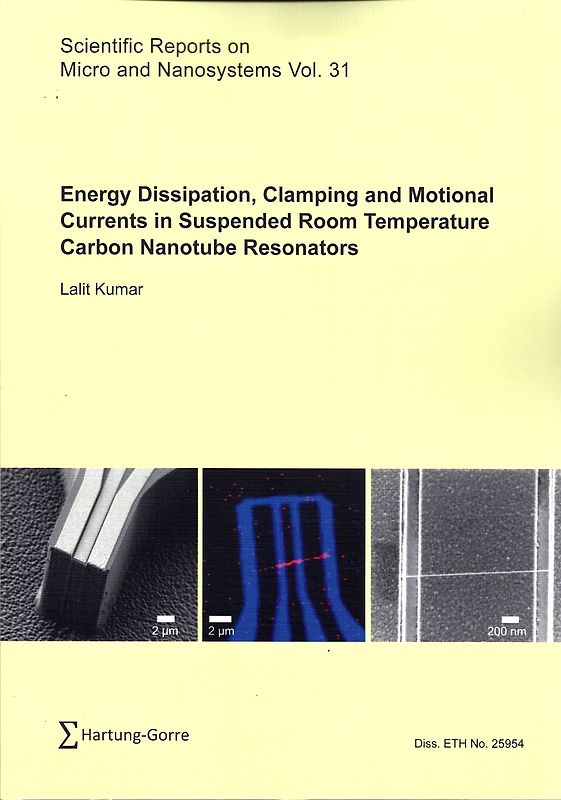
Energy Dissipation, Clamping and Motional Currents in Suspended Room Temperature Carbon Nanotube Resonators
Lalit Kumar (Unbekannter Einband, Englisch)
★★★★★
☆☆☆☆☆ Keine Bewertungen vorhanden
Optischer Zustand
Beschreibung
With continuous downscaling in NEMS based devices such as nanomechan- ical resonators, clamping is argued to be of signi cant importance as it controls two important aspects - mechanical stability and energy dissipa- tion mechanisms. While theoretical work including analytical and atomistic simulations has been reported, the lack of su cient experimental investiga- tions currently limits our… understanding of clamping mechanisms, especially at the nanoscale. This thesis reports on the experimental investigation of clamping e ects performed with an individual suspended carbon nanotube based nanomechanical resonator at room temperature. Non-linear dynamics of resonators were exploited for insights into clamping strength and energy dissipation at room temperature. The research was carried out in collabo- ration with Laura V. Jenni and Miroslav Haluska.
The resonator devices were based on a bottom gate eld e ect transistor based architecture with a designed channel length of 2 μm and a chan- nel gate distance of 270 nm. A selectively pre-characterized individual carbon nanotube was dry-transfered onto the source-drain palladium elec- trodes resulting in a bottom clamped con guration. Subsequent optional top-metallization of contact electrodes with 20 nm platinum using atomic layer deposition was performed to obtain a top-bottom clamped con gu- ration. The clamping between the nanotube and the metal was presum- ably governed by surface interactions such as van der Waals and frictional forces.
The mechanical resonances of suspended carbon nanotubes were character- ized by measuring both conduction modulation current and piezoresistive current. The former was attributed to the gate induced eld e ect while the latter was the result of strain modulation, both being proportional to nanotube motional amplitude. As a result of static displacement, induced by the DC gate bias, mixing of both motional currents at resonance was ob- served. For instance, at a DC gate bias of 1.4 V, 75% of the output current was conduction modulation current. The remaining 25% was piezoresistive current generated from the DC pre-strain of ∼0.0056% in the nanotube. For a 2.1 μm long and 1.8 nm diameter small bandgap semiconducting nanotube, the intermixing of motional currents was used to extract the low strain Gauge factor of ∼1.8.
The mechanical resonances were used to investigate clamping stability of both bottom clamped and top-bottom clamped devices. Under high DC gate bias > 1.5 V, non-linear Du ng response, attributed to large nanotube motional amplitude, was observed for all devices. Continuous operation un- der large DC gate bias resulted in an irreversible downshift in the resonance frequency. The Large motional amplitude of the nanotube initiated slipping which led to the decrease in the nanotube tension, or mechanical stress re- laxation, which was observed as a decrease in the resonance frequency. For a bottom clamped nanotube device with a 2.1 μm suspended length and 2.4 nm diameter clamped on either side onto palladium electrodes, the onset of slipping was observed at a motional amplitude of 7.4 nm at a DC gate bias of 1.1 V. An additional nanotube tension of 70 pN was estimated to over- come the clamping forces to initiate slipping, quantifying the weak nature of clamping strength. The resonance frequencies decreased until saturation was attained. The saturated resonance frequencies were two to three times higher than the fundamental beam mode and were attributed to clamping induced residual strains. Residual strains for both clamping con gurations were estimated in the range of 94-130 pN.
Weak clamping behavior was also assumed to in uence energy dissipation through clamping losses. An already saturated bottom clamped device was subjected to top metallization resulting in two di erent clamping con gura- tions for the same device. Top-bottom clamped device showed an improve- ment in quality factors up to two times and was attributed to the reduction in the non-linear damping. The amplitude dependent non-linear damping was signi cantly observed in bottom clamped devices. The same bottom clamped device, which observed an onset of slipping behavior at ∼ 7.4 nm, exhibited amplitude dependent non-linear damping at a motional amplitude of ∼ 11 nm (and higher). The non-linearity in energy losses and improved quality factors were attributed to possible external dissipation channels as- sociated with clamping, which previously has only been discussed from a phenomenological and mathematical point of view.
The dynamic measurements based on resonance frequency downshift and saturation provides an alternative way for investigation of clamping e ects on both mechanical stability and energy dissipation. The dependency on motional amplitude suggested a signi cant role of surface interactions on the clamped edges with forces in the order of pN. The experimental ndings reported here argues against the assumption of perfect clamping conditions, which are often taken into consideration in various reported experimental and theoretical studies. Such assumptions might explain the discrepancies between the experimental ndings and analytical or simulation based models for nanomechanical resonators. Dieses Produkt haben wir gerade leider nicht auf Lager.
Handgeprüfte Gebrauchtware
Bis zu 50 % günstiger als neu
Der Umwelt zuliebe
Technische Daten
Erscheinungsdatum
05.08.2019
Sprache
Englisch
EAN
9783866286504
Herausgeber
Hartung-Gorre
Serien- oder Bandtitel
Scientific Reports on Micro and Nanosystems
Sonderedition
Nein
Autor
Lalit Kumar
Seitenanzahl
182
Auflage
1
Einbandart
Unbekannter Einband
-.-
★★★★★
☆☆☆☆☆ Leider noch keine Bewertungen
Leider noch keine Bewertungen
Sicher bei rebuy kaufen

Schreib die erste Bewertung für dieses Produkt!
Wenn du eine Bewertung für dieses Produkt schreibst, hilfst du allen Kund:innen, die noch überlegen, ob sie das Produkt kaufen wollen. Vielen Dank, dass du mitmachst!
Sicher bei rebuy kaufen