
iPhoneAlle anzeigen
iPhone 11iPhone 11 ProiPhone 11 Pro MaxiPhone 12iPhone 12 ProiPhone 12 Pro MaxiPhone 12 miniiPhone 13iPhone 13 ProiPhone 13 Pro MaxiPhone 13 miniiPhone 14iPhone 14 PlusiPhone 14 ProiPhone 14 Pro MaxiPhone 15iPhone 15 PlusiPhone 15 ProiPhone 15 Pro MaxiPhone 16iPhone 16 PlusiPhone 16 ProiPhone 16 Pro MaxiPhone 16eiPhone 8iPhone 8 PlusiPhone SE 2020iPhone SE 2022iPhone XiPhone XRiPhone XSiPhone XS Max
Galaxy A-SerieAlle anzeigen
Galaxy A12Galaxy A13Galaxy A13 5GGalaxy A14Galaxy A15Galaxy A16Galaxy A17 5GGalaxy A20eGalaxy A21Galaxy A22Galaxy A23Galaxy A24Galaxy A25Galaxy A26 5GGalaxy A32Galaxy A33Galaxy A34Galaxy A35Galaxy A36 5GGalaxy A40Galaxy A41Galaxy A42Galaxy A50Galaxy A51Galaxy A52Galaxy A53Galaxy A54Galaxy A55Galaxy A56 5GGalaxy A70Galaxy A71Galaxy A72
Redmi SeriesAlle anzeigen
Redmi 10Redmi 13CRedmi 15 5GRedmi Note 10Redmi Note 10 ProRedmi Note 11Redmi Note 11 ProRedmi Note 11 Pro Plus 5GRedmi Note 11sRedmi Note 12Redmi Note 12 5GRedmi Note 12 ProRedmi Note 12 Pro 5GRedmi Note 12 Pro PlusRedmi Note 13Redmi Note 13 5GRedmi Note 13 ProRedmi Note 13 Pro PlusRedmi Note 14Redmi Note 14 Pro PlusRedmi Note 8Redmi Note 8 ProRedmi Note 9Redmi Note 9 Pro
- Startseite
Bücher Englische Bücher Wissen & Bildung Naturwissenschaft, Medizin, Informatik, Technik Chemie Physikalische Chemie Handbook of Chlor-Alkali Technology
Derzeit nicht verfügbar
Handgeprüfte Gebrauchtware
Bis zu 50 % günstiger als neu
Der Umwelt zuliebe
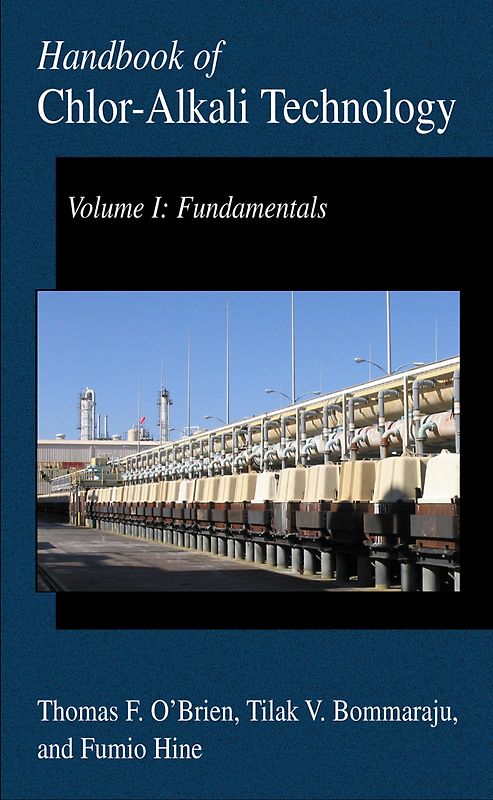
Handbook of Chlor-Alkali Technology
Thomas F. O'Brien, Tilak V. Bommaraju, Fumio Hine (Unbekannter Einband, Englisch)
★★★★★
☆☆☆☆☆ Keine Bewertungen vorhanden
Optischer Zustand
Beschreibung
Foreword:- It is surprising that we had to wait so long for a new book that gives a comprehensive treatment of chlor-alkali manufacturing technology. Technologists are largely still making do with the classical book edited by Sconce, but that is more than thirty years old. At the time of its publication, metal anodes were just beginning to appear, and ion-exchange membrane technology was confined… to laboratories. The various encyclopedias of industrial technology have more up-to-date information, but they are necessarily limited in their scope. Schmittinger recently provided an excellent shorter treatment of the broad field of chlorine technology and applications. After discussing electrolysis and the principal types of cell, this, too, gives rather brief coverage to brine and product processing. It then follows on with descriptions of the major derivatives and direct uses of chlorine and a discussion of environmental issues. The last feature named above has relieved the authors of this work of the obligation to cover applications in any detail. Instead, they provide a concentrated treatment of all aspects of technology and handling directly related to the products of electrolysis. It covers the field from a history of the industry, through the fundamentals of thermodynamics and electrochemistry, to the treatment and disposal of the waste products of manufacture. Membrane cells are considered the state of the art, but the book does not ignore mercury and diaphragm cells. They are considered both from a historical perspective and as examples of current technology that is still evolving and improving. Dear to the heart of a director of Euro Chlor, the book also pays special attention to safe handling of the products, the obligations of Responsible Care®, and process safety management. Other major topics include corrosion, membranes, electrolyzer design, brine preparation and treatment, and the design and operation ofprocessing facilities. Perhaps uniquely, the book also includes a chapter on plant commissioning. The coverage of membranes is both fundamental and applied. The underlying transport processes and practical experience with existing types of membrane both are covered. The same is true of electrolyzer design. The book explores the basic electrode processes and the fundamentals of current distribution in electrolyzers as well as the characteristics of the leading cell designs. The authors have chosen to treat the critical subject of brine treatment in two separate chapters. The chapter on brine production and treatment first covers the sources of salt and the techniques used to prepare brine. It then explains the mechanisms by which brine impurities affect cell performance and outlines the processes by which they can be removed or controlled. While pointing out the lack of fundamental science in much of the process, it describes the various unit operations phenomenologically and discusses methods for sizing equipment and choosing materials of construction. The chapter on processing and handling of products is similarly comprehensive. Again, it is good to see that the authors have included a lengthy discussion of safe methods and facilities for the handling of the products, particularly liquid chlorine. While the discussion of the various processing steps includes the topic of process control, there is also a separate chapter on instrumentation which is more hardware-oriented. Other chapters deal with utility systems, cell room design and arrangement (with an emphasis on direct current supply), alternative processes for the production of either chlorine or caustic without the other, the production of hypochlorite, industrial hygiene, and speculations on future developments in technology. There is an Appendix with selected physical property data. The authors individually have extensive experience in chlor-alkali technology but with diverse backgrounds and fields of specialization. This allows them to achieve both the breadth and the depth which are offered here. The work is divided into five volumes, successively treating fundamentals, brine preparation and treatment, production technology, support systems such as utilities and instrumentation, and ancillary topics. Anyone with interest in the large field of chlor-alkali manufacture and distribution, and indeed in industrial electrochemistry in general, will find something useful here. The work is recommended to students; chlor-alkali technologists; electrochemists; engineers; and producers, shippers, packagers, distributors, and consumers of chlorine, caustic soda, and caustic potash. This book is thoroughly up to date and should become the standard reference in its field. Barrie S. Gilliatt, Executive Director, Euro Chlor Dieses Produkt haben wir gerade leider nicht auf Lager.
Handgeprüfte Gebrauchtware
Bis zu 50 % günstiger als neu
Der Umwelt zuliebe
Technische Daten
Erscheinungsdatum
31.08.2005
Sprache
Englisch
EAN
9780306486234
Herausgeber
Springer US
Sonderedition
Nein
Autor
Thomas F. O'Brien, Tilak V. Bommaraju, Fumio Hine
Seitenanzahl
1580
Einbandart
Unbekannter Einband
Buch Untertitel
Volume I: Fundamentals, Volume II: Brine Treatment and Cell Operation, Volume III: Facility Design and Product Handling, Volume IV: Operations, Volume V: Corrosion, Environmental Issues, and Future Developments
Anzahl Bücher
5
Schlagwörter
Brine treatment, Cell operation in electrolysis, Caustic soda, Ion-exchange membrane, Brine preparation
Thema-Inhalt
PNRH - Elektrochemie und Magnetochemie
PNR - Physikalische Chemie
PNK - Anorganische Chemie
TDC - Industrielle Chemie und Chemietechnologie
Höhe
254 mm
Breite
17.8 cm
Hersteller: Humana, Europaplatz 3, Heidelberg, Deutschland, 69115, ProductSafety@springernature.com, Springer Nature Customer Service Center GmbH
-.-
★★★★★
☆☆☆☆☆ Leider noch keine Bewertungen
Leider noch keine Bewertungen
Sicher bei rebuy kaufen

Schreib die erste Bewertung für dieses Produkt!
Wenn du eine Bewertung für dieses Produkt schreibst, hilfst du allen Kund:innen, die noch überlegen, ob sie das Produkt kaufen wollen. Vielen Dank, dass du mitmachst!
Sicher bei rebuy kaufen