
Derzeit nicht verfügbar
Handgeprüfte Gebrauchtware
Bis zu 50 % günstiger als neu
Der Umwelt zuliebe
Optischer Zustand
Beschreibung
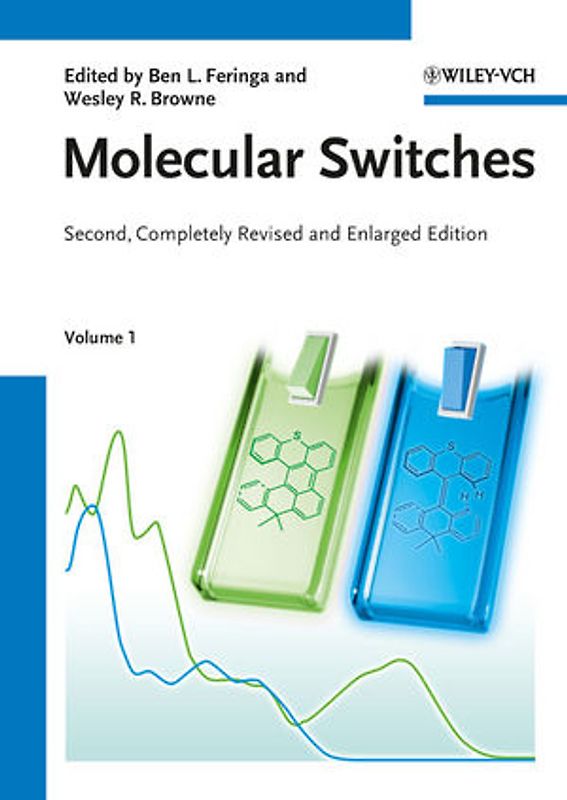
The long-awaited second edition of the successful book covering molecular switches now in two volumes!
Providing principles and applications this book brings you everything you need to know about molecular switches - a hot topic in the nanoworld. The major classes of molecular switches including catenanes, rotaxanes, azobenzenes together with polymer and biomolecular switching systems and DNA Dieses Produkt haben wir gerade leider nicht auf Lager.
Handgeprüfte Gebrauchtware
Bis zu 50 % günstiger als neu
Der Umwelt zuliebe
Technische Daten
Erscheinungsdatum
15.06.2011
Sprache
Englisch
EAN
9783527634422
Herausgeber
Wiley-VCH
Sonderedition
Nein
Seitenanzahl
792
Auflage
2
Einbandart
Unbekannter Einband
Einbandart Details
E107
Autorenporträt
Ben L. Feringa is the Distinguished Jacobus Van't Hoff Professor of Organic Chemistry at the University of Groningen, where he is also the director of the Stratingh Institute for Chemistry. His research career spans four decades and covers topics as diverse as materials science, total synthesis, homogeneous catalysis and of course molecular photochemistry with chirality as the core guiding theme in his research career which includes over 500 scientific papers published to date. For his contributions to research he has received numerous awards including the Spinoza award of the Netherlands Organization for Scientific research and the ACS Norrish Award and is a member of the Royal Netherlands Academy of Sciences and Honorary Foreign member of the National Academy of Sciences (USA). He was appointed recently as an Academy Professor of the Royal Netherlands Academy of Sciences.
Wesley R. Browne is Assistant Professor of Molecular Systems & Interfaces at the University of Groningen. He completed his undergraduate and doctoral studies (under Prof. Han Vos) at Dublin City University, Ireland in 2002 for which he was awarded the Prize for Young Chemists by the Royal Irish Academy, before taking up a postdoctoral position first in Queens University Belfast (NI, under Prof. John McGarvey) and then at the University of Groningen. In 2007 he was awarded a VIDI fellowship from the Netherlands Organization for Scientific research and in 2008 was appointed to his present position as Assistant Professor. His research interests are diverse and include electrochemistry and Raman spectroscopy applied to both studying mechanisms in oxidation catalysis and to the photochemistry of molecular materials and polymers. He has published over 70 research papers to date.
Anzahl Bücher
2
Schlagwörter
Biochemie u. Chemische Biologie, Biochemistry (Chemical Biology), Chemie, Chemie / Organische Chemie, Chemistry, Electrochemistry, Elektrochemie, Nanomaterialien, Nanomaterials, Nanotechnologie, Nanotechnology, Organic Chemistry, Organische Chemie, Physical Chemistry, Physikalische Chemie, Polymer Science & Technology, Polymerwissenschaft u. -technologie, Schalter
Thema-Inhalt
PNN - Organische Chemie
Inhaltsverzeichnis
VOLUME ONE
PART I: Molecular Switching
MULTIFUNCTIONAL DIARYLETHENES
Introduction
Electrochemical Ring-Closing and Ring-Opening of DTEs
Using Dithienylethenes to Modulate How Chemicals React or Interact with Others
Gated Photochromism
Reactivity-Gated Photochromism Using the Functional Group Effect
Conclusion
PHOTOSWITCHABLE MOLECULAR SYSTEMS BASED ON SPIROPYRANS AND SPIROOXAZINES
Introduction
Mechanism of the Photochromic Reaction
Switching of Physical Properties and Biological Activities via Photochromic Rearrangements of Functionalized Spiropyrans and Spirooxazines
Spiropyrans and Spirooxazines as Photodynamic Sensors for Metal Ions
Modulation of the Intramolecular Energy-Transfer Processes in SP/SPO-Containing Transition-Metal Complexes
Spiropyran-Containing Photoresponsive Polymers
Spiropyran/Spirooxazine-Containing Biphotochromic Systems
Concluding Remarks
FULGIDES AND RELATED COMPOUNDS
Introduction - Fulgides
Review Dealing with Fulgides
Introduction of New Fulgides towards Molecular Switches
Photophysics of Molecular Switches
Towards Optical Recording
Understanding of Molecular Structures from Calculations
Development of Photochromic Switches Closely Related to Fulgides
Perspectives of Research with Fulgides
TRANSITION METAL-COMPLEXED CATENANES AND ROTAXANES AS MOLECULAR MACHINE PROTOTYPES
Introduction
Copper-Complexed [2]Catenanes in Motion: The Archetypes
Fighting the Kinetic Inertness of the First Copper-Based Machines; Fast-Moving Pirouetting Rotaxanes
Molecular Motions Driven by Chemical Reactions - Use of a Chemical Reaction to Induce the Concentration/Stretching Process of a Muscle-Like Rotaxane Dimer
Electrochemically Controlled Intramolecular Motion within a Heterodinuclear Bismacrocycle Transition-Metal Complex
Ru(III)-Complexes as Light-Driven Molecular Machine Prototypes
Conclusion and Prospective
CHIROPTICAL MOLECULAR SWITCHES
Introduction
Molecular Switching
Chiral Fulgides
Light-Driven Molecular Rotary Motors
Liquid Crystals
Gels
Conclusions and Perspectives
MULTISTATE/MULTIFUNCTIONAL MOLECULAR-LEVEL SYSTEMS: PHOTOCHROMIC FLAVYLIUM COMPOUNDS
Introduction
Energy Stimulation
Photochromic Systems
Bistable and Multistable Systems
Nature of the Species Involved in the Chemistry of Flavylium Compounds
Thermal Reactions of the 4'-Methoxyflavylium Ion
Flavylium Ions with OH Substituents
Flavylium Ions with Other Substituents
Energy-Level Diagrams
Chemical Process Networks
Conclusions
NUCLEIC-ACID-BASED SWITCHES
Molecular Switches Made from DNA and RNA
Switchable Ribozymes
Regulatory RNA Molecules
Sensor Applications
DNA Computing
DNA Machines
Switchable Molecular Networks and Materials
Conclusion and Outlook
PART II: Switching in Containers, Polymers and Channels
SWITCHING PROCESSES IN CAVITANDS, CONTAINERS AND CAPUSLES
Introduction
Switchable Covalently Constructed Cavitands and Container Molecules
H-Bonded Molecular Capsules
Assembly and Disassembly of Metal-Ion-Coordination Cages
Conclusions
CYCLODEXTRIN-BASED SWITCHES
Introduction
In and Out Switching
Back and Forth Switching
Displacement Switching
Coordination Switching
Rearrangement Switching
Conclusion and Perspective
PHOTOSWITCHABLE POLYPEPTIDES
Photoresponsive Polypeptides
Light-Induced Conformational Transitions
Photostimulated Aggregation-Disaggregation Effects
Photoeffects in Molecular and Thin Films
Photoresponsive Polypeptide Membranes
Summary and Recent Developments
Towards More Complex Biorelated Photoswitchable Polypeptides
ION TRANSLOCATION WITHIN MULTISITE RECEPTORS
Introduction
Metal-Ion Translocation: Changing Metal's Oxidation State
Metal-Ion Translocation: Changing through a pH Variation the Coordinating Properties of One Receptor's Compartment
The Simultaneous Translocation of Two Metal Ions
Redox-Driven Anion Translocation
Anion Swapping in a Heteroditopic Receptor, Driven by a Concentration Gradient
Conclusions and Perspectives: Further Types of Molecular Machines?
VOLUME TWO
OPTICALLY INDUCED PROCESSES IN AZOPOLYMERS
Int
-.-
Leider noch keine Bewertungen
Leider noch keine Bewertungen
Sicher bei rebuy kaufen

Schreib die erste Bewertung für dieses Produkt!
Wenn du eine Bewertung für dieses Produkt schreibst, hilfst du allen Kund:innen, die noch überlegen, ob sie das Produkt kaufen wollen. Vielen Dank, dass du mitmachst!
Sicher bei rebuy kaufen