
iPhoneAlle anzeigen
iPhone 11iPhone 11 ProiPhone 11 Pro MaxiPhone 12iPhone 12 ProiPhone 12 Pro MaxiPhone 12 miniiPhone 13iPhone 13 ProiPhone 13 Pro MaxiPhone 13 miniiPhone 14iPhone 14 PlusiPhone 14 ProiPhone 14 Pro MaxiPhone 15iPhone 15 PlusiPhone 15 ProiPhone 15 Pro MaxiPhone 16iPhone 16 PlusiPhone 16 ProiPhone 16 Pro MaxiPhone 16eiPhone 8iPhone 8 PlusiPhone SE 2020iPhone SE 2022iPhone XiPhone XRiPhone XSiPhone XS Max
Galaxy A-SerieAlle anzeigen
Galaxy A12Galaxy A13Galaxy A13 5GGalaxy A14Galaxy A15Galaxy A16Galaxy A17 5GGalaxy A20eGalaxy A21Galaxy A22Galaxy A23Galaxy A24Galaxy A25Galaxy A26 5GGalaxy A32Galaxy A33Galaxy A34Galaxy A35Galaxy A36 5GGalaxy A40Galaxy A41Galaxy A42Galaxy A50Galaxy A51Galaxy A52Galaxy A53Galaxy A54Galaxy A55Galaxy A56 5GGalaxy A70Galaxy A71Galaxy A72
Redmi SeriesAlle anzeigen
Redmi 10Redmi 13CRedmi 15 5GRedmi Note 10Redmi Note 10 ProRedmi Note 11Redmi Note 11 ProRedmi Note 11 Pro Plus 5GRedmi Note 11sRedmi Note 12Redmi Note 12 5GRedmi Note 12 ProRedmi Note 12 Pro 5GRedmi Note 12 Pro PlusRedmi Note 13Redmi Note 13 5GRedmi Note 13 ProRedmi Note 13 Pro PlusRedmi Note 14Redmi Note 14 Pro PlusRedmi Note 8Redmi Note 8 ProRedmi Note 9Redmi Note 9 Pro
- Startseite
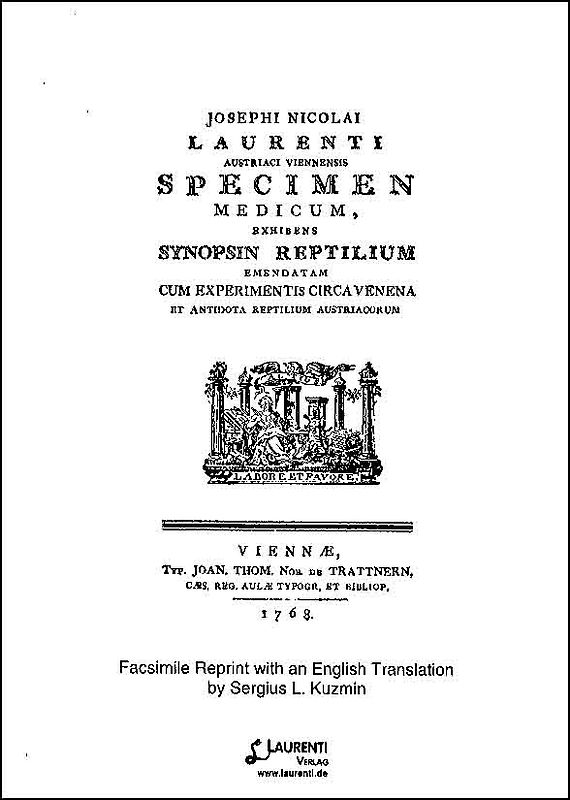
Bücher Englische Bücher Wissen & Bildung Naturwissenschaft, Medizin, Informatik, Technik Biologie Zoologie Specimen Medicum, Exhibens Synopsin Reptilium Emendatam cum Experimentis Circa Venena et Antidota Reptilium Austriacorum
Derzeit nicht verfügbar
Handgeprüfte Gebrauchtware
Bis zu 50 % günstiger als neu
Der Umwelt zuliebe
Specimen Medicum, Exhibens Synopsin Reptilium Emendatam cum Experimentis Circa Venena et Antidota Reptilium Austriacorum
Joseph N Laurenti (Unbekannter Einband, Englisch, Latein)
★★★★★
☆☆☆☆☆ Keine Bewertungen vorhanden
Optischer Zustand
Beschreibung
In modern biology and medecine, particularly when molecular genetics is involved, the results of current research have an extremely short half-life period, i. e. they get increasingly rapidly out of date. This was to some degree certainly also true already for the experimental medical and physiological aspects of Josephus Nicolaus Laurenti's doctoral dissertation in 1768 which was fully entitled… „Specimen medicum, exhibens synopsin reptilium emendatam cum experimentis circa venena et antidota reptilium austri-acorum“. I am pretty sure that the medical importance of this work was rather shortly out of date also at that time, and the reader today might feel happy about the modern standards of medecine, including treatments of envenomations caused by reptile spe-cies (although in the former Austrian empire as well as in today Austria Vipera ammo-dytes would be the only harmful member of this group).
One must, however, recall that in the second half of the 18th century the knowl-edge about animals and their biology was in many aspects still rudimentary. A famous „Natural history“ which appeared 10 years after Laurenti's work still grouped arma-dillos with tortoises and not with mammals, and 70 years after Laurenti, the famous „father“ of hormonal research, Adolph Arnold Berthold started experiments on the ability of amphibians to survive in 37 °C warm water without air-breathing possibility, in order to find out whether the numerous reports of that time on living amphibians coming out of the stomachs and mouths of humans (particularly of young women) were compatible with experimental results: „Ueber den Aufenthalt lebender Am-phibien im Menschen“. 1849). It is important to note that this level of serious re-search is just 150 years ago!
So, it is obviously not the meaning of Laurenti's „Specimen medicum" itself which at-tracts a broad, general interest today (i. e. an interest exceeding pure historical as-pects). Rather, it is the aspect of his „Synopsis reptilium“ which means the first, non-medical part of his work, the zoological classification of the „reptiles“ (i. e. including modern amphibians) known to him at that time. This classification stands in the tradi-tion of the pioneer of biological classifaction and nomenclature, Carolus Linnaeus, whose 10th edition of his famous „Systema Naturae“ (1758) is still marking the year zero for modern biosystematics. But in contrast to Linnaeus, Laurenti distinguished already 30 different genera, and of his seven newly described amphibian and twelve reptiles species from „circum Viennam“, seven respectively six taxa are still consid-ered valid today.
And it is just this last aspect of systematic validity of described taxa that makes the old classic works in zoology (or herpetology, as Laurenti's book dealt with here) so long-living. Any systematist in herpetology has to deal with any available name relevant for his group under study before he may think about the creation of new names. That's why a 250 years old reference is still unrenouncable for current re-search.
It is therefore most meritious of Burkhard Thiesmeier to undertake the risk of reprinting this classical work, the more as his Publishing House received its name from the important old researcher. And it is pleasing for me that just the original copy of the herpetological library of Museum Koenig in Bonn could be used to produce the present facsimile reprint.
However, one problem complicates things. Latin, the international scientific lan-guage of Laurenti's time which he naturally used also for his dissertation, is regarded today a „dead language“ and consequently becoming more and more extinct among students. Due to this circumstance – one may regret it or not – Burkhard Thiesmeier decided to publish a bilingual edition, the Latin original being opposed – page by page – by an English translation. The Latin translation was prepared by his friend and col-league Sergius Kuzmin who is well known and reputed also for historical herpetologi-cal topics. To make it even a bit more complicated, Kuzmin first translated the Latin original into Russian and then re-translated the latter into English. But these efforts were actually worth while. Publisher and translator may be proud to present the fac-simile reprint of an old, classical work to the scientific public which they make thus available again. And because of the simultaneous translation into English, they make it at the same time also accessible. I am sure this will be highly appreciated by a large number of readers who will also like to own this important work.
Bonn, February 2005 Prof. Dr. Wolfgang Böhme Dieses Produkt haben wir gerade leider nicht auf Lager.
Handgeprüfte Gebrauchtware
Bis zu 50 % günstiger als neu
Der Umwelt zuliebe
Technische Daten
Erscheinungsdatum
01.06.2005
Sprache
Englisch, Latein
EAN
9783933066244
Herausgeber
Laurenti
Serien- oder Bandtitel
Zeitschrift f. Feldherpetologie - Supplemente
Sonderedition
Nein
Autor
Joseph N Laurenti
Seitenanzahl
246
Einbandart
Unbekannter Einband
Buch Untertitel
Medical Treatise, Exhibiting an Emended Synopsis of Reptiles, with Experiments Concerning Venoms and Antidotes for Austrian Reptiles
-.-
★★★★★
☆☆☆☆☆ Leider noch keine Bewertungen
Leider noch keine Bewertungen
Sicher bei rebuy kaufen

Schreib die erste Bewertung für dieses Produkt!
Wenn du eine Bewertung für dieses Produkt schreibst, hilfst du allen Kund:innen, die noch überlegen, ob sie das Produkt kaufen wollen. Vielen Dank, dass du mitmachst!
Sicher bei rebuy kaufen