
iPhoneAlle anzeigen
iPhone 11iPhone 11 ProiPhone 11 Pro MaxiPhone 12iPhone 12 ProiPhone 12 Pro MaxiPhone 12 miniiPhone 13iPhone 13 ProiPhone 13 Pro MaxiPhone 13 miniiPhone 14iPhone 14 PlusiPhone 14 ProiPhone 14 Pro MaxiPhone 15iPhone 15 PlusiPhone 15 ProiPhone 15 Pro MaxiPhone 16iPhone 16 PlusiPhone 16 ProiPhone 16 Pro MaxiPhone 16eiPhone 8iPhone 8 PlusiPhone SE 2020iPhone SE 2022iPhone XiPhone XRiPhone XSiPhone XS Max
Galaxy A-SerieAlle anzeigen
Galaxy A12Galaxy A13Galaxy A13 5GGalaxy A14Galaxy A15Galaxy A16Galaxy A17 5GGalaxy A20eGalaxy A21Galaxy A22Galaxy A23Galaxy A24Galaxy A25Galaxy A26 5GGalaxy A32Galaxy A33Galaxy A34Galaxy A35Galaxy A36 5GGalaxy A40Galaxy A41Galaxy A42Galaxy A50Galaxy A51Galaxy A52Galaxy A53Galaxy A54Galaxy A55Galaxy A56 5GGalaxy A70Galaxy A71Galaxy A72
Redmi SeriesAlle anzeigen
Redmi 10Redmi 13CRedmi 15 5GRedmi Note 10Redmi Note 10 ProRedmi Note 11Redmi Note 11 ProRedmi Note 11 Pro Plus 5GRedmi Note 11sRedmi Note 12Redmi Note 12 5GRedmi Note 12 ProRedmi Note 12 Pro 5GRedmi Note 12 Pro PlusRedmi Note 13Redmi Note 13 5GRedmi Note 13 ProRedmi Note 13 Pro PlusRedmi Note 14Redmi Note 14 Pro PlusRedmi Note 8Redmi Note 8 ProRedmi Note 9Redmi Note 9 Pro
- Startseite
Bücher Englische Bücher Wissen & Bildung Naturwissenschaft, Medizin, Informatik, Technik Physik & Astronomie Elektrizität, Magnetismus, Optik High-Precision Frequency Comparisons and Searches for New Physics with Yb+ Optical Clocks
Derzeit nicht verfügbar
Handgeprüfte Gebrauchtware
Bis zu 50 % günstiger als neu
Der Umwelt zuliebe
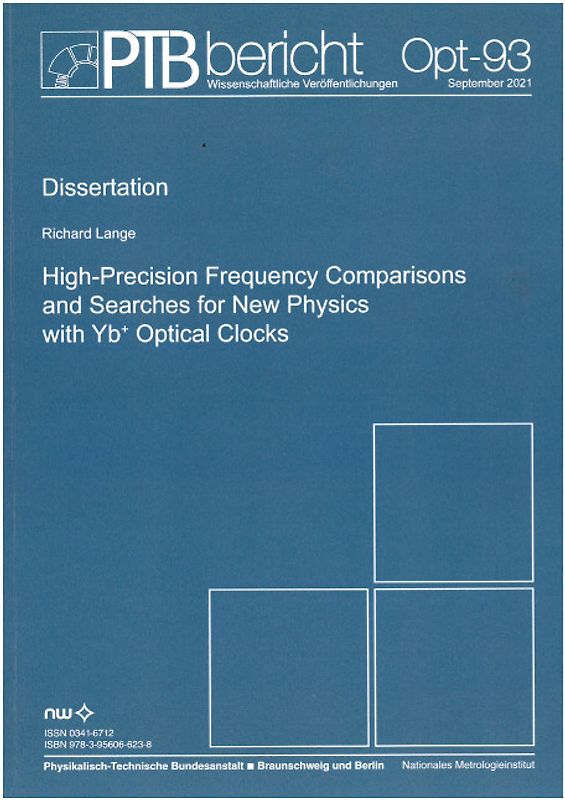
High-Precision Frequency Comparisons and Searches for New Physics with Yb+ Optical Clocks
Richard Lange (Broschiert, Englisch)
★★★★★
☆☆☆☆☆ Keine Bewertungen vorhanden
Optischer Zustand
Beschreibung
State-of-the-art optical atomic clocks are based on laser-cooled trapped atoms or
ions featuring forbidden transitions. A laser with sub-Hertz linewidth is frequency
stabilized to such a transition, which permits frequency measurements with relative
systematic uncertainties in the low 10-18 range. The performance of optical atomic
clocks is continuously improved by more efficient detection and… suppression of external perturbations that cause shifts of the atomic transition frequency, and by
enhancing the coherent interaction between atom and laser oscillator.
In this thesis, advances of the 171Yb+ single-ion optical clocks at the national
metrology institute of Germany (PTB) are reported, realizing the frequencies of both
an electric quadrupole (E2) and an electric octupole (E3) transition. Two Yb+(E3)
clocks are compared and an agreement within their combined fractional uncertainty
of 4.2×10⁻¹⁸ is found. An analysis of the data for potential frequency oscillations improves the limits on Lorentz violating parameters for electrons by about two orders of
magnitude. A long-term comparison of the E3/E2 transition frequency ratio tightens
the limit on potential temporal variations of the fine structure constant α by about
a factor of 20 to (1/α)(dα/ dt) = 1.0(1.1) × 10−18/yr. Comparisons of an Yb+(E3)
clock and two caesium fountain clocks yields νE3 = 642 121 496 772 645.10(8) Hz, the
most accurate determination of an optical transition frequency to date.
Relevant atomic parameters of the E3 transition are investigated in more detail:
From the transition strength and laser intensity, the excited state natural lifetime
is determined as 1.58(7) years. For a characterization of the light shift of the E3
transition, the zero-crossing point of the scalar differential polarizability is measured
at 681.2(5) nm, which is called a magic wavelength. Precision measurements of the
electric quadrupole moments of the excited states of both the E2 and E3 transition,
Θ(2D3/2) = 1.95(1)ea20
and Θ(2F7/2) = −0.0297(5)ea20, with e the elementary
charge and a0 the Bohr radius, indicate the different electronic structure of the
excited states and the different sensitivities of the two transitions to shifts induced
by electric field gradients.
The characterization of an advanced single-ion Yb+ trap system employing goldcoated endcap electrodes is presented. A reduction of the ion motional heating rate
by a factor of 25 compared to previous trap versions is obtained, facilitating longer
interaction times between ion and laser. First frequency comparisons to the other
Yb+ clocks at PTB yield agreements at the low 10−17 level, presumably limited by
photoelectric stray fields.
Novel interrogation methods for the control or suppression of specific frequency
shifts are discussed: A coherent suppression scheme for tensorial frequency shifts is
introduced, relying on a rotation of the magnetic field vector during the dark time of a
Ramsey sequence, and a suppression of the electric quadrupole shift by a factor of 260
is demonstrated. Autobalanced Ramsey spectroscopy is presented that provides universal immunity to frequency shifts related to aberrations of the pulses in a Ramsey
sequence. Finally, excitation of an E3 transition using twisted light, i.e. with the ion
placed in the dark center of a Laguerre-Gaussian beam featuring orbital angular momentum, is demonstrated for the first time, permitting a reduction of the light shift. Dieses Produkt haben wir gerade leider nicht auf Lager.
Handgeprüfte Gebrauchtware
Bis zu 50 % günstiger als neu
Der Umwelt zuliebe
Technische Daten
Erscheinungsdatum
07.10.2021
Sprache
Englisch
EAN
9783956066238
Herausgeber
Fachverlag NW in Carl Ed. Schünemann KG
Serien- oder Bandtitel
PTB-Berichte. Optik (Opt)
Sonderedition
Nein
Autor
Richard Lange
Seitenanzahl
166
Auflage
1
Einbandart
Broschiert
-.-
★★★★★
☆☆☆☆☆ Leider noch keine Bewertungen
Leider noch keine Bewertungen
Sicher bei rebuy kaufen

Schreib die erste Bewertung für dieses Produkt!
Wenn du eine Bewertung für dieses Produkt schreibst, hilfst du allen Kund:innen, die noch überlegen, ob sie das Produkt kaufen wollen. Vielen Dank, dass du mitmachst!
Sicher bei rebuy kaufen