
iPhoneAlle anzeigen
iPhone 11iPhone 11 ProiPhone 11 Pro MaxiPhone 12iPhone 12 ProiPhone 12 Pro MaxiPhone 12 miniiPhone 13iPhone 13 ProiPhone 13 Pro MaxiPhone 13 miniiPhone 14iPhone 14 PlusiPhone 14 ProiPhone 14 Pro MaxiPhone 15iPhone 15 PlusiPhone 15 ProiPhone 15 Pro MaxiPhone 16iPhone 16 PlusiPhone 16 ProiPhone 16 Pro MaxiPhone 16eiPhone 8iPhone 8 PlusiPhone SE 2020iPhone SE 2022iPhone XiPhone XRiPhone XSiPhone XS Max
Galaxy A-SerieAlle anzeigen
Galaxy A12Galaxy A13Galaxy A13 5GGalaxy A14Galaxy A15Galaxy A16Galaxy A17 5GGalaxy A20eGalaxy A21Galaxy A22Galaxy A23Galaxy A24Galaxy A25Galaxy A26 5GGalaxy A32Galaxy A33Galaxy A34Galaxy A35Galaxy A36 5GGalaxy A40Galaxy A41Galaxy A42Galaxy A50Galaxy A51Galaxy A52Galaxy A53Galaxy A54Galaxy A55Galaxy A56 5GGalaxy A70Galaxy A71Galaxy A72
Redmi SeriesAlle anzeigen
Redmi 10Redmi 13CRedmi 15 5GRedmi Note 10Redmi Note 10 ProRedmi Note 11Redmi Note 11 ProRedmi Note 11 Pro Plus 5GRedmi Note 11sRedmi Note 12Redmi Note 12 5GRedmi Note 12 ProRedmi Note 12 Pro 5GRedmi Note 12 Pro PlusRedmi Note 13Redmi Note 13 5GRedmi Note 13 ProRedmi Note 13 Pro PlusRedmi Note 14Redmi Note 14 Pro PlusRedmi Note 8Redmi Note 8 ProRedmi Note 9Redmi Note 9 Pro
- Startseite
Bücher Englische Bücher Wissen & Bildung Naturwissenschaft, Medizin, Informatik, Technik Physik & Astronomie Atomphysik & Kernphysik Investigation into the feasibility of a DNA based radiosensitve device
Derzeit nicht verfügbar
Handgeprüfte Gebrauchtware
Bis zu 50 % günstiger als neu
Der Umwelt zuliebe
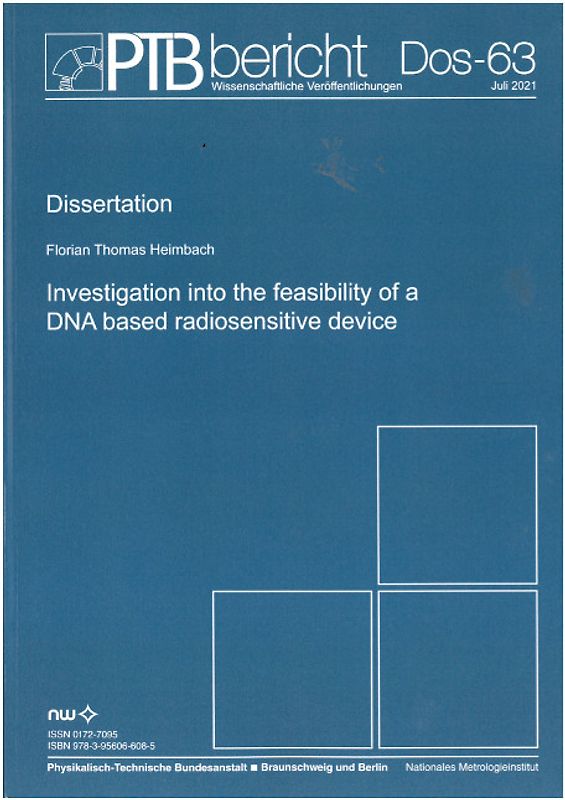
Investigation into the feasibility of a DNA based radiosensitve device
Florian Thomas Heimbach (Broschiert, Englisch)
★★★★★
☆☆☆☆☆ Keine Bewertungen vorhanden
Optischer Zustand
Beschreibung
In this work, the application of deoxyribonucleic acid (DNA) as a radiosensitive detector material is investigated. The aim is to bridge a measurable physical quantity
with the severity of radiation damages on the biochemical stage. Radiation damages,
which are expressed in alterations of the molecular structure of the DNA, can influence the charge transport properties of the molecule. The… electrical conductivity is
therefore a measure for the magnitude of the radiation damage.
DNA samples consist of a substrate material with gold electrodes of nano- or microscale dimensions and of DNA molecules contacted between these electrodes. Experiments were performed with two types of DNA samples. λ-DNA molecules of several micrometer length suspended in air and single DNA origami structures trapped
via dielectrophoresis.
λ-DNA samples were provided by San Diego State University. The samples are
expected to have non-uniform conductivity values, due to differences in number
and alignment of the DNA strands. Therefore, an exact quantitative analysis of
the radiation effects might not be possible. Nevertheless, the effects of different
radiation qualities were studied on these samples. Changes of conductivity were
monitored in situ during irradiation. The experiments showed that the conductivity
of DNA is indeed sensitive to radiation. For the application as a detector material,
a quantitative relation between the amount of DNA damage and the change in
conductivity needs to be established.
Single DNA origami structures can be electrically contacted using dielectrophoretic
trapping. Experiments were carried out to investigate whether samples can be produced which retain ohmic conductivity in dry conditions. This investigation was accompanied by molecular dynamics simulations of microhydrated, multilayered DNA
molecules. These can give insight under which conditions the DNA molecules keep
their regular helical structures. It was found that tightly packed multilayered structures were indeed much more stable than individual or loosely packed strands. However, stable helical structures as in the case of fully hydrated states, were still only
achieved for very high hydration levels in the simulation. To further increase the
resilience of the DNA origami structures, they were covered with a layer of poly-Llysine (PLL). It has been shown in studies that PLL coatings stabilize DNA origami
structures against buffers of low salt concentrations. Experiments with these samples showed ohmic conductivity in dry conditions. The measured resistance values
were in the range of several megaohm. A frequently observed phenomenon was
the local destruction of the substrate material and electrodes after DEP trapping.
The destruction was the result of high electrical currents. This indicates that the
DNA origami structures can possess even higher values of electrical conductivity.
Therefore, experiments with current limitation during DEP trapping should be the
subject of future experiments. The subsequent step would be to test the influence
of different radiation qualities and doses on the conductivity of these samples. Dieses Produkt haben wir gerade leider nicht auf Lager.
Handgeprüfte Gebrauchtware
Bis zu 50 % günstiger als neu
Der Umwelt zuliebe
Technische Daten
Erscheinungsdatum
14.10.2021
Sprache
Englisch
EAN
9783956066085
Herausgeber
Fachverlag NW in Carl Ed. Schünemann KG
Serien- oder Bandtitel
PTB-Berichte. Dosimetrie (DOS)
Sonderedition
Nein
Autor
Florian Thomas Heimbach
Seitenanzahl
144
Auflage
1
Einbandart
Broschiert
-.-
★★★★★
☆☆☆☆☆ Leider noch keine Bewertungen
Leider noch keine Bewertungen
Sicher bei rebuy kaufen

Schreib die erste Bewertung für dieses Produkt!
Wenn du eine Bewertung für dieses Produkt schreibst, hilfst du allen Kund:innen, die noch überlegen, ob sie das Produkt kaufen wollen. Vielen Dank, dass du mitmachst!
Sicher bei rebuy kaufen