
iPhoneAlle anzeigen
iPhone 11iPhone 11 ProiPhone 11 Pro MaxiPhone 12iPhone 12 ProiPhone 12 Pro MaxiPhone 12 miniiPhone 13iPhone 13 ProiPhone 13 Pro MaxiPhone 13 miniiPhone 14iPhone 14 PlusiPhone 14 ProiPhone 14 Pro MaxiPhone 15iPhone 15 PlusiPhone 15 ProiPhone 15 Pro MaxiPhone 16iPhone 16 PlusiPhone 16 ProiPhone 16 Pro MaxiPhone 16eiPhone 8iPhone 8 PlusiPhone SE 2020iPhone SE 2022iPhone XiPhone XRiPhone XSiPhone XS Max
Galaxy A-SerieAlle anzeigen
Galaxy A12Galaxy A13Galaxy A13 5GGalaxy A14Galaxy A15Galaxy A16Galaxy A17 5GGalaxy A20eGalaxy A21Galaxy A22Galaxy A23Galaxy A24Galaxy A25Galaxy A26 5GGalaxy A32Galaxy A33Galaxy A34Galaxy A35Galaxy A36 5GGalaxy A40Galaxy A41Galaxy A42Galaxy A50Galaxy A51Galaxy A52Galaxy A53Galaxy A54Galaxy A55Galaxy A56 5GGalaxy A70Galaxy A71Galaxy A72
Redmi SeriesAlle anzeigen
Redmi 10Redmi 13CRedmi 15 5GRedmi Note 10Redmi Note 10 ProRedmi Note 11Redmi Note 11 ProRedmi Note 11 Pro Plus 5GRedmi Note 11sRedmi Note 12Redmi Note 12 5GRedmi Note 12 ProRedmi Note 12 Pro 5GRedmi Note 12 Pro PlusRedmi Note 13Redmi Note 13 5GRedmi Note 13 ProRedmi Note 13 Pro PlusRedmi Note 14Redmi Note 14 Pro PlusRedmi Note 8Redmi Note 8 ProRedmi Note 9Redmi Note 9 Pro
- Startseite
Bücher Englische Bücher Wissen & Bildung Naturwissenschaft, Medizin, Informatik, Technik Chemie Physikalische Chemie Rational Design of Purely Peptidic Amphiphiles for Drug Delivery Applications
Derzeit nicht verfügbar
Handgeprüfte Gebrauchtware
Bis zu 50 % günstiger als neu
Der Umwelt zuliebe
Rational Design of Purely Peptidic Amphiphiles for Drug Delivery Applications
Dirk de Bruyn Ouboter (Unbekannter Einband, Englisch)
★★★★★
☆☆☆☆☆ Keine Bewertungen vorhanden
Optischer Zustand
Beschreibung
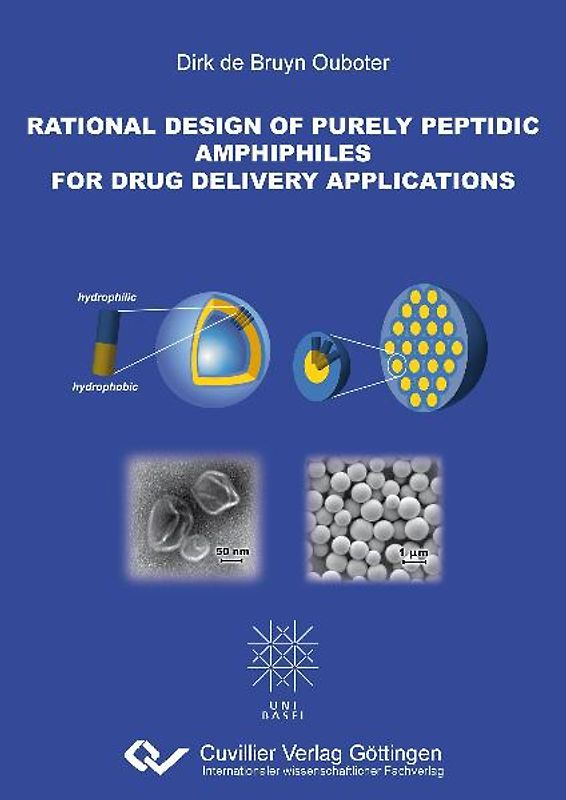
A broad range of new properties is emerging from supramolecular aggregates. Self-assembled structures of purely peptidic amphiphiles exploit these properties to produce biocompatible, biodegradable, smart materials for drug administration. This thesis explores the design, synthesis, purification, characterization of purely peptidic amphiphiles, and the evaluation of potential applications.
The… first chapter provides a general introduction to the field of self-assembly and drug delivery as compared to nature’s delivery mechanisms. Further, the advantage of amino acid based molecules in producing smart materials for drug delivery applications is highlighted via biocompatibility and biodegradability considerations. Next, synthetic strategies and purification methods are discussed. Finally gramicidin A (gA) – a naturally occurring, short, hydrophobic, membrane-integrating peptide used to produce the amphiphilic peptides presented here – is introduced.
Chapter two presents an initial approach to produce self-assembled structures by purely peptidic amphiphiles. The undecamer used features a repetitive L-tryptophan and D-leucine [LW-DL] motif representing the hydrophobic block, and an N-terminally attached hydrophilic (lysine or acetylated lysine) section. Besides solid-phase peptide synthesis and purification, the process that self-assembles micelles and spherical peptide particles, termed “peptide beads” was characterized as a function of temperature and solvent composition by means of electron paramagnetic resonance (EPR), dynamic and static light scattering, fluorimetry and electron microscopy. An equilibrium process between single peptide molecules, micelles and peptide beads is then presented.
Chapter three examines the structure of self-assembled peptide beads of diameters between 200 to 1500 nm. The beads were analyzed by electron and atomic force microscopy (AFM), static and dynamic light-, and small angle X-ray scattering. The beads are seen to result from hierarchical organization of micellar-like subunits and confirm the concept of multicompartment micelles. An improved understanding of the beads’ capacity to embed hydrophobic and hydrophilic payloads and provide perspectives for drug delivery applications emerges.
Chapter four presents a library of longer peptides, based on the full sequence of gA. The peptide design includes three parts: (a) a charged lysine part, (b) an acetylated lysine part and (c) a constant hydrophobic rod-like helix, based on gA. Stepwise replacement of free lysine (K) with acetylated lysine (X) generated the ten peptides Ac-X8-gA and KmX8-m-gA (m ranging from 0 to 8). With the change in the primary sequence, a change in secondary structure was observed. The transition reflected a change in the self-assembled structures from fibers to micelles. This demonstrates how even small point mutations influence the supramolecular outcome and serve as an important step to understanding and controlling self-assembly.
In chapter five, the knowledge gained on gA-based peptides is applied to produce purely peptidic vesicles. The work here demonstrated that, to form such structures with short amphiphiles, additional stabilizing factors were necessary. Thus, we exploited different dimerization strategies to form stable peptide membranes and developed a general recipe to form purely peptidic vesicles. The vesicles demonstrated pH responsiveness as well as the capacity to embed hydrophilic and hydrophobic payloads in their structure.
Chapter six presents the potential of self-assembled peptide beads in drug delivery applications. The hydrophobic and hydrophilic payload-filled peptide beads are shown to be internalized by human cells. Further, a method to increase embedding efficiency for RNA/DNA to 99% due to charge-driven complexation and embedding is presented. The internalization of the gene delivery vehicle into cells led to gene silencing through delivered siRNA and to antibiotic resistance, and siRNA production followed by gene silencing through a delivered plasmid. The delivery of co-embedded paclitaxel and doxorubicin was then probed and proven effective. The results also demonstrate that the new class of drug delivery material caused no measurable toxicity during the experiments. Therefore, the material is suggested as a biocompatible drug delivery vehicle for gene therapy and multi-drug delivery.
In chapter 7, the self-assembly capacity of the peptide is used to template the dense packing of gold nanoparticles. The C-terminally cysteinated peptide Ac-X3-gT-C was used to coat gold nanoparticles and form gold core micelles. These micelles then aggregate to composite peptide-gold nanoparticles in which the individual gold nanoparticles remain separated from another. The dense packing of the gold nanoparticles offers opportunities for exceptional optical- and electronic properties as well as the use of composite material for a potential, triggered destruction of the peptide beads by the typical radiation absorption effect of gold nanoparticles. The latter could, in particular, be useful to control the release of embedded payloads.
The final chapter summarizes and discusses the achievements of this work. Further, it gives an overview of ongoing work and an outlook for worthwhile research from the present point of view. This includes e.g. the development of drug delivery applications, the use of the presented peptidic self-assembly system as template material in nanosciences, as well as the use of the material to investigate cellular uptake pathways of nano-sized objects. Dieses Produkt haben wir gerade leider nicht auf Lager.
Handgeprüfte Gebrauchtware
Bis zu 50 % günstiger als neu
Der Umwelt zuliebe
Technische Daten
Erscheinungsdatum
29.07.2011
Sprache
Englisch
EAN
9783869558240
Herausgeber
Cuvillier Verlag
Sonderedition
Nein
Autor
Dirk de Bruyn Ouboter
Seitenanzahl
138
Auflage
1
Einbandart
Unbekannter Einband
-.-
★★★★★
☆☆☆☆☆ Leider noch keine Bewertungen
Leider noch keine Bewertungen
Sicher bei rebuy kaufen

Schreib die erste Bewertung für dieses Produkt!
Wenn du eine Bewertung für dieses Produkt schreibst, hilfst du allen Kund:innen, die noch überlegen, ob sie das Produkt kaufen wollen. Vielen Dank, dass du mitmachst!
Sicher bei rebuy kaufen