
iPhoneAlle anzeigen
iPhone 11iPhone 11 ProiPhone 11 Pro MaxiPhone 12iPhone 12 ProiPhone 12 Pro MaxiPhone 12 miniiPhone 13iPhone 13 ProiPhone 13 Pro MaxiPhone 13 miniiPhone 14iPhone 14 PlusiPhone 14 ProiPhone 14 Pro MaxiPhone 15iPhone 15 PlusiPhone 15 ProiPhone 15 Pro MaxiPhone 16iPhone 16 PlusiPhone 16 ProiPhone 16 Pro MaxiPhone 16eiPhone 8iPhone 8 PlusiPhone SE 2020iPhone SE 2022iPhone XiPhone XRiPhone XSiPhone XS Max
Galaxy A-SerieAlle anzeigen
Galaxy A12Galaxy A13Galaxy A13 5GGalaxy A14Galaxy A15Galaxy A16Galaxy A17 5GGalaxy A20eGalaxy A21Galaxy A22Galaxy A23Galaxy A24Galaxy A25Galaxy A26 5GGalaxy A32Galaxy A33Galaxy A34Galaxy A35Galaxy A36 5GGalaxy A40Galaxy A41Galaxy A42Galaxy A50Galaxy A51Galaxy A52Galaxy A53Galaxy A54Galaxy A55Galaxy A56 5GGalaxy A70Galaxy A71Galaxy A72
Redmi SeriesAlle anzeigen
Redmi 10Redmi 13CRedmi 15 5GRedmi Note 10Redmi Note 10 ProRedmi Note 11Redmi Note 11 ProRedmi Note 11 Pro Plus 5GRedmi Note 11sRedmi Note 12Redmi Note 12 5GRedmi Note 12 ProRedmi Note 12 Pro 5GRedmi Note 12 Pro PlusRedmi Note 13Redmi Note 13 5GRedmi Note 13 ProRedmi Note 13 Pro PlusRedmi Note 14Redmi Note 14 Pro PlusRedmi Note 8Redmi Note 8 ProRedmi Note 9Redmi Note 9 Pro
- Startseite
Bücher Englische Bücher Wissen & Bildung Naturwissenschaft, Medizin, Informatik, Technik Technik Luft- und Raumfahrttechnik Mitigation of Aerodynamic and Hydrodynamic Induced Loads of Offshore Wind Turbines
Derzeit nicht verfügbar
Handgeprüfte Gebrauchtware
Bis zu 50 % günstiger als neu
Der Umwelt zuliebe
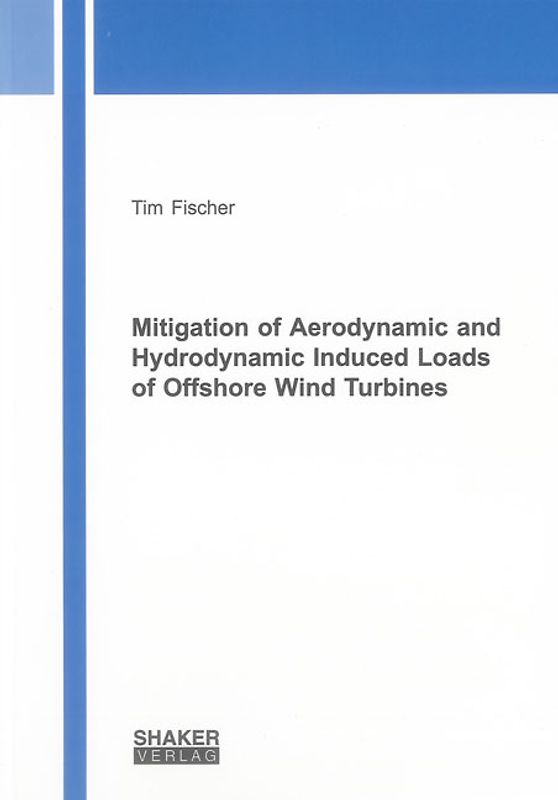
Mitigation of Aerodynamic and Hydrodynamic Induced Loads of Offshore Wind Turbines
Tim Fischer (Unbekannter Einband, Englisch)
★★★★★
☆☆☆☆☆ Keine Bewertungen vorhanden
Optischer Zustand
Beschreibung
Offshore wind energy is one of the movers in the transition of Europe’s energy system. However, the further reduction of cost of offshore wind energy is the key to its future success. A significant potential for such improvements is given by the currently rather high costs associated with the design, manufacturing, installation and maintenance of the support structure. The present research… proposes and demonstrates a methodology to lower the support structure investment cost by mitigation of aerodynamic and hydrodynamic induced fatigue loads through an integrated design approach as well as site and design specific wind turbine control concepts.
In order to facilitate such an approach the requirements of load mitigation on three levels in the design process are analysed in detail and the most promising concepts are identified. Firstly load mitigation aspects can be included already on the design level by selecting a specific concept for the entire offshore wind turbine or the site specific design in the wind farm layout to enhance important damping effects or to reduce certain external excitations. On a next level the turbine’s capabilities with respect to its operational control like by using a rotational speed window or a soft cut-out are addressed. The largest potential is found on the dynamic control level, where different advanced control concepts can be included and to damp the loads actively.
The comparison of monopile and jacket designs for a typical 5MW turbine at three reference sites ranging from 10 to 50 m (MSL) water depth points out that such application of control concepts is much dependent on the selected support structure concept, offshore site, turbine type and finally the considered load effect and operational conditions. If hydrodynamic excitation of the support structure in fore-aft direction is dominant, concepts like collective pitch control with tower-feedback, active idling control or an (active) soft cut-out are promising. They all focus on enhancing the effect of aerodynamic damping and thus achieve reductions in support structure fore-aft excitation. If in contrast, the misalignment of wind and wave direction imposes design-driving loads in the sideways direction, individual pitch control or an active generator torque controller are more powerful means. In addition or as alterative to the above-mentioned control concepts of the rotornacelle-assembly, structural damper devices (either passive or semi-active) are promising solutions. Such concepts have the benefits of mitigating both directions of the support structure movements with the same efficiency and of being largely independent from the availability of the electro-mechanical system of the turbine.
The state-of-the-art is an integrated design approach where rotor-nacelle-assembly and structure are considered as one entire unit and where aero-elastic and hydrodynamic load effects are analysed simultaneously. In the current research this approach is even further extended by implementing the selection of suitable load mitigation concepts and the tailoring of turbine control and design in the design iteration process. The design objective is to improve the overall cost-performance of the entire offshore wind farm. Therefore a final demonstration of the developed design methodology is performed. The study considers a standard 5 MW turbine on a monopile support structure in 25 m (MSL) water depth at exposed North Sea conditions. Such a design configuration is currently considered to be beyond the current design depth limit. A reference design of the support structure is made following a standard integrated design approach. Subsequently, the combination of four different load mitigation concepts, which did not require expensive new control hardware, leads to a significant reduction in the design driving fatigue loads at mudline of 13 %. A structural re-design for the design load envelope show considerable material savings of 9 % in the support structure and additional energy yield due to the extended cut-out. Undesired collateral effects, such as increased loads and wear of other machinery components, are rather low since overall system loads and characteristics remain within acceptable ranges. In general, the research points out that the integrated design process, extended by using offshore-specific controls to face the design-driving load events, is able to provide technically robust and cost-effective design solutions.
For the future it is foreseen that turbines are getting even larger and sites with higher water depth are to be exploited. This will imply the need for new design concepts as well as further development of specific load mitigation concepts in order to achieve cost effective designs. Dieses Produkt haben wir gerade leider nicht auf Lager.
Handgeprüfte Gebrauchtware
Bis zu 50 % günstiger als neu
Der Umwelt zuliebe
Technische Daten
Erscheinungsdatum
14.12.2012
Sprache
Englisch
EAN
9783844015010
Herausgeber
Shaker
Serien- oder Bandtitel
Berichte aus der Luft- und Raumfahrttechnik
Sonderedition
Nein
Autor
Tim Fischer
Seitenanzahl
227
Auflage
1
Einbandart
Unbekannter Einband
Schlagwörter
loads, offshore, integrated design, wind turbine, control
Thema-Inhalt
TRP - Luft- und Raumfahrttechnik
Höhe
210 mm
Breite
14.8 cm
-.-
★★★★★
☆☆☆☆☆ Leider noch keine Bewertungen
Leider noch keine Bewertungen
Sicher bei rebuy kaufen

Schreib die erste Bewertung für dieses Produkt!
Wenn du eine Bewertung für dieses Produkt schreibst, hilfst du allen Kund:innen, die noch überlegen, ob sie das Produkt kaufen wollen. Vielen Dank, dass du mitmachst!
Sicher bei rebuy kaufen