
iPhoneAlle anzeigen
iPhone 11iPhone 11 ProiPhone 11 Pro MaxiPhone 12iPhone 12 ProiPhone 12 Pro MaxiPhone 12 miniiPhone 13iPhone 13 ProiPhone 13 Pro MaxiPhone 13 miniiPhone 14iPhone 14 PlusiPhone 14 ProiPhone 14 Pro MaxiPhone 15iPhone 15 PlusiPhone 15 ProiPhone 15 Pro MaxiPhone 16iPhone 16 PlusiPhone 16 ProiPhone 16 Pro MaxiPhone 16eiPhone 8iPhone 8 PlusiPhone SE 2020iPhone SE 2022iPhone XiPhone XRiPhone XSiPhone XS Max
Galaxy A-SerieAlle anzeigen
Galaxy A12Galaxy A13Galaxy A13 5GGalaxy A14Galaxy A15Galaxy A16Galaxy A17 5GGalaxy A20eGalaxy A21Galaxy A22Galaxy A23Galaxy A24Galaxy A25Galaxy A26 5GGalaxy A32Galaxy A33Galaxy A34Galaxy A35Galaxy A36 5GGalaxy A40Galaxy A41Galaxy A42Galaxy A50Galaxy A51Galaxy A52Galaxy A53Galaxy A54Galaxy A55Galaxy A56 5GGalaxy A70Galaxy A71Galaxy A72
Redmi SeriesAlle anzeigen
Redmi 10Redmi 13CRedmi 15 5GRedmi Note 10Redmi Note 10 ProRedmi Note 11Redmi Note 11 ProRedmi Note 11 Pro Plus 5GRedmi Note 11sRedmi Note 12Redmi Note 12 5GRedmi Note 12 ProRedmi Note 12 Pro 5GRedmi Note 12 Pro PlusRedmi Note 13Redmi Note 13 5GRedmi Note 13 ProRedmi Note 13 Pro PlusRedmi Note 14Redmi Note 14 Pro PlusRedmi Note 8Redmi Note 8 ProRedmi Note 9Redmi Note 9 Pro
- Startseite
Bücher Englische Bücher Wissen & Bildung Naturwissenschaft, Medizin, Informatik, Technik Biologie Landwirtschaft & Ernährung Gas exchange, evapotranspiration efficiency, morphophysiology and productivity of cowpeas under water deficit
Derzeit nicht verfügbar
Handgeprüfte Gebrauchtware
Bis zu 50 % günstiger als neu
Der Umwelt zuliebe
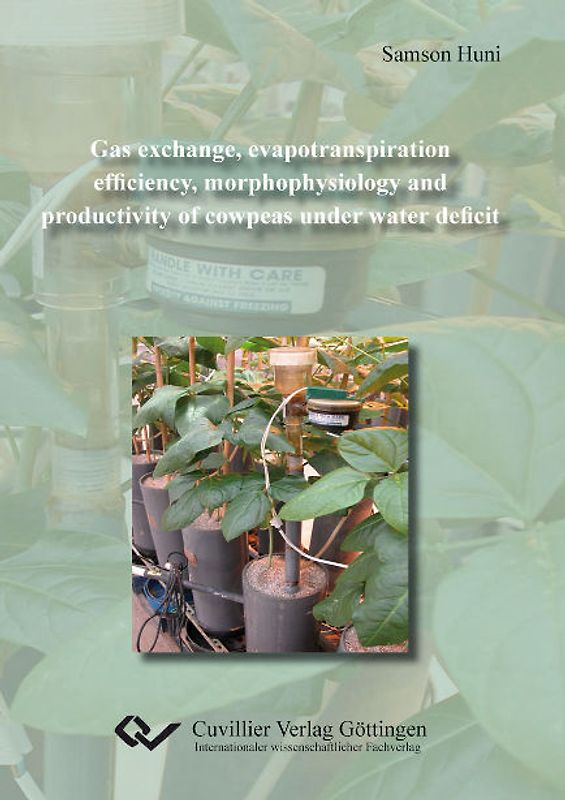
Gas exchange, evapotranspiration efficiency, morphophysiology and productivity of cowpeas under water deficit
Samson Huni (Unbekannter Einband, Englisch)
★★★★★
☆☆☆☆☆ Keine Bewertungen vorhanden
Optischer Zustand
Beschreibung
The cowpea [Vigna unguiculata (L.) Walp.], a legume which originated in Africa, is now grown in the Tropics and many subtropical regions. Cowpea is of significance for food and feed and its yield is frequently severely affected by drought, resulting in its low average yield. Hence the influence of water deficit on gas exchange, growth, development and yield of cowpea was studied here, with the aim… of contributing to our understanding of the response of cowpeas to water deficit and to the provision of efficient and viable information for breeding of drought resistant genotypes. To achieve this aim, several traits were examined, which included
- gas exchange [stomatal conductance (gs), net photosynthetic rate PN), transpiration rate (E) and intrinsic transpiration efficiency TEi)], evapotranspiration efficiency (ETE), water
use (WU) and yield/yield components,
- relationship among these traits and variability among the various genotypes.
From the results it was expected that it would be possible to find efficient plant types and characteristics to predict ETE and yield which could eventually be used in cowpea drought resistance breeding programmes.
For this purpose three pot experiments were conducted in the greenhouse under drip irrigation. The control (well-watered treatment) was irrigated continuously from the beginning to the end of the experiments, while the water-deficit treatment experienced a reduced irrigation resulting in a soil water potential of -350 to -450hPa at the onset of flowering for 14 to 21 days. Measurement and analyses of various traits were carried out before the induction of water-deficit stress, during and at the end of stress. All remaining plants were then fully irrigated up to the end of the experiments. In experiments 1 and 2 the plants were harvested at maturity to determine yield and yield components, and biomass and ETE.
Water-deficit stress impacted on all analysed traits and there were variations among genotypes in both treatments. Water deficit elicited the reduction of leaf relative water content and stomatal conductance. Consequently, PN and E declined as well. However, E decreased more than PN due to the influence of stress, generally leading to a higher TEi of the water-deficit treatment. There were differences among experiments, probably due to interactions between the genotypes and the environment. After stress, gas exchange recovered to similar levels of the control treatment. Biomass production, water use and evapotranspiration efficiency varied among genotypes within and between treatments. Compared with the control, water use and growth rate decreased clearly under stress. The role of PN for biomass production became evident in the positive correlation between both parameters. TEi had no distinct relationship to ETE.
Three traits, specifically leaf temperature (ΔT), leaf senescence (expressed as leaf shedding score, LSS) and cell membrane stability (CMS, calculated from electrolyte leakage values) distinguish themselves as valuable tools for drought resistance analysis. ΔT rose up to 3°C higher under stress than well-watered conditions. LSS increased under stress as well, whereby the genotypes which shed a relative high number of leaves under well-watered conditions also shed an even higher amount of leaves under stress. The sole genotype which retained all its leaves under stress, UCR 328, maintained all its leaves green, which was probably tremendously valuable for a quick recovery of different plant processes after stress. ΔT was consistently positively correlated with LSS, but negatively with CMS, particularly under stress. ΔT and LSS also displayed significant relationships with ETE, TEi, grain yield and harvest index (HI). Owing to the fact that ΔT and LSS are simple, fast, cheap and non-invasively determined, they could be used in drought resistance breeding programmes as indirect selection traits for efficient plant types regarding transpiration, TEi, ETE and yield.
The various genotypes yielded differently and the HI also varied under both treatments, a probable indication of differing genotypic yield potential. Water deficit at flowering reduced yield, but some genotypes had a higher HI. Generally, the genotypes with a high “yield potential” also manifested a higher yield under stress. TVu 12348 had the highest yield stability, but a low yield potential. UCR 328 and IFH 27-8 had a relatively high yield stability coupled with a high yield under stress Dieses Produkt haben wir gerade leider nicht auf Lager.
Handgeprüfte Gebrauchtware
Bis zu 50 % günstiger als neu
Der Umwelt zuliebe
Technische Daten
Erscheinungsdatum
23.12.2010
Sprache
Englisch
EAN
9783869555997
Herausgeber
Cuvillier Verlag
Sonderedition
Nein
Autor
Samson Huni
Seitenanzahl
136
Auflage
1
Einbandart
Unbekannter Einband
Schlagwörter
leaf temperature, leaf senescence, cell membrane stability, leaf area, specific leaf area, stem mass to stem length ratio, drought stress susceptibility index, drought stress intensity, cowpea, Vigna unguiculata, drought, gas exchange, photosynthetic rate, transpiration rate, stomatal conductance, transpiration efficiency, evapotranspiration efficiency, yield and yield components,
-.-
★★★★★
☆☆☆☆☆ Leider noch keine Bewertungen
Leider noch keine Bewertungen
Sicher bei rebuy kaufen

Schreib die erste Bewertung für dieses Produkt!
Wenn du eine Bewertung für dieses Produkt schreibst, hilfst du allen Kund:innen, die noch überlegen, ob sie das Produkt kaufen wollen. Vielen Dank, dass du mitmachst!
Sicher bei rebuy kaufen