
iPhoneAlle anzeigen
iPhone 11iPhone 11 ProiPhone 11 Pro MaxiPhone 12iPhone 12 ProiPhone 12 Pro MaxiPhone 12 miniiPhone 13iPhone 13 ProiPhone 13 Pro MaxiPhone 13 miniiPhone 14iPhone 14 PlusiPhone 14 ProiPhone 14 Pro MaxiPhone 15iPhone 15 PlusiPhone 15 ProiPhone 15 Pro MaxiPhone 16iPhone 16 PlusiPhone 16 ProiPhone 16 Pro MaxiPhone 16eiPhone 8iPhone 8 PlusiPhone SE 2020iPhone SE 2022iPhone XiPhone XRiPhone XSiPhone XS Max
Galaxy A-SerieAlle anzeigen
Galaxy A12Galaxy A13Galaxy A13 5GGalaxy A14Galaxy A15Galaxy A16Galaxy A17 5GGalaxy A20eGalaxy A21Galaxy A22Galaxy A23Galaxy A24Galaxy A25Galaxy A26 5GGalaxy A32Galaxy A33Galaxy A34Galaxy A35Galaxy A36 5GGalaxy A40Galaxy A41Galaxy A42Galaxy A50Galaxy A51Galaxy A52Galaxy A53Galaxy A54Galaxy A55Galaxy A56 5GGalaxy A70Galaxy A71Galaxy A72
Redmi SeriesAlle anzeigen
Redmi 10Redmi 13CRedmi 15 5GRedmi Note 10Redmi Note 10 ProRedmi Note 11Redmi Note 11 ProRedmi Note 11 Pro Plus 5GRedmi Note 11sRedmi Note 12Redmi Note 12 5GRedmi Note 12 ProRedmi Note 12 Pro 5GRedmi Note 12 Pro PlusRedmi Note 13Redmi Note 13 5GRedmi Note 13 ProRedmi Note 13 Pro PlusRedmi Note 14Redmi Note 14 Pro PlusRedmi Note 8Redmi Note 8 ProRedmi Note 9Redmi Note 9 Pro
- Startseite
Bücher Englische Bücher Wissen & Bildung Naturwissenschaft, Medizin, Informatik, Technik Technik Elektronik, Elektro- und Nachrichtentechnik Automatic Modulation Classification in Mobile OFDM Systems with Adaptive Modulation
Derzeit nicht verfügbar
Handgeprüfte Gebrauchtware
Bis zu 50 % günstiger als neu
Der Umwelt zuliebe
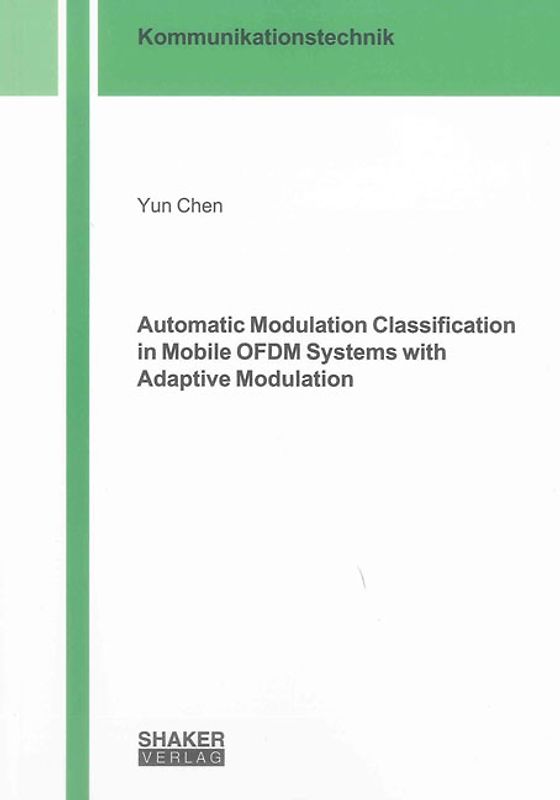
Automatic Modulation Classification in Mobile OFDM Systems with Adaptive Modulation
Yun Chen (Unbekannter Einband, Englisch)
★★★★★
☆☆☆☆☆ Keine Bewertungen vorhanden
Optischer Zustand
Beschreibung
Adaptive modulation is an efficient way to combat the effects of deep fades in broadband orthogonal frequency division multiplexing (OFDM) systems with time-varying multipath channels, where modulation schemes are adapted to the current channel state. Bandwidth efficient modulation schemes are applied on subcarriers with high channel quality, while robust modulation schemes or even no modulation… is preferred for subcarriers in deep fades. The resulting benefit in terms of required transmit power was demonstrated for a fixed data rate in the literature, where a gain of 5 ··· 15 dB was recorded for a BER of 10 -3 over the OFDM system with a fixed modulation. Alternatively, adaptive modulation can also be used to improve the bandwidth efficiency under the condition of a constraint transmit power and predefined quality of service (QoS). In the literature, several algorithms for adaptive modulation have been proposed with different emphasis on bandwidth efficiency and implemental complexity. In the thesis, the algorithm proposed by Chow is used due to its excellent tradeoff between performance and complexity.
A main drawback of adaptive modulation is that it requires a synchronization of adapted modulation schemes to enable demodulation in the receiver. Traditionally, this synchronization is organized in forms of explicit signalling, which reduces the bandwidth efficiency due to the signalling overhead. In the thesis, proposals are developed to reduce this undesirable overhead. These proposals exploit the correlation properties inherently existing in the transmission channel in both time and frequency domain, which leads to memory effects in the signalling source. State-dependent Huffman coding schemes are then applied to reduce the redundancy resulting from these memory effects.
This signalling overhead can be totally eliminated by automatic modulation classification (AMC). In the past, AMC was mainly of interest in military fields like threat analysis and electronic surveillance, where no prior knowledge about the used modulation scheme is available. The received signal is the single information source for classification. Under such circumstance, maximum likelihood (ML) based AMC provides the optimum solution in the sense that the classification error probability is minimized. Nowadays, AMC is drawing more and more research interest also in civilian applications like systems with adaptive modulation, where certain co-operations are organized as in the system considered in this thesis. These co-operations provide certain prior information, which can be utilized to improve the classification reliability. Consequently, the ML based approach does not deliver the minimum error probability any more. Investigations have to be conducted to verify how much the performance can be improved by incorporating this prior information into the AMC algorithm. As one focus in this thesis, a maximum a posteriori (MAP) based AMC is developed, which is potentially able to minimize the classification error probability again. Another focus is to reduce the implemental complexity to enable the application of AMC in systems with high time requirements like real-time systems.
In the last part of the thesis, comparisons are performed between these two approaches, namely explicit signalling and signalling-free AMC, in terms of final packet error probability. To ensure a fair comparison, the net data rate is always maintained as a constant in both operation modes. Dieses Produkt haben wir gerade leider nicht auf Lager.
Handgeprüfte Gebrauchtware
Bis zu 50 % günstiger als neu
Der Umwelt zuliebe
Technische Daten
Erscheinungsdatum
10.02.2014
Sprache
Englisch
EAN
9783844025255
Herausgeber
Shaker
Serien- oder Bandtitel
Berichte aus der Kommunikationstechnik
Sonderedition
Nein
Autor
Yun Chen
Seitenanzahl
161
Auflage
1
Einbandart
Unbekannter Einband
-.-
★★★★★
☆☆☆☆☆ Leider noch keine Bewertungen
Leider noch keine Bewertungen
Sicher bei rebuy kaufen

Schreib die erste Bewertung für dieses Produkt!
Wenn du eine Bewertung für dieses Produkt schreibst, hilfst du allen Kund:innen, die noch überlegen, ob sie das Produkt kaufen wollen. Vielen Dank, dass du mitmachst!
Sicher bei rebuy kaufen