
iPhoneAlle anzeigen
iPhone 11iPhone 11 ProiPhone 11 Pro MaxiPhone 12iPhone 12 ProiPhone 12 Pro MaxiPhone 12 miniiPhone 13iPhone 13 ProiPhone 13 Pro MaxiPhone 13 miniiPhone 14iPhone 14 PlusiPhone 14 ProiPhone 14 Pro MaxiPhone 15iPhone 15 PlusiPhone 15 ProiPhone 15 Pro MaxiPhone 16iPhone 16 PlusiPhone 16 ProiPhone 16 Pro MaxiPhone 16eiPhone 8iPhone 8 PlusiPhone SE 2020iPhone SE 2022iPhone XiPhone XRiPhone XSiPhone XS Max
Galaxy A-SerieAlle anzeigen
Galaxy A12Galaxy A13Galaxy A13 5GGalaxy A14Galaxy A15Galaxy A16Galaxy A17 5GGalaxy A20eGalaxy A21Galaxy A22Galaxy A23Galaxy A24Galaxy A25Galaxy A26 5GGalaxy A32Galaxy A33Galaxy A34Galaxy A35Galaxy A36 5GGalaxy A40Galaxy A41Galaxy A42Galaxy A50Galaxy A51Galaxy A52Galaxy A53Galaxy A54Galaxy A55Galaxy A56 5GGalaxy A70Galaxy A71Galaxy A72
Redmi SeriesAlle anzeigen
Redmi 10Redmi 13CRedmi 15 5GRedmi Note 10Redmi Note 10 ProRedmi Note 11Redmi Note 11 ProRedmi Note 11 Pro Plus 5GRedmi Note 11sRedmi Note 12Redmi Note 12 5GRedmi Note 12 ProRedmi Note 12 Pro 5GRedmi Note 12 Pro PlusRedmi Note 13Redmi Note 13 5GRedmi Note 13 ProRedmi Note 13 Pro PlusRedmi Note 14Redmi Note 14 Pro PlusRedmi Note 8Redmi Note 8 ProRedmi Note 9Redmi Note 9 Pro
- Startseite
Bücher Englische Bücher Sachbücher Kunst & Literatur Architektur SEPRA and Clorindo Testa: Banco de Londres y América del Sud, Buenos Aires 1959–1966
Derzeit nicht verfügbar
Handgeprüfte Gebrauchtware
Bis zu 50 % günstiger als neu
Der Umwelt zuliebe
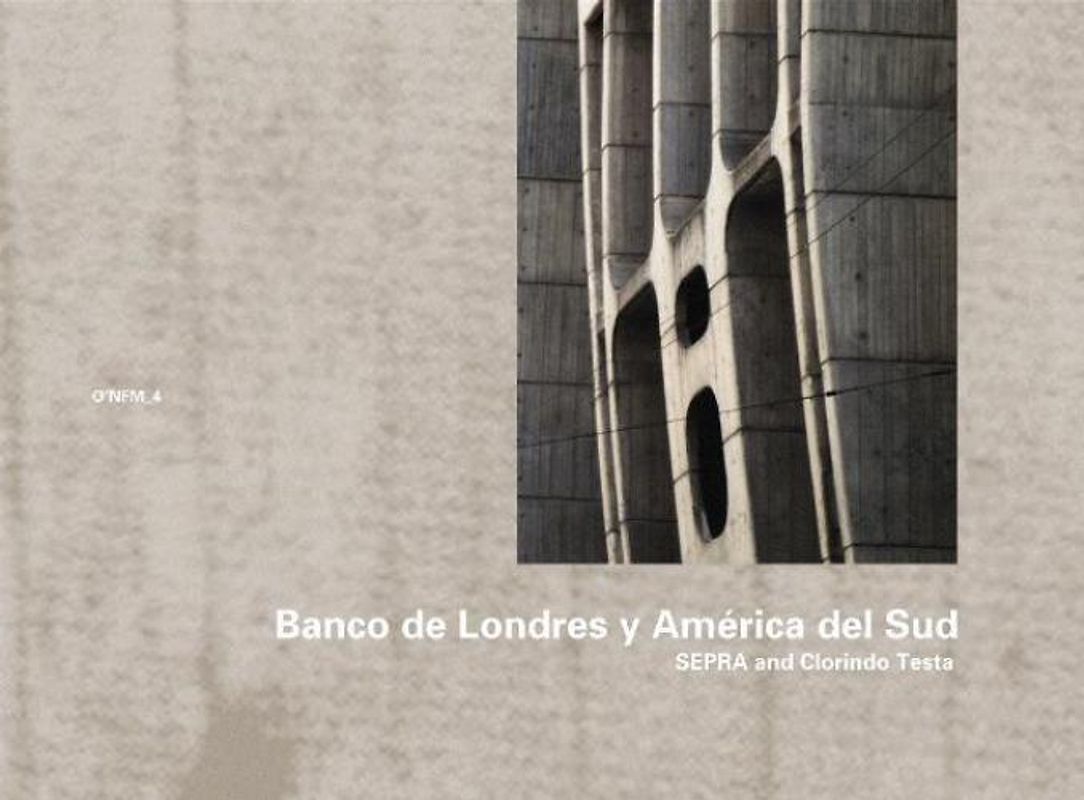
SEPRA and Clorindo Testa: Banco de Londres y América del Sud, Buenos Aires 1959–1966
(Broschiert, Englisch)
★★★★★
☆☆☆☆☆ Keine Bewertungen vorhanden
Optischer Zustand
Beschreibung
With this fourth O’Neil Ford Monograph, The Center for American Architecture and Design together with the O’Neil Ford Chair in Architecture at The University of Texas at Austin are publishing another building of the "Modern" period that deserves wider attention. Certainly well-known amongst South American architectural connoiseurs, the Banco de Londres y América del Sud gives evidence that the… efforts of a large design team, and not following the Western myth of the lone creative genius at the fountainhead, in a country that was ready for challenges of this magnitude, can result in an exceptional and exemplary piece of architecture.
Argentina is a grand nation: proud on and off the soccer field, culturally memorable, economically potent, and politically challenged. Generations of European immigrants have set deep roots here. Spanish and Italians have been the decisive cultural groups, but also other Europeans such as the English have established their "colonies." To serve this community of traders and "ex-pats," a variety of umbilical cords were created to ensure a link to the old homeland. The Banco de Londres y América del Sud was one of these strands of the umbilical cord. Its precursor, founded in 1862 in London as the "London, Buenos Ayres, and River Plate Bank," undergoing changes in name and stakeholders (a share having been bought in 1918 by the then Lloyds Bank, the majority in the Banco de Londres y América del Sud was actually only acquired in 1971, now Lloyds Banking Group), occupied a modest Neo-Classical, single story building on the current site right at the center of Buenos Aires' financial district.
The winning entry to the limited competition organized in 1959 for the new Argentinian headquarters brought forth a radically different solution beyond the Neo-Classical or Neo-Modernist norms. With Europe and the USA still reeling from the aftereffects of the Second World War, it was at the heart of the conservative financial district of Buenos Aires, that an integral entity of a visionary architecture was to be built, not by the constructivists in the USSR, not by the modernist immigrants in the USA and not those left in Europe. This Monograph thus presents to the interested reader an early case of a figured, structurally heroic, technologically advanced piece of architecture, the likes of which had not been seen in either Europe or the USA.
Following extensive research on this building, it has been possible to gather drawings from the archives of the current owner of the Bank, the Banco Hipotecario, the successor offices of SEPRA and the office of Clorindo Testa. These are gathered here for the first time, thereby allowing an overview of the design process from the competition stage to the detailing of key building elements.
The close up view of these documents supports the otherwise cursory assessment, that this building is one of the outstanding examples of modern architecture. In its stance, the creation of single volume that is occupied by suspended floors as well as rising floors slabs, that has every sinew of even its smallest element thoroughly honed, the Banco de Londres y América del Sud can be considered both as a singular phenomenon in which the aspirations and experience of a large number of designers and engineers could be realized as well as an exemplary case of a relatively independent language that set itself free from either the expected Neo-Classicism or the then new orthodoxy of rationalist Modernism.
In this instance, the umbilical cord was to work in the other direction, feeding the homeland with inspiration. It was decades later that the figured components of the English High-Tech architects (Rogers, Foster et al) were to find their realization, including the ironic version by Stirling and Gowan. The Banco de Londres y América del Sud, like few other cases before it, had shown a direction for contemporary architecture to follow that would live the key principles of modern architecture – unity of purpose and form, constructional rationality and built veracity all in a liberated space/time continuum – while embodying the roots of the past and at the same time providing a vision of the future. Dieses Produkt haben wir gerade leider nicht auf Lager.
Handgeprüfte Gebrauchtware
Bis zu 50 % günstiger als neu
Der Umwelt zuliebe
Technische Daten
Erscheinungsdatum
25.03.2012
Sprache
Englisch
EAN
9783803007407
Herausgeber
Verlag Wasmuth & Zohlen
Serien- oder Bandtitel
O'Neil Ford Monograph Series
Sonderedition
Nein
Seitenanzahl
248
Auflage
1
Einbandart
Broschiert
Bandzählung
4
Schlagwörter
Neoklassizismus, Bankenarchitektur, Buenos Aires, SEPRA, Argentinien, Testa, Clorindo, Bankgebäude
Thema-Inhalt
AMB - Einzelne Architekten und Architekturbüros
AMC - Architektonische Struktur und Gestaltung
AMX - Geschichte der Architektur
Höhe
215 mm
Breite
29.5 cm
-.-
★★★★★
☆☆☆☆☆ Leider noch keine Bewertungen
Leider noch keine Bewertungen
Sicher bei rebuy kaufen

Schreib die erste Bewertung für dieses Produkt!
Wenn du eine Bewertung für dieses Produkt schreibst, hilfst du allen Kund:innen, die noch überlegen, ob sie das Produkt kaufen wollen. Vielen Dank, dass du mitmachst!
Sicher bei rebuy kaufen