
iPhoneAlle anzeigen
iPhone 11iPhone 11 ProiPhone 11 Pro MaxiPhone 12iPhone 12 ProiPhone 12 Pro MaxiPhone 12 miniiPhone 13iPhone 13 ProiPhone 13 Pro MaxiPhone 13 miniiPhone 14iPhone 14 PlusiPhone 14 ProiPhone 14 Pro MaxiPhone 15iPhone 15 PlusiPhone 15 ProiPhone 15 Pro MaxiPhone 16iPhone 16 PlusiPhone 16 ProiPhone 16 Pro MaxiPhone 16eiPhone 8iPhone 8 PlusiPhone SE 2020iPhone SE 2022iPhone XiPhone XRiPhone XSiPhone XS Max
Galaxy A-SerieAlle anzeigen
Galaxy A12Galaxy A13Galaxy A13 5GGalaxy A14Galaxy A15Galaxy A16Galaxy A17 5GGalaxy A20eGalaxy A21Galaxy A22Galaxy A23Galaxy A24Galaxy A25Galaxy A26 5GGalaxy A32Galaxy A33Galaxy A34Galaxy A35Galaxy A36 5GGalaxy A40Galaxy A41Galaxy A42Galaxy A50Galaxy A51Galaxy A52Galaxy A53Galaxy A54Galaxy A55Galaxy A56 5GGalaxy A70Galaxy A71Galaxy A72
Redmi SeriesAlle anzeigen
Redmi 10Redmi 13CRedmi 15 5GRedmi Note 10Redmi Note 10 ProRedmi Note 11Redmi Note 11 ProRedmi Note 11 Pro Plus 5GRedmi Note 11sRedmi Note 12Redmi Note 12 5GRedmi Note 12 ProRedmi Note 12 Pro 5GRedmi Note 12 Pro PlusRedmi Note 13Redmi Note 13 5GRedmi Note 13 ProRedmi Note 13 Pro PlusRedmi Note 14Redmi Note 14 Pro PlusRedmi Note 8Redmi Note 8 ProRedmi Note 9Redmi Note 9 Pro
- Startseite
Bücher Wissen & Bildung Naturwissenschaft, Medizin, Informatik, Technik Biologie Landwirtschaft & Ernährung Vergleichende Bewertung der Ertragsfähigkeit und Faserqualität von Lein (Linum usitatissimum L.), Hanf (Cannabis sativa L.) und Fasernessel (Urtica dioica L.) zur Produktion hochwertiger Industriefasern
Derzeit nicht verfügbar
Handgeprüfte Gebrauchtware
Bis zu 50 % günstiger als neu
Der Umwelt zuliebe
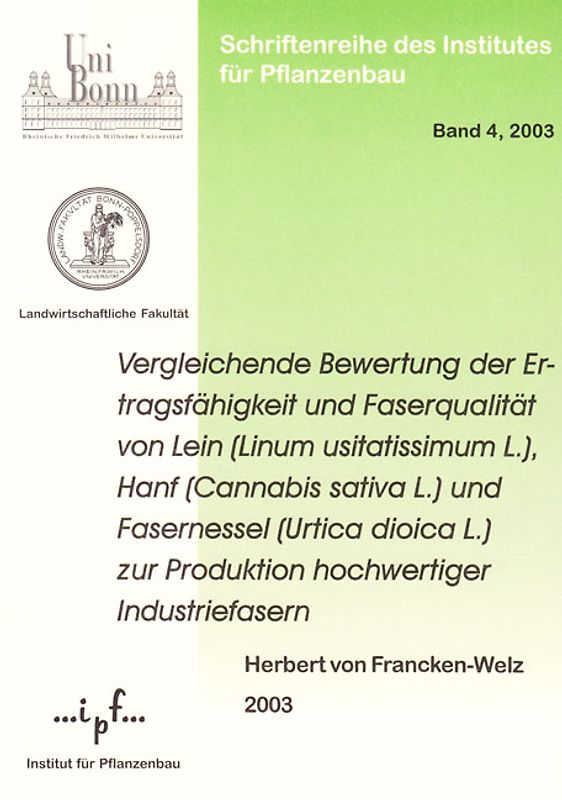
Vergleichende Bewertung der Ertragsfähigkeit und Faserqualität von Lein (Linum usitatissimum L.), Hanf (Cannabis sativa L.) und Fasernessel (Urtica dioica L.) zur Produktion hochwertiger Industriefasern
Herbert von Francken-Welz (Broschiert, Deutsch)
★★★★★
☆☆☆☆☆ Keine Bewertungen vorhanden
Optischer Zustand
Beschreibung
In Central Europe flax, hemp, and fibre nettle are generally available for the production of natural fibres for industrial use. However, cultivation of natural fibres is only competitive if growing methods are optimised and if the produced fibre is of high quality. Therefore, productivity and quality of the indigenous fibre crops were compared over a period of two years and the influences of… genotypes and environment were examined. So as to gain information about yield and quality during maturation, various samples were taken within the vegetation period. For hemp, the influence of locational factors was scrutinised over a period of one year.
Flax, as well as short fibre flax, achieves higher fibre yields than linseed. The seed yield of short fibre flax falls behind that of linseed, but surpasses the seed yield of flax. The fibre yield rises with an increase of seed density. Higher seed density leads to finer fibres and increases the specific tensile strength of fibres. Raising the N-fertilisation does not affect the fibre yield but furthers the risk of lodging, while mechanical properties decrease. The fibre yield rises until the end of flowering. The mechanical properties do not change after blossom, so that the crop can be harvested at the point of capsular maturity.
Hemp trials showed no significant deviation in yield at different locations in spite of varying soil quality. Moreover, an increase in seed density and N-fertilisation did not result in higher yields. In contrast, the fibre quality was affected by soil properties, i.e. clay soils lead to a higher strength of fibres compared to sandy soil. Higher seed densities also improve the fibre strength, whereas high N-fertilisation diminishes the mechanical properties of fibres. Both factors have no effect on the yield. Late ripening hemp genotypes produced a higher fibre yield than early ripening varieties. This can be enhanced by a later date of harvest. Early flowering species do not achieve any increase in fibre yield after flowering.
With respect to fibre nettles, clones obtain a higher fibre yield than seedlings. By an increase of plant density with up to 5 plants/m² fibre content as well as fibre yield can be considerably enhanced. The fibre yield goes up during the vegetation period. The fibres become finer and more durable, while the mechanical properties of seedlings exceed those of clones.
Of all the species looked at, flax shows the highest variability of yield components depending on the year, whereas fibre nettle has the most constant parameters of yield. Fibre nettle, though, shows the highest variability in the parameters of quality. Generally, the cultivation of hemp achieves the highest fibre yield. However, the results of the highestquality flax varieties can be compared to mediocre hemp species. Due to the low fibre content, the fibre yield of fibre nettle falls clearly behind the yield of flax, short fibre flax and even linseed.
Taking into account that the fibres differ in their quality, flax, hemp and fibre nettle are suitable for various use, whereby the production of each plant can be optimised for a best outcome. Dieses Produkt haben wir gerade leider nicht auf Lager.
Handgeprüfte Gebrauchtware
Bis zu 50 % günstiger als neu
Der Umwelt zuliebe
Technische Daten
Erscheinungsdatum
18.06.2003
Sprache
Deutsch
EAN
9783832215958
Herausgeber
Shaker
Serien- oder Bandtitel
Schriftenreihe des Instituts für Pflanzenbau
Sonderedition
Nein
Autor
Herbert von Francken-Welz
Seitenanzahl
168
Auflage
1
Einbandart
Broschiert
Schlagwörter
Pflanzenbau, Pflanzenzüchtung, Nachwachsende Rohstoffe, Faserqualität, Faserpflanzen
Thema-Inhalt
TV - Landwirtschaft
Höhe
210 mm
Breite
14.8 cm
-.-
★★★★★
☆☆☆☆☆ Leider noch keine Bewertungen
Leider noch keine Bewertungen
Sicher bei rebuy kaufen

Schreib die erste Bewertung für dieses Produkt!
Wenn du eine Bewertung für dieses Produkt schreibst, hilfst du allen Kund:innen, die noch überlegen, ob sie das Produkt kaufen wollen. Vielen Dank, dass du mitmachst!
Sicher bei rebuy kaufen