
iPhoneAlle anzeigen
iPhone 11iPhone 11 ProiPhone 11 Pro MaxiPhone 12iPhone 12 ProiPhone 12 Pro MaxiPhone 12 miniiPhone 13iPhone 13 ProiPhone 13 Pro MaxiPhone 13 miniiPhone 14iPhone 14 PlusiPhone 14 ProiPhone 14 Pro MaxiPhone 15iPhone 15 PlusiPhone 15 ProiPhone 15 Pro MaxiPhone 16iPhone 16 PlusiPhone 16 ProiPhone 16 Pro MaxiPhone 16eiPhone 8iPhone 8 PlusiPhone SE 2020iPhone SE 2022iPhone XiPhone XRiPhone XSiPhone XS Max
Galaxy A-SerieAlle anzeigen
Galaxy A12Galaxy A13Galaxy A13 5GGalaxy A14Galaxy A15Galaxy A16Galaxy A17 5GGalaxy A20eGalaxy A21Galaxy A22Galaxy A23Galaxy A24Galaxy A25Galaxy A26 5GGalaxy A32Galaxy A33Galaxy A34Galaxy A35Galaxy A36 5GGalaxy A40Galaxy A41Galaxy A42Galaxy A50Galaxy A51Galaxy A52Galaxy A53Galaxy A54Galaxy A55Galaxy A56 5GGalaxy A70Galaxy A71Galaxy A72
Redmi SeriesAlle anzeigen
Redmi 10Redmi 13CRedmi 15 5GRedmi Note 10Redmi Note 10 ProRedmi Note 11Redmi Note 11 ProRedmi Note 11 Pro Plus 5GRedmi Note 11sRedmi Note 12Redmi Note 12 5GRedmi Note 12 ProRedmi Note 12 Pro 5GRedmi Note 12 Pro PlusRedmi Note 13Redmi Note 13 5GRedmi Note 13 ProRedmi Note 13 Pro PlusRedmi Note 14Redmi Note 14 Pro PlusRedmi Note 8Redmi Note 8 ProRedmi Note 9Redmi Note 9 Pro
- Startseite
Bücher Englische Bücher Wissen & Bildung Naturwissenschaft, Medizin, Informatik, Technik Physik & Astronomie Elektrizität, Magnetismus, Optik Zone-Melting Recrystallization for Crystalline Silicon Thin-Film Solar Cells
Derzeit nicht verfügbar
Handgeprüfte Gebrauchtware
Bis zu 50 % günstiger als neu
Der Umwelt zuliebe
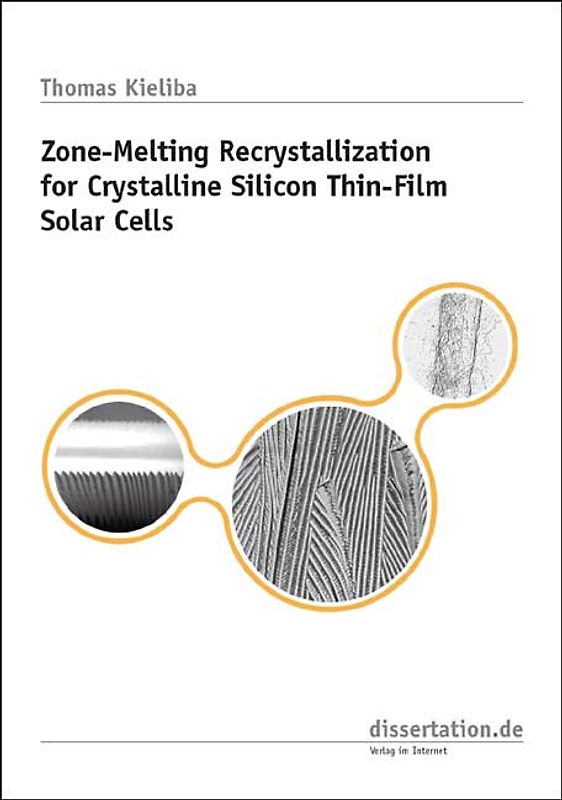
Zone-Melting Recrystallization for Crystalline Silicon Thin-Film Solar Cells
Thomas Kieliba (Unbekannter Einband, Englisch)
★★★★★
☆☆☆☆☆ Keine Bewertungen vorhanden
Optischer Zustand
Beschreibung
Thin-film solar cells from crystalline silicon require only a fraction of the high purity absorber material needed for wafer based solar cells. Due to the crystalline structure, the silicon film can be processed into solar cells analogous to multicrystalline silicon wafers - and the cells can reach similar conversion efficiencies.
This work investigates a crystalline silicon thin-film solar cell… technology that is based on a so-called "high temperature approache". A thin silicon film is applied onto a substrate by chemical vapor deposition (CVD) and subsequently transferred into a coarse-grained structure by zone-melting recrystallization (ZMR). This film acts as a "seed film", which is afterwards epitaxially thickened. The final silicon thin film can mainly be processed into solar cells with standard technology.
The ZMR process largely determines the conversion efficiency of the final solar cell, since crystal defects like dislocations or grain boundaries are replicated by the subsequent epitaxial growth. Of special importance are low angle grain boundaries, which are an inevitable feature of the ZMR process and in this connection are called subgrain boundaries. This work examines how dislocations in the epitaxial film are related to subgrain boundaries in the seed film. Experimental results confirm a theory that explained subgrain boundary formation by tilting of subgrains and polygonization of dislocations. Further, the effect of different material and process parameters on dislocation density is examined, like film thickness and ZMR scan speed.
For a quantitative description of the relation between dislocations and electronic film properties, a theoretical model is developed, based upon the work of Donolato [J. Appl. Phys. 84, 2656 (1998)]. For the purpose of this work Donolato's model is extended regarding the use of the "quantum efficiency effective diffusion length" and the appropriate description of thin devices with a finite thickness and a finite back surface recombination velocity. A technique for automated etch pit density (EPD) mapping has been developed for application of the model to experimental data. Normalized recombination strength values are determined from EPD data and measurements of effective diffusion lengths by spectrally resolved light beam induced current (SR-LBIC). Further, the model can be used to describe the dependence of open circuit voltage on dislocation density.
The last part of this work demonstrates how solar cell conversion efficiency can be improved by a process that is especially adapted to the silicon thin films. With such an optimized process, conversion efficiencies up to 13.5 % (Voc = 610 mV, Jsc = 30.9 mA/cm², and FF = 71.7 %) are demonstrated, for a "model" substrate with a ~31 µm thick silicon film. Dieses Produkt haben wir gerade leider nicht auf Lager.
Handgeprüfte Gebrauchtware
Bis zu 50 % günstiger als neu
Der Umwelt zuliebe
Technische Daten
Erscheinungsdatum
19.12.2006
Sprache
Englisch
EAN
9783866241961
Herausgeber
Winter Industries
Serien- oder Bandtitel
Dissertation Premium
Sonderedition
Nein
Autor
Thomas Kieliba
Seitenanzahl
244
Auflage
1
Einbandart
Unbekannter Einband
Bandzählung
1296
Schlagwörter
Dünnschichtsolarzelle, Zonenschmelzverfahren, charge carrier lifetime, Polykristall, Ladungsträger, Gitterbaufehler, Silicium
Höhe
210 mm
Breite
15 cm
-.-
★★★★★
☆☆☆☆☆ Leider noch keine Bewertungen
Leider noch keine Bewertungen
Sicher bei rebuy kaufen

Schreib die erste Bewertung für dieses Produkt!
Wenn du eine Bewertung für dieses Produkt schreibst, hilfst du allen Kund:innen, die noch überlegen, ob sie das Produkt kaufen wollen. Vielen Dank, dass du mitmachst!
Sicher bei rebuy kaufen