
iPhoneAlle anzeigen
iPhone 11iPhone 11 ProiPhone 11 Pro MaxiPhone 12iPhone 12 ProiPhone 12 Pro MaxiPhone 12 miniiPhone 13iPhone 13 ProiPhone 13 Pro MaxiPhone 13 miniiPhone 14iPhone 14 PlusiPhone 14 ProiPhone 14 Pro MaxiPhone 15iPhone 15 PlusiPhone 15 ProiPhone 15 Pro MaxiPhone 16iPhone 16 PlusiPhone 16 ProiPhone 16 Pro MaxiPhone 16eiPhone 8iPhone 8 PlusiPhone SE 2020iPhone SE 2022iPhone XiPhone XRiPhone XSiPhone XS Max
Galaxy A-SerieAlle anzeigen
Galaxy A12Galaxy A13Galaxy A13 5GGalaxy A14Galaxy A15Galaxy A16Galaxy A17 5GGalaxy A20eGalaxy A21Galaxy A22Galaxy A23Galaxy A24Galaxy A25Galaxy A26 5GGalaxy A32Galaxy A33Galaxy A34Galaxy A35Galaxy A36 5GGalaxy A40Galaxy A41Galaxy A42Galaxy A50Galaxy A51Galaxy A52Galaxy A53Galaxy A54Galaxy A55Galaxy A56 5GGalaxy A70Galaxy A71Galaxy A72
Redmi SeriesAlle anzeigen
Redmi 10Redmi 13CRedmi 15 5GRedmi Note 10Redmi Note 10 ProRedmi Note 11Redmi Note 11 ProRedmi Note 11 Pro Plus 5GRedmi Note 11sRedmi Note 12Redmi Note 12 5GRedmi Note 12 ProRedmi Note 12 Pro 5GRedmi Note 12 Pro PlusRedmi Note 13Redmi Note 13 5GRedmi Note 13 ProRedmi Note 13 Pro PlusRedmi Note 14Redmi Note 14 Pro PlusRedmi Note 8Redmi Note 8 ProRedmi Note 9Redmi Note 9 Pro
- Startseite
Bücher Englische Bücher Wissen & Bildung Naturwissenschaft, Medizin, Informatik, Technik Physik & Astronomie Theoretische Physik Helium and Hydrogen Isotope Adsorption and Separation in Metal-Organic Frameworks
Derzeit nicht verfügbar
Handgeprüfte Gebrauchtware
Bis zu 50 % günstiger als neu
Der Umwelt zuliebe
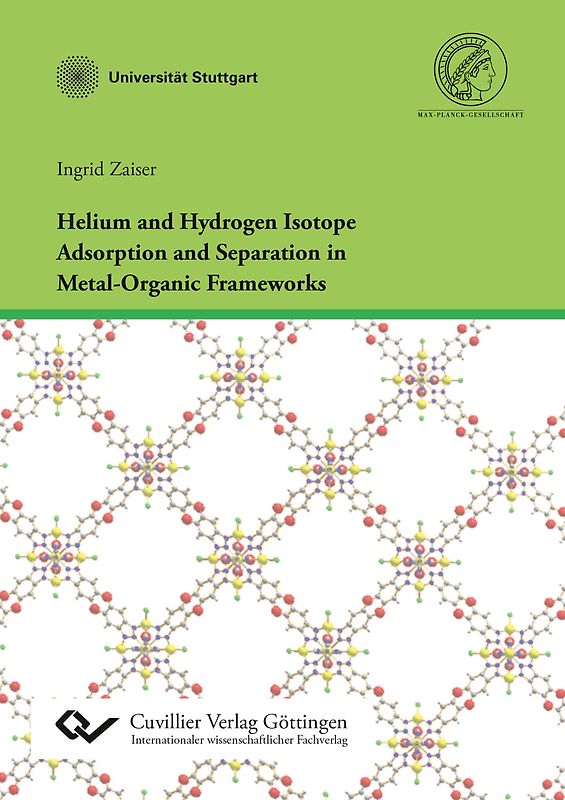
Helium and Hydrogen Isotope Adsorption and Separation in Metal-Organic Frameworks
Ingrid Zaiser (Broschiert, Englisch)
★★★★★
☆☆☆☆☆ Keine Bewertungen vorhanden
Optischer Zustand
Beschreibung
The separation of isotopes has always been a challenge because of their identical size, shape and thermodynamic properties. Nowadays, the extraction of deuterium is performed e.g. by the Girdler Sulfid process or cryogenic distillation, which lead to low separation factors (below 2.5) in combination with high energy costs. The standard way to produce helium-3 is to skim it as a byproduct of the… radioactive tritium decay.
In this thesis, two alternative approaches have been investigated for the separation of light isotopes, Quantum Sieving and Chemical Affinity Sieving . While Quantum Sieving is based on confinement in small pores, Chemical Affinity Sieving relies on strong adsorption sites. Both methods use the mass difference of the isotopes, which is related to their zero-point energy.
The microporous metal-organic frameworks are excellent candidates for studying these quantum effects due to their well-defined pore structure and the possibility to introduce strong adsorption sites directly into the framework. The samples have been exposed to an isotope mixture and the adsorbed quantity of each isotope was detected by low-temperature thermal desorption spectroscopy (TDS). The ratio of the desorbed amount of the isotopes leads directly to the selectivity (separation factor). The selectivity is determined as a function of exposure time and temperature and exhibits the highest value of 25 observed for hydrogen isotopes at temperatures well above the boiling point of liquid nitrogen. Dieses Produkt haben wir gerade leider nicht auf Lager.
Handgeprüfte Gebrauchtware
Bis zu 50 % günstiger als neu
Der Umwelt zuliebe
Technische Daten
Erscheinungsdatum
31.10.2016
Sprache
Englisch
EAN
9783736993778
Herausgeber
Cuvillier Verlag
Sonderedition
Nein
Autor
Ingrid Zaiser
Seitenanzahl
200
Auflage
1
Einbandart
Broschiert
Schlagwörter
Quantum Sieving, Chemical Affinity Sieving, MOF, Isotope separation
Thema-Inhalt
PH - Physik
-.-
★★★★★
☆☆☆☆☆ Leider noch keine Bewertungen
Leider noch keine Bewertungen
Sicher bei rebuy kaufen

Schreib die erste Bewertung für dieses Produkt!
Wenn du eine Bewertung für dieses Produkt schreibst, hilfst du allen Kund:innen, die noch überlegen, ob sie das Produkt kaufen wollen. Vielen Dank, dass du mitmachst!
Sicher bei rebuy kaufen