
iPhoneAlle anzeigen
iPhone 11iPhone 11 ProiPhone 11 Pro MaxiPhone 12iPhone 12 ProiPhone 12 Pro MaxiPhone 12 miniiPhone 13iPhone 13 ProiPhone 13 Pro MaxiPhone 13 miniiPhone 14iPhone 14 PlusiPhone 14 ProiPhone 14 Pro MaxiPhone 15iPhone 15 PlusiPhone 15 ProiPhone 15 Pro MaxiPhone 16iPhone 16 PlusiPhone 16 ProiPhone 16 Pro MaxiPhone 16eiPhone 8iPhone 8 PlusiPhone SE 2020iPhone SE 2022iPhone XiPhone XRiPhone XSiPhone XS Max
Galaxy A-SerieAlle anzeigen
Galaxy A12Galaxy A13Galaxy A13 5GGalaxy A14Galaxy A15Galaxy A16Galaxy A17 5GGalaxy A20eGalaxy A21Galaxy A22Galaxy A23Galaxy A24Galaxy A25Galaxy A26 5GGalaxy A32Galaxy A33Galaxy A34Galaxy A35Galaxy A36 5GGalaxy A40Galaxy A41Galaxy A42Galaxy A50Galaxy A51Galaxy A52Galaxy A53Galaxy A54Galaxy A55Galaxy A56 5GGalaxy A70Galaxy A71Galaxy A72
Redmi SeriesAlle anzeigen
Redmi 10Redmi 13CRedmi 15 5GRedmi Note 10Redmi Note 10 ProRedmi Note 11Redmi Note 11 ProRedmi Note 11 Pro Plus 5GRedmi Note 11sRedmi Note 12Redmi Note 12 5GRedmi Note 12 ProRedmi Note 12 Pro 5GRedmi Note 12 Pro PlusRedmi Note 13Redmi Note 13 5GRedmi Note 13 ProRedmi Note 13 Pro PlusRedmi Note 14Redmi Note 14 Pro PlusRedmi Note 8Redmi Note 8 ProRedmi Note 9Redmi Note 9 Pro
- Startseite
Bücher Englische Bücher Wissen & Bildung Naturwissenschaft, Medizin, Informatik, Technik Informatik & EDV Informatik Ontology of Communication
Derzeit nicht verfügbar
Handgeprüfte Gebrauchtware
Bis zu 50 % günstiger als neu
Der Umwelt zuliebe
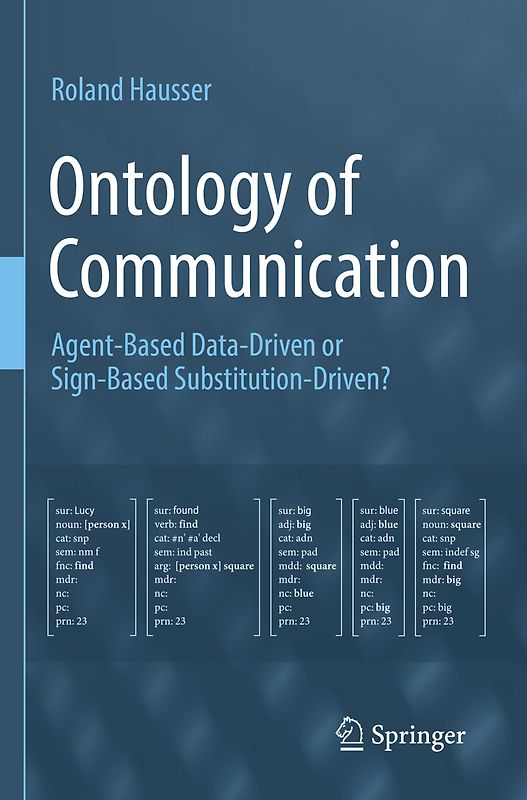
Ontology of Communication
Roland Hausser (Broschiert, Englisch)
★★★★★
☆☆☆☆☆ Keine Bewertungen vorhanden
Optischer Zustand
Beschreibung
The book gives a comprehensive discussion of Database Semantics (DBS) as an agent-based data-driven theory of how natural language communication essentially works. In language communication, agents switch between speak mode , driven by cognition-internal content (input) resulting in cognition-external raw data (e.g. sound waves or pixels, which have no meaning or grammatical properties but can be… measured by natural science), and hear mode , driven by the raw data produced by the speaker resulting in cognition-internal content. The motivation is to compare two approaches for an ontology of communication: agent-based data-driven vs. sign-based substitution-driven. A gent-based means: design of a cognitive agent with (i) an interface component for converting raw data into cognitive content (recognition) and converting cognitive content into raw data (action), (ii) an on-board, content-addressable memory (database) for the storage and content retrieval, (iii) separate treatments of the speak and the hear mode. Data-driven means: (a) mapping a cognitive content as input to the speak-mode into a language-dependent surface as output, (b) mapping a surface as input to the hear-mode into a cognitive content as output. Oppositely, s ign - based means: no distinction between speak and hear mode, whereas substitution-driven means: using a single start symbol as input for generating infinitely many outputs, based on substitutions by rewrite rules. Collecting recent research of the author, this beautiful, novel and original exposition begins with an introduction to DBS, makes a linguistic detour on subject/predicate gapping and slot-filler repetition, and moves on to discuss computational pragmatics, inference and cognition, grammatical disambiguation and other related topics. The book is mostly addressed to experts working in the field of computational linguistics, as well as toenthusiasts interested in the history and early development of this subject, starting with the pre-computational foundations of theoretical computer science and symbolic logic in the 30s. Dieses Produkt haben wir gerade leider nicht auf Lager.
Handgeprüfte Gebrauchtware
Bis zu 50 % günstiger als neu
Der Umwelt zuliebe
Technische Daten
Erscheinungsdatum
05.01.2024
Sprache
Englisch
EAN
9783031227417
Herausgeber
Springer International Publishing
Sonderedition
Nein
Autor
Roland Hausser
Seitenanzahl
258
Auflage
1
Einbandart
Broschiert
Buch Untertitel
Agent-Based Data-Driven or Sign-Based Substitution-Driven?
Schlagwörter
Database Semantics, Computational Pragmatics, Agent-Based Data-Driven Ontology, Sign-Based Substitution-Driven Ontology, Grammatical Disambiguation, Chomsky Generative Grammar, Phrase-Structure Grammar, Computational Inference, Talking Robots, Predicate Calculus
Thema-Inhalt
UYQL - Natürliche Sprachen und maschinelle Übersetzung
UYQ - Künstliche Intelligenz
UYQE - Wissensbasierte Systeme, Expertensysteme
UYQM - Maschinelles Lernen
CFX - Computerlinguistik und Korpuslinguistik
Höhe
235 mm
Breite
15.5 cm
Hersteller: Springer, Europaplatz 3, Heidelberg, Deutschland, 69115, ProductSafety@springernature.com, Springer Nature Customer Service Center GmbH
-.-
★★★★★
☆☆☆☆☆ Leider noch keine Bewertungen
Leider noch keine Bewertungen
Sicher bei rebuy kaufen

Schreib die erste Bewertung für dieses Produkt!
Wenn du eine Bewertung für dieses Produkt schreibst, hilfst du allen Kund:innen, die noch überlegen, ob sie das Produkt kaufen wollen. Vielen Dank, dass du mitmachst!
Sicher bei rebuy kaufen