
iPhoneAlle anzeigen
iPhone 11iPhone 11 ProiPhone 11 Pro MaxiPhone 12iPhone 12 ProiPhone 12 Pro MaxiPhone 12 miniiPhone 13iPhone 13 ProiPhone 13 Pro MaxiPhone 13 miniiPhone 14iPhone 14 PlusiPhone 14 ProiPhone 14 Pro MaxiPhone 15iPhone 15 PlusiPhone 15 ProiPhone 15 Pro MaxiPhone 16iPhone 16 PlusiPhone 16 ProiPhone 16 Pro MaxiPhone 16eiPhone 8iPhone 8 PlusiPhone SE 2020iPhone SE 2022iPhone XiPhone XRiPhone XSiPhone XS Max
Galaxy A-SerieAlle anzeigen
Galaxy A12Galaxy A13Galaxy A13 5GGalaxy A14Galaxy A15Galaxy A16Galaxy A17 5GGalaxy A20eGalaxy A21Galaxy A22Galaxy A23Galaxy A24Galaxy A25Galaxy A26 5GGalaxy A32Galaxy A33Galaxy A34Galaxy A35Galaxy A36 5GGalaxy A40Galaxy A41Galaxy A42Galaxy A50Galaxy A51Galaxy A52Galaxy A53Galaxy A54Galaxy A55Galaxy A56 5GGalaxy A70Galaxy A71Galaxy A72
Redmi SeriesAlle anzeigen
Redmi 10Redmi 13CRedmi 15 5GRedmi Note 10Redmi Note 10 ProRedmi Note 11Redmi Note 11 ProRedmi Note 11 Pro Plus 5GRedmi Note 11sRedmi Note 12Redmi Note 12 5GRedmi Note 12 ProRedmi Note 12 Pro 5GRedmi Note 12 Pro PlusRedmi Note 13Redmi Note 13 5GRedmi Note 13 ProRedmi Note 13 Pro PlusRedmi Note 14Redmi Note 14 Pro PlusRedmi Note 8Redmi Note 8 ProRedmi Note 9Redmi Note 9 Pro
- Startseite
Bücher Englische Bücher Wissen & Bildung Naturwissenschaft, Medizin, Informatik, Technik Technik Luft- und Raumfahrttechnik On the Role of the Number of Rotor Blades for Helicopter Vibrations
Derzeit nicht verfügbar
Handgeprüfte Gebrauchtware
Bis zu 50 % günstiger als neu
Der Umwelt zuliebe
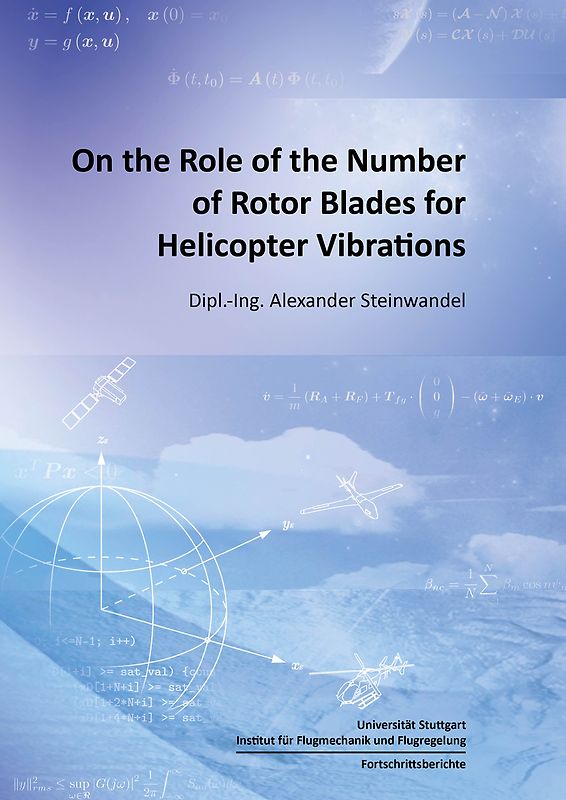
On the Role of the Number of Rotor Blades for Helicopter Vibrations
Alexander Steinwandel (Broschiert, Englisch)
★★★★★
☆☆☆☆☆ Keine Bewertungen vorhanden
Optischer Zustand
Beschreibung
The permanent changes of the airflow at the blades of a helicopter rotor lead to vibratory airloads at the blades, resulting in vibrations in the helicopter airframe. These vibrations have an adverse effect on passenger comfort and cause a significant part of the maintenance costs of a helicopter. Apart from passive approaches, research has increasingly focused on the use of active systems for… helicopter vibration reduction. The concept of individual blade control (IBC), allowing individual inputs for every blade, is one of the most promising approaches currently under investigation.
Since studies of helicopter vibrations and IBC typically investigate the physical and technical aspects of a specific rotor system, the role of the number of rotor blades does not receive much consideration. To fill this gap, the present work investigates the role of the number of rotor blades for helicopter vibration and active vibration reduction using IBC. To this end, models of the quasi steady helicopter main rotor vibrations are formulated as analytical functions of the quasi steady vibrations of the single blade and the number of rotor blades. As these models use only general dynamic properties of the rotor blade, the analysis of these models results in general conclusions not limited to a particular kind of helicopter rotor.
The investigation distinguishes between two kinds of helicopter main rotor vibrations. The first kind results from the superposition of vibration contributions of identical rotor blades. As this kind of vibration occurs even under ideal circumstances, it is referred to as systematic main rotor vibration. In contrast to that, the random main rotor vibrations are caused by dissimilarities among the rotor blades. These dissimilarities are caused by the tolerances in blade manufacturing and rotor assembly for any real world rotor system.
To investigate the systematic main rotor vibrations, the vibratory forces and moments at the rotor hub are determined by superposing the vibratory loads at the roots of an arbitrary number of blades. This analysis shows that the number of blades selects the harmonics of the vibratory blade root loads, which contribute to the resulting vibratory forces and moments at the rotor hub. For the investigation of the active reduction of systematic main rotor vibrations using IBC, a model for the quasi steady transfer behavior from IBC inputs to the vibratory rotor hub loads is derived based on the model for the vibratory hub loads developed earlier. From the analysis of this model can be observed that the number of rotor blades has no direct influence on the potential of an IBC system for the reduction of systematic main rotor vibrations.
The effects of the number of rotor blades for random main rotor vibrations are analyzed using a stochastic model of the helicopter main rotor vibrations. For the derivation of this model, stochastic representations of the vibrations contributed by the individual blades are superposed. The analysis of the stochastic vibration model shows that the expectation and the variance of the amplitude of the random main rotor vibrations are decreasing with an increasing number of blades if the mass of the helicopter is kept constant. For the active reduction of random main rotor vibrations, a general control concept formulated as a function of the number of blades is presented. This control concept aims at reducing random vibrations by applying quasi static IBC inputs to the rotor. The basis for this concept is provided by the analysis of the transfer paths from quasi static IBC inputs to random vibrations using the model of an ideal rotor with an arbitrary number of blades. Apart from the general design of the controller, the results of this analysis are also employed to generalize the solution to problems arising from the practical application of this control concept. This encompasses the efficient re parametrization of the weighted control law using a symbolic singular value decomposition, the systematic avoidance of integrator drift in ineffective parts of the space of control commands, as well as an algorithm for the quasi optimal limitation of control commands. In the final step, the function of this generalized control concept is validated in simulations for rotors with 3 to 8 blades. Dieses Produkt haben wir gerade leider nicht auf Lager.
Handgeprüfte Gebrauchtware
Bis zu 50 % günstiger als neu
Der Umwelt zuliebe
Technische Daten
Erscheinungsdatum
16.01.2024
Sprache
Englisch
EAN
9783844093506
Herausgeber
Shaker
Serien- oder Bandtitel
Fortschrittsberichte des Instituts für Flugmechanik und Flugregelung
Sonderedition
Nein
Autor
Alexander Steinwandel
Seitenanzahl
194
Auflage
1
Einbandart
Broschiert
-.-
★★★★★
☆☆☆☆☆ Leider noch keine Bewertungen
Leider noch keine Bewertungen
Sicher bei rebuy kaufen

Schreib die erste Bewertung für dieses Produkt!
Wenn du eine Bewertung für dieses Produkt schreibst, hilfst du allen Kund:innen, die noch überlegen, ob sie das Produkt kaufen wollen. Vielen Dank, dass du mitmachst!
Sicher bei rebuy kaufen