
Derzeit nicht verfügbar
Handgeprüfte Gebrauchtware
Bis zu 50 % günstiger als neu
Der Umwelt zuliebe
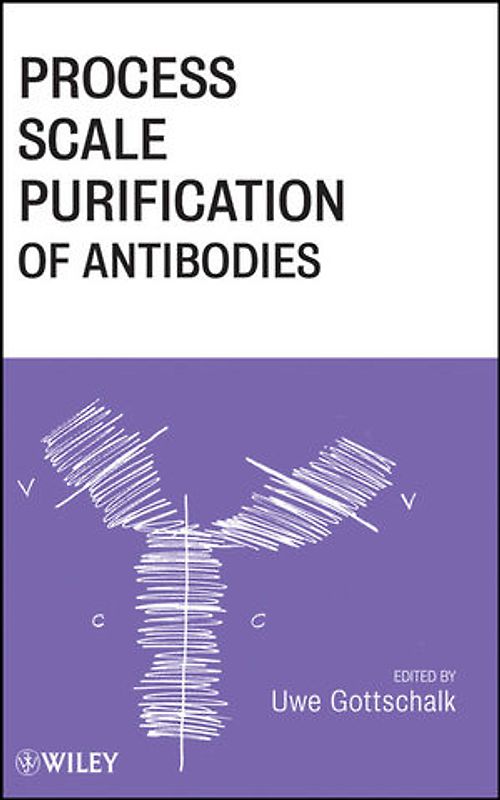
Process Scale Purification of Antibodies
Uwe Gottschalk (Gebundene Ausgabe, Englisch)
Keine Bewertungen vorhanden
Optischer Zustand
Beschreibung
The cutting edge in antibody purification written by industry experts
Biopharmaceutical companies are under extreme pressure to develop robust and economical large-scale processes while consistently meeting regulatory standards for safety and purity. Traditional column chromatography dominates today's purification trains, and many of the productivity gains rely on upscaling such devices. This Dieses Produkt haben wir gerade leider nicht auf Lager.
Handgeprüfte Gebrauchtware
Bis zu 50 % günstiger als neu
Der Umwelt zuliebe
Technische Daten
Erscheinungsdatum
06.03.2009
Sprache
Englisch
EAN
9780470209622
Herausgeber
John Wiley & Sons
Sonderedition
Nein
Autor
Uwe Gottschalk
Seitenanzahl
456
Einbandart
Gebundene Ausgabe
Autorenporträt
Uwe Gottschalk, PhD, is Group Vice President, Purification Technologies, at Sartorius Stedim Biotech. Previously, he worked for Bayer Health Care, overseeing the purification of monoclonal antibodies and recombinant proteins produced in various expression systems. Dr. Gottschalk received a doctorate in chemistry from the University of Münster. He lectures at the University of Duisburg-Essen and the EPFL in Lausanne, Switzerland and has written extensively in the areas of biotechnology and somatic gene therapy.
Schlagwörter
Antikörper, Biochemie u. Chemische Biologie, Biochemistry (Chemical Biology), Biomedical Engineering, Biomedizintechnik, Chemie, Chemistry, Drug Discovery & Development, Protein Engineering, Protein-Engineering, Wirkstoffforschung u. -entwicklung
Thema-Inhalt
PNB - Medizinische Chemie, Pharmazeutische Chemie
Inhaltsverzeichnis
Preface.
About the Author.
Contributors.
Chapter 1: Downstream Processing of Monoclonal Antibodies: Current Practices and Future Opportunities (Brian Kelly, Greg Blank and Ann Lee).
1.1 Introduction.
1.2 A Brief History of cGMP mAb and Intravenous Immunoglobulin IgIV Purification.
1.3 Current Approaches in Purification Process Development: Impact of Platform Processes.
1.4 Typical Unit Operations and Processing Alternatives.
1.5 VLS Processes: Ton-scale Production and Beyond.
1.6 Process Validation.
1.7 Product Life-cycle Management.
1.8 Future Opportunities.
1.9 Conclusions .
1.10 Acknowledgments.
1.11 References.
Chapter 2: The Development of Antibody Purification Technologies (John Curling).
2.1 Introduction.
2.2 Chromatographic Purification of Antibodies Before Protein A.
2.3 Antibody Purification After 1975.
2.4 Additional Technologies for Antibody Purification.
2.5 Purification of mAbs Approved in North America and Europe.
2.6 Acknowledgments.
2.7 References .
Chapter 3: Harvest and Recovery of Monoclonal Antibodies: Cell Removal and Clarification (Abhinav A. Shukla and Jagannadha Rao Kandula).
3.1 Introduction.
3.2 Centrifugation.
3.3 Microfiltration.
3.4 Depth Filtration.
3.5 Flocculation.
3.6 Absolute Filtration.
3.7 Expanded-Bed Chromatography.
3.8 Comparison of Harvest and Clarification of Unit Operations.
3.9 Acknowledgments.
3.10 References.
Chapter 4: Protein A-Based Affinity Chromatography (Suresh Vunnum, Ganesh Vedantham and Brian Hubbard).
4.1 Introduction.
4.2 Properties of Protein A and Commercially-Available Protein A Resins.
4.3 Protein A Chromatography Step Development.
4.4 Additional Considerations during Development and Scale-up.
4.5 Virus Removal/Inactivation.
4.6 Validation and Robustness.
4.7 Conclusions.
4.8 Acknowledgments.
4.9 References.
Chapter 5: Purification of Human Monoclonal Antibodies: Non-Protein A Strategies (Alahari Arunakumari and Jue Wang).
5.1 Introduction.
5.2 Integrated Process Designs for Human Monoclonal Antibody (HuMab) Production.
5.3 Purification Process Designs for HuMabs.
5.4 Conclusions .
5.5 Acknowledgments.
5.6 References.
Chapter 6: Purification of Monoclonal Antibodies by Mixed Mode Chromatography (Pete Gagnon).
6.1 Introduction.
6.2 A Brief History.
6.3 Prerequisites for Industrial Implementation.
6.4 Mechanisms, Screening and Method Development.
6.5 Capture Applications.
6.6 Polishing Applications.
6.7 Sequential Capture/Polishing Applications.
6.8 The Future.
6.9 Acknowledgments.
6.10 References.
Chapter 7: Integrated Polishing Steps for Monoclonal Antibody Purification (Sanchayita Ghose, Mi Jin, Jin Liu and John Hickey).
7.1 Introduction.
7.2 Polishing Steps in Antibody Purification.
7.3 Integration of Polishing Steps.
7.4 Conclusions.
7.5 Acknowledgments.
7.6 References.
Chapter 8: Orthogonal Virus Clearance Applications in Monoclonal Antibody Production (Joe X Zhou).
8.1 Introduction.
8.2 Model Viruses and Virus Assays.
8.3 Virus Clearance Strategies from First in Human (FIH) to Biological License Application (BLA) Filing.
8.4 Orthogonal Viral Clearance in mAB Production.
8.5 Conclusions and Future Perspectives.
8.6 Acknowledgments.
8.7 References.
Chapter 9: Development of A Platform Process for the Purification of Therapeutic Monoclonal Antibodies (Yuling Li, David W. Kahn, Olga Galperina, Erich Blatter, Robert Luo, Yaling Wu and Guihang Zhang).
9.1 Introduction.
9.2 Chromatography Steps in the Platform Process.
9.3 Virus Inactivation.
9.4 UF/DF Platform Development.
9.5 Platform Development: Virus Filtration and Bulk Fill.
9.6 Examples of Platform Processes.
9.7 Developing a Viral Clearance Database using a Platform Process.
9.8 Summary.
9.9 References.
Chapter 10: Advances in Technology and Process Development for Industrial Scale Monoclonal Antibody Purification (Nuno Fontes and Robert van Reis).
10.1 Introduction.
10.2 Affinity Purification Platform.
10.3 Advances in CEX Purification of mABs.
10.4 HPTFF.
10.5 A New Nonaffinity Platform.
10.6 References.
Chapter 11: Continuous Chromatography for the Purification of Monoclonal Antibodies (Thomas Müller-Späth and Massimo Morbidelli).
11.1 Introduction.
11.2 Product Variants and the Separation Problem.
11.3 Definition of Performance Parameters.
11.4 Gradient Chromatography for Biomolecules.
11.5 Continuous Chromatography to Increase Productivity.
11.6 The MCSGP Process.
11.7 Upgrades for Continuous Processes to Improve Stability.
11.8 Impact of Increasing Fermentation Titers.
11.9 Outlook.
11.10 Acknowledgments.
11.11 References.
Chapter 12: Process Economic Drivers in Industrial Monoclonal Antibody Manufacture (Suzanne S. Farid).
12.1 Introduction.
12.2 Challenges When Striving for the Cost-Effective Manufacture of mAbs.
12.3 Cost Definitions and Benchmark Values.
12.4 Economies of Scale.
12.5 Overall Process Economic Drivers.
12.6 DSP Drivers at High Titers.
12.7 Process Economic Trade-Offs for DSP Bottlenecks.
12.8 Summary and Outlook.
12.9 References.
Chapter 13: Design and Optimization of Manufacturing (Andrew Sinclair).
13.1 Introduction.
13.2 Process Design and Optimization.
13.3 Modeling Approaches.
13.4 Cost Models in Practice.
13.5 Simulation in Practice.
13.6 Acknowledgments.
13.7 References.
Chapter 14: Alternatives to Packed-Bed Chromatography for Antibody Extraction and Purification (Jörg Thömmes and Uwe Gottschalk).
14.1 Introduction.
14.2 Increasing the Selectivity of Harvest Procedures: Flocculation of Particulate and Nonparticulate Impurities.
14.3 Solutions for Antibody Extraction, Concentration and Purification.
14.4 Nonchromatographic Solutions for Antibody Purification and Formulation.
14.5 Membrane Adsorbers.
14.6 Conclusions.
14.7 Acknowledgments.
14.8 References.
Chapter 15: Process-Scale Precipitation of Impurities in Mammalian Cell Culture Broth (Judy Glynn).
15.1 Introduction.
15.2 Precipitation of DNA and Protein - Other Applications.
15.3 A Comprehensive Evaluation of Potential Precipitants for Impurity Removal.
15.4 Industrial-Scale Precipitation.
15.5 Cost of Goods in Comparison.
15.6 Summary.
15.7 Acknowledgments.
15.8 References.
Chapter 16: Charged Ultrafiltration and Microfiltration Membranes in Antibody Purification (Mark R. Etzel).
16.1 Introduction.
16.2 Charged Ultrafiltration Membranes.
16.3 Concentration Polarization and Permeate Flux.
16.4 Stagnant Film Model.
16.5 Osmotic Pressure Model.
16.6 Mass Transfer Coefficient.
16.7 Sieving Coefficient.
16.8 Diffusion Convection Model.
16.9 Scale-up Strategies and the Constant Wall Concentration (Cw) Approach.
16.10 Protein Fractionation Using Charged Ultrafiltration Membranes.
16.11 Case Study.
16.12 Membrane Cascades.
16.13 Charged Microfiltration Membranes.
16.14 Virus Clearance.
16.15 Salt Tolerance.
16.16 Conclusions.
16.17 Acknowledgments.
16.18 References.
Chapter 17: Downstream Processing of Monoclonal Antibody Fragments (Mariangela Spitali).
17.1 Introduction.
17.2 Production of Antibody Fragments for Therapeutic Use.
17.3 Downstream Processing.
17.4 Improving the Pharmacological Characteristics of Antibody Fragments.
17.5 Conclusions.
17.6 Acknowledgments.
17.7 References .
Chapter 18: Purification of Antibodies Other Than IgG - The Case of IgM and IgA (Charlotte Cabanne and Xavier Santarelli).
18.1 Introduction.
18.2 Purification of Immunoglobulin M (IgM).
18.3 Purification of IgA.
18.4 Conclusion.
18.5 Acknowledgments.
18.5 References.
Chapter 19: Purification of Antibodies From Transgenic Plants (Zivko L. Nikolov, Jeffrey T. Regan, Lynn F. Dickey and Susan L. Woodward).
19.1 Introduction.
19.2 Antibody Production in Transgenic Plants.
19.3 Downstream Processing of Antibodies Produced in Transgenic Plants.
19.4 Purification of Plant-Derived mAbs using Protein A.
19.5 Purification of Plant-Derived mAbs using Non-Protein A Media.
19.6 Polishing Steps.
19.7 Conclusions.
19.8 Acknowledgments.
19.9 References .
Chapter 20: Antibody Purification: Drivers of Change (Narahari Pujar, Duncan Low and Rhona O'Leary).
20.1 Introduction.
20.2 The Changing Regulatory Environment - Pharmaceutical Manufacturing for the Twenty-First Century.
20.3 Technology Drivers - Advances and Innovations.
20.4 Economic Drivers.
20.5 Conclusions.
20.6 Acknowledgments.
20.7 References.
Index.
Höhe
238 mm
Breite
16.4 cm
-.-
Leider noch keine Bewertungen
Leider noch keine Bewertungen
Sicher bei rebuy kaufen

Schreib die erste Bewertung für dieses Produkt!
Wenn du eine Bewertung für dieses Produkt schreibst, hilfst du allen Kund:innen, die noch überlegen, ob sie das Produkt kaufen wollen. Vielen Dank, dass du mitmachst!
Sicher bei rebuy kaufen