
Derzeit nicht verfügbar
Handgeprüfte Gebrauchtware
Bis zu 50 % günstiger als neu
Der Umwelt zuliebe
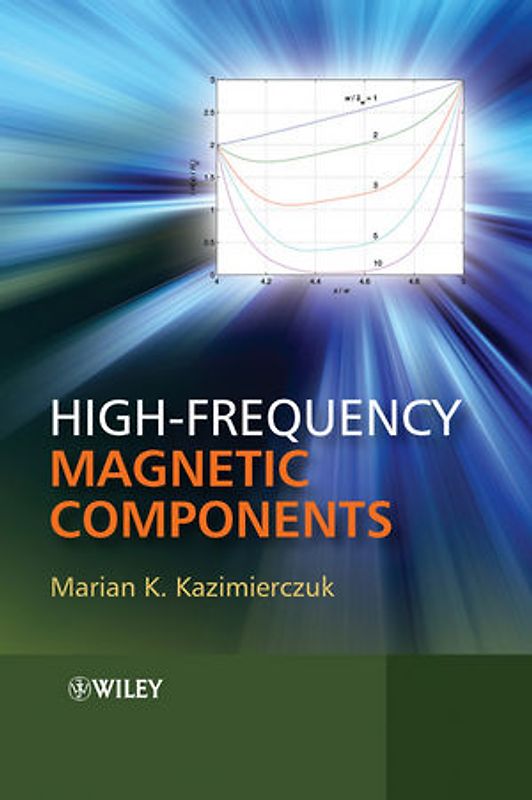
High-Frequency Magnetic Components
Marian K. Kazimierczuk (Gebundene Ausgabe, Englisch)
Keine Bewertungen vorhanden
Optischer Zustand
Beschreibung
If you are looking for a complete study of the fundamental concepts in magnetic theory, read this book. No other textbook covers magnetic components of inductors and transformers for high-frequency applications in detail.
This unique text examines design techniques of the major types of inductors and transformers used for a wide variety of high-frequency applications including switching-mode Dieses Produkt haben wir gerade leider nicht auf Lager.
Handgeprüfte Gebrauchtware
Bis zu 50 % günstiger als neu
Der Umwelt zuliebe
Technische Daten
Erscheinungsdatum
11.09.2009
Sprache
Englisch
EAN
9780470714539
Herausgeber
John Wiley & Sons
Sonderedition
Nein
Autor
Marian K. Kazimierczuk
Seitenanzahl
508
Auflage
1
Einbandart
Gebundene Ausgabe
Autorenporträt
Marian K. Kazimierczuk is Robert J. Kegerreis Distinguished Professor of Electrical Engineering at Wright State University, Dayton, Ohio, USA. He is the author of six books, over 130 archival refereed journal papers, over 150 conference papers, and seven patents. He is a Fellow of the IEEE. He received the Outstanding Teaching Award from the American Society for Engineering Education (ASEE) in 2008. His research interests are in power electronics, including pulse-width modulated dc-dc power converters, resonant dc-dc power converters, modeling and controls, RF power amplifiers and oscillators, semiconductor power devices, high-frequency magnetic devices, renewable energy sources, and evanescent microwave microscopy
Schlagwörter
Hochfrequenztechnik
Inhaltsverzeichnis
Preface.
About the Author.
List of Symbols.
1 Fundamentals of Magnetic Devices.
1.1 Introduction.
1.2 Magnetic Relationships.
1.3 Magnetic Circuits.
1.4 Magnetic Laws.
1.5 Eddy Currents.
1.6 Core Saturation.
1.7 Volt-Second Balance.
1.8 Inductance.
1.9 Inductance Factor.
1.10 Magnetic Energy.
1.11 Self-Resonant Frequency.
1.12 Classification of Power Losses in Magnetic Components.
1.13 Noninductive Coils.
1.14 Summary.
1.15 References.
1.16 Review Questions.
1.17 Problems.
2 Magnetic Cores.
2.1 Introduction.
2.2 Properties of Core Materials.
2.3 Magnetic Dipoles.
2.4 Magnetic Domains.
2.5 Curie Temperature.
2.6 Magnetization.
2.7 Magnetic Materials.
2.8 Hysteresis.
2.9 Core Permeability.
2.10 Core Geometries.
2.11 Iron Alloy Cores.
2.12 Amorphous Alloy Cores.
2.13 Nickel-Iron and Cobalt-Iron Cores.
2.14 Ferrite Cores.
2.15 Powder Cores.
2.16 Nanocrystalline Cores.
2.17 Superconductors.
2.18 Hysteresis Core Loss.
2.19 Eddy-Current Core Loss.
2.20 Total Core Loss.
2.21 Complex Permeability.
2.22 Summary.
2.23 References.
2.24 Review Questions.
2.25 Problems.
3 Skin Effect.
3.1 Introduction.
3.2 Skin Depth.
3.3 Ratio of AC-to-DC Winding Resistance.
3.4 Skin Effect in Long Single Round Conductor.
3.5 Current Density in Single Round Conductor.
3.6 Impedance of Round Conductor.
3.7 Magnetic Field Intensity for Round Wire.
3.8 Other Methods of Determining the Round Wire Inductance.
3.9 Power Density in Round Conductor.
3.10 Skin Effect on Single Rectangular Plate.
3.11 Summary.
3.12 References.
3.13 Review Questions.
3.14 Problems.
4 Proximity Effect.
4.1 Introduction.
4.2 Proximity and Skin Effects in Two Parallel Plates.
4.3 Antiproximity and Skin Effects in Two Parallel Plates.
4.4 Proximity Effect in Multiple-Layer Inductor.
4.5 Summary.
4.6 Appendix: Derivation of Proximity Power Loss.
4.7 References.
4.8 Review Questions.
4.9 Problems.
5 Winding Resistance at High Frequencies.
5.1 Introduction.
5.2 Winding Resistance.
5.3 Square and Round Conductors.
5.4 Winding Resistance of Rectangular Conductor.
5.5 Winding Resistance of Square Wire.
5.6 Winding Resistance of Round Wire.
5.7 Leakage Inductance.
5.8 Solution for Round Conductor Winding in Cylindrical Coordinates.
5.9 Litz Wire.
5.10 Winding Power Loss for Inductor Current with Harmonics.
5.11 Effective Winding Resistance for Nonsinusoidal Inductor Current.
5.12 Thermal Model of Inductors.
5.13 Summary.
5.14 References.
5.15 Review Questions.
5.16 Problems.
6 Laminated Cores.
6.1 Introduction.
6.2 Low-Frequency Solution.
6.3 General Solution.
6.4 Summary.
6.5 References.
6.6 Review Questions.
6.7 Problems.
7 Transformers.
7.1 Introduction.
7.2 Ideal Transformer.
7.3 Voltage Polarities and Current Directions in Transformers.
7.4 Nonideal Transformers.
7.5 Neumann's Formula for Mutual Inductance.
7.6 Mutual Inductance.
7.7 Coupling Coefficient.
7.8 Dot Convention.
7.9 Series-Aiding and Series-Opposing Connections.
7.10 Reflected Impedance.
7.11 Energy Stored in Coupled Inductors.
7.12 Magnetizing Inductance.
7.13 Leakage Inductance.
7.14 Transformers with Air Gap.
7.15 Autotransformers.
7.16 Measurement of Transformer Inductances.
7.17 Stray Capacitance.
7.18 High-Frequency Transformer Model.
7.19 Noninterleaved Windings.
7.20 Interleaved Windings.
7.21 AC Current Transformers.
7.22 Winding Power Losses with Harmonics.
7.23 Thermal Model of Transformers.
7.24 Summary.
7.25 References.
7.26 Review Questions.
7.27 Problems.
8 Integrated Inductors.
8.1 Introduction.
8.2 Skin Effect.
8.3 Resistance of Rectangular Trace.
8.4 Inductance of Straight Rectangular Trace.
8.5 Construction of Integrated Inductors.
8.6 Meander Inductors.
8.7 Inductance of Straight Round Conductor.
8.8 Inductance of Circular Round Wire Loop.
8.9 Inductance of Two-Parallel Wire Loop.
8.10 Inductance of Rectangle of Round Wire.
8.11 Inductance of Polygon Round Wire Loop.
8.12 Bondwire Inductors.
8.13 Single-Turn Planar Inductor.
8.14 Inductance of Planar Square Loop.
8.15 Planar Spiral Inductors.
8.16 Multi-metal Spiral Inductors.
8.17 Planar Transformers.
8.18 MEMS Inductors.
8.19 Inductance of Coaxial Cable.
8.20 Inductance of Two-Wire Transmission Line.
8.21 Eddy Currents in Integrated Inductors.
8.22 Model of RF Integrated Inductors.
8.23 PCB Inductors.
8.24 Summary.
8.25 References.
8.26 Review Questions.
8.27 Problems.
9 Self-Capacitance.
9.1 Introduction.
9.2 High-Frequency Inductor Model.
9.3 Self-Capacitance Components.
9.4 Capacitance of Parallel-Plate Capacitor.
9.5 Self-Capacitance of Foil Winding Inductors.
9.6 Capacitance of Two Parallel Round Conductors.
9.7 Capacitance of Round Conductor and Conducting Plane.
9.8 Self-Capacitance of Single-Layer Inductors.
9.9 Self-Capacitance of Multi-layer Inductors.
9.10 Capacitance of Coaxial Cable.
9.11 Summary.
9.12 References.
9.13 Review Questions.
9.14 Problems.
10 Design of Inductors.
10.1 Introduction.
10.2 Magnet Wire.
10.3 Wire Insulation.
10.4 Restrictions on Inductors.
10.5 Window Utilization Factor.
10.6 Temperature Rise of Inductors.
10.7 Mean Turn Length of Inductors.
10.8 Area Product Method.
10.9 AC Inductor Design.
10.10 Inductor Design for Buck Converter in CCM.
10.11 Inductor Design for Buck Converter in DCM Using Ap Method.
10.12 Core Geometry Coefficient Kg Method.
10.13 Inductor Design for Buck Converter in CCM Using Kg Method.
10.14 Inductor Design for Buck Converter in DCM Using Kg Method.
10.15 Summary.
10.16 References.
10.17 Review Questions.
10.18 Problems.
11 Design of Transformers.
11.1 Introduction.
11.2 Area Product Method.
11.3 Optimum Flux Density.
11.4 Transformer Design for Flyback Converter in CCM.
11.5 Transformer Design for Flyback Converter in DCM.
11.6 Geometrical Coefficient Kg Method.
11.7 Transformer Design for Flyback Converter in CCM Using Kg Method.
11.8 Transformer Design for Flyback Converter in DCM Using Kg Method.
11.9 Summary.
11.10 References.
11.11 Review Questions.
11.12 Problems.
Appendix A Fourier Series.
Appendix B Introduction to MATLAB.
Answers to Problems.
Index.
Höhe
244 mm
Breite
16.8 cm
-.-
Leider noch keine Bewertungen
Leider noch keine Bewertungen
Sicher bei rebuy kaufen

Schreib die erste Bewertung für dieses Produkt!
Wenn du eine Bewertung für dieses Produkt schreibst, hilfst du allen Kund:innen, die noch überlegen, ob sie das Produkt kaufen wollen. Vielen Dank, dass du mitmachst!
Sicher bei rebuy kaufen