
iPhoneAlle anzeigen
iPhone 11iPhone 11 ProiPhone 11 Pro MaxiPhone 12iPhone 12 ProiPhone 12 Pro MaxiPhone 12 miniiPhone 13iPhone 13 ProiPhone 13 Pro MaxiPhone 13 miniiPhone 14iPhone 14 PlusiPhone 14 ProiPhone 14 Pro MaxiPhone 15iPhone 15 PlusiPhone 15 ProiPhone 15 Pro MaxiPhone 16iPhone 16 PlusiPhone 16 ProiPhone 16 Pro MaxiPhone 16eiPhone 5iPhone 5CiPhone 5SiPhone 6iPhone 6 PlusiPhone 6SiPhone 6S PlusiPhone 7iPhone 7 PlusiPhone 8iPhone 8 PlusiPhone SEiPhone SE 2020iPhone SE 2022iPhone XiPhone XRiPhone XSiPhone XS Max
NokiaAlle anzeigen
108 Reihe220 Reihe225 Reihe2600 classic Reihe2680 slide Reihe2710 Reihe3120 classic Reihe3220 Reihe500 Reihe515 Reihe5230 Reihe603 Reihe6131 Reihe6200 Reihe6300 Reihe6500 Reihe6700 Reihe700 Reihe7200 Reihe8310 ReiheAshaC1C2C3C5C6C7E51E52E6E63E65E7E71E72N73N8N9N95N97Nokia 3Nokia 4.2Nokia 5Nokia 6Nokia 7Nokia 8SiroccoWeitere ModelleXX2X3X6XLXpressMusic
Galaxy A-SerieAlle anzeigen
Galaxy A12Galaxy A13Galaxy A13 5GGalaxy A14Galaxy A15Galaxy A16Galaxy A17 5GGalaxy A20eGalaxy A21Galaxy A22Galaxy A23Galaxy A24Galaxy A25Galaxy A26 5GGalaxy A3Galaxy A32Galaxy A33Galaxy A34Galaxy A35Galaxy A36 5GGalaxy A37Galaxy A40Galaxy A41Galaxy A42Galaxy A50Galaxy A51Galaxy A52Galaxy A53Galaxy A54Galaxy A55Galaxy A56 5GGalaxy A70Galaxy A71Galaxy A72
Redmi SeriesAlle anzeigen
Redmi 10Redmi 13CRedmi 15 5GRedmi Note 10Redmi Note 10 ProRedmi Note 11Redmi Note 11 ProRedmi Note 11 Pro Plus 5GRedmi Note 11sRedmi Note 12Redmi Note 12 5GRedmi Note 12 ProRedmi Note 12 Pro 5GRedmi Note 12 Pro PlusRedmi Note 13Redmi Note 13 5GRedmi Note 13 ProRedmi Note 13 Pro PlusRedmi Note 14Redmi Note 14 Pro PlusRedmi Note 8Redmi Note 8 ProRedmi Note 9Redmi Note 9 Pro
- Startseite
Bücher Wissen & Bildung Englische Bücher Naturwissenschaft, Medizin, Informatik, Technik Biologie Botanik Amaranthus: A Promising Crop of Future
Derzeit nicht verfügbar
Handgeprüfte Gebrauchtware
Bis zu 50 % günstiger als neu
Der Umwelt zuliebe
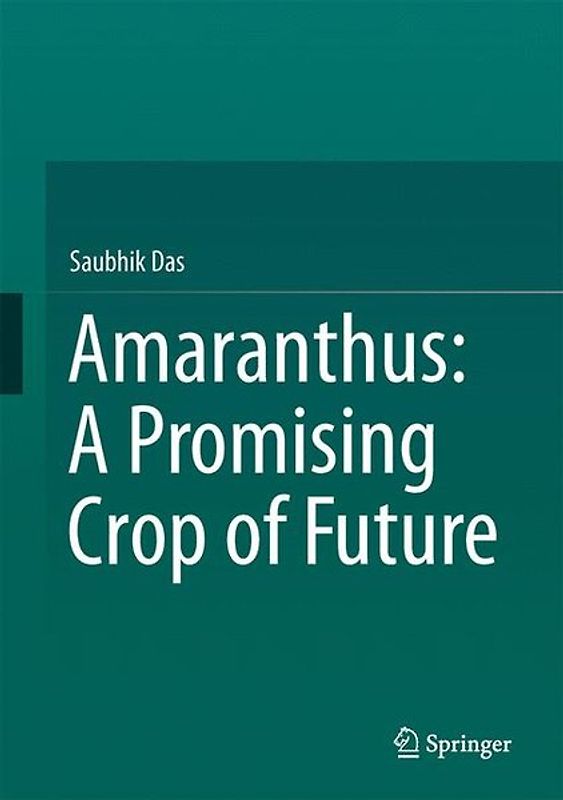
Amaranthus: A Promising Crop of Future
Saubhik Das (Gebundene Ausgabe, Englisch)
★★★★★
☆☆☆☆☆ Keine Bewertungen vorhanden
Optischer Zustand
Beschreibung
This book serves the larger community of plant researchers working on the taxonomy, species delimitation, phylogeny, and biogeography of pseudo-cereals, with a special emphasis on amaranths. It also provides extensive information on the nutritive value of underutilized pseudo-cereals, the goal being to broaden the vegetable list.Amaranthus is a cosmopolitan genus of annual or short-lived perennial… plants. Most of the species are summer annual weeds and are commonly referred to as pigweed. Only a few are cultivated as vitamin-rich vegetables and ornamentals. The protein-rich seeds of a handful of species, known as grain amaranths, are consumed as pseudo-cereals. Amaranthusmanifests considerable morphological diversity among and even within certain species, and there is no general agreement on the taxonomy or number of species. Currently the genus Amaranthus is believed to include three recognized subgenera and 70 species. Amatanthus is considered to potentially offer an alternative crop in temperate and tropical climate.The classification of amaranths is ambiguous due to the lack of discrete and quantitative species-defining characteristics and the wide range of phenotypic plasticity, as well as introgression and hybridization involving weedy and crop species. It is a known fact that both vegetable and grain amaranths have evolved from their respective weed progenitors. There are more than 180 different weed species that are herbicide-resistant, and amaranths are considered to be leading members of the resistant biotypes. Amaranth species provide ample scope for investigating herbicide resistance mechanisms. Amaranths also show variability in terms of their mating behavior and germplasm, adaptability to different growing conditions, and wide range of variability in sexual systems, from monoecy to dioecy. A solid grasp of these parameters is essential to the future utilization of amaranths as super crops. There are quite a few amaranth research center and germplasm collections all over the world that maintain and evaluate working germplasms. To date, the genetic improvement of amaranths has primarily involved the application of conventional selection methods. But advances in genomics and biotechnology have dramatically enriched the potential to manipulate the amaranth genome, especially improving the amount and availability of nutrients.In conclusion, the book covers all aspects of amaranths, including their food value, significance as vegetables and pseudo-cereals, taxonomy, phylogeny, germplasm variability, breeding behavior and strategies, cultivation practices, and variability in terms of their sexual systems. It offers a valuable resource for all students, researchers and experts working in the field of plant taxonomy and diversity. Dieses Produkt haben wir gerade leider nicht auf Lager.
Handgeprüfte Gebrauchtware
Bis zu 50 % günstiger als neu
Der Umwelt zuliebe
Technische Daten
Erscheinungsdatum
05.08.2016
Sprache
Englisch
EAN
9789811014680
Herausgeber
Springer Singapore
Sonderedition
Nein
Autor
Saubhik Das
Seitenanzahl
208
Einbandart
Gebundene Ausgabe
Autorenporträt
Dr. Shaubhik Das is currently working as Assistant Professor of Botany in Taki Govt. College, Kolkata, West Bengal, India. His publications: 1. Das, S. and Iamonico, D. (2014). Amaranthus bengalense (Amaranthaceae) a new species from India, with taxonomical notes on A. blitum aggregate. Phytotaxa 181(5): 293-300. (Magnolia Press, Auckland, New Zealand, Impact factor 1.376) 2. Das, S. (2014). Amaranthus parganensis (Amaranthaceae) a new species form West Bengal, India. Novon 23: 406-410. (Missouri Botanical Garden Press, Impact Factor 0.279) 3. Das, S. (2013). Demestication, phylogeny and taxonomic delimitation in underutilized grain amaranths – a status review. Feddes Repertorium 123 (4): 273 – 282 (Wiley-VCH Verlag GmbH & Co.) 4. Das, S. (2013). Infraspecific variability of Amaranthus tricolor (Amaranthaceae) in India with a new variety. Phytotaxa <88(2): 25-30. (DOI: http://dx.doi.org/10.11646/phytotaxa.88.2.2. (Magnolia Press, Auckland, New Zealand, Impact factor 1.376)
Schlagwörter
Pseudo-cereals, Amaranths, Food value, Taxonomic Delimitation, Phylogeny, Biogeography, Systematic Botany
Thema-Inhalt
PSTB - Pflanzenbiologie
PSAJ - Evolution
PST - Botanik und Pflanzenwissenschaften
TCB - Biotechnologie
TVB - Agrarwissenschaften
Höhe
254 mm
Breite
17.8 cm
Hersteller: Springer Nature Customer Service Center GmbH, Europaplatz 3, Heidelberg, Deutschland, 69115, ProductSafety@springernature.com
-.-
★★★★★
☆☆☆☆☆ Leider noch keine Bewertungen
Leider noch keine Bewertungen
Sicher bei rebuy kaufen

Schreib die erste Bewertung für dieses Produkt!
Wenn du eine Bewertung für dieses Produkt schreibst, hilfst du allen Kund:innen, die noch überlegen, ob sie das Produkt kaufen wollen. Vielen Dank, dass du mitmachst!
Sicher bei rebuy kaufen